
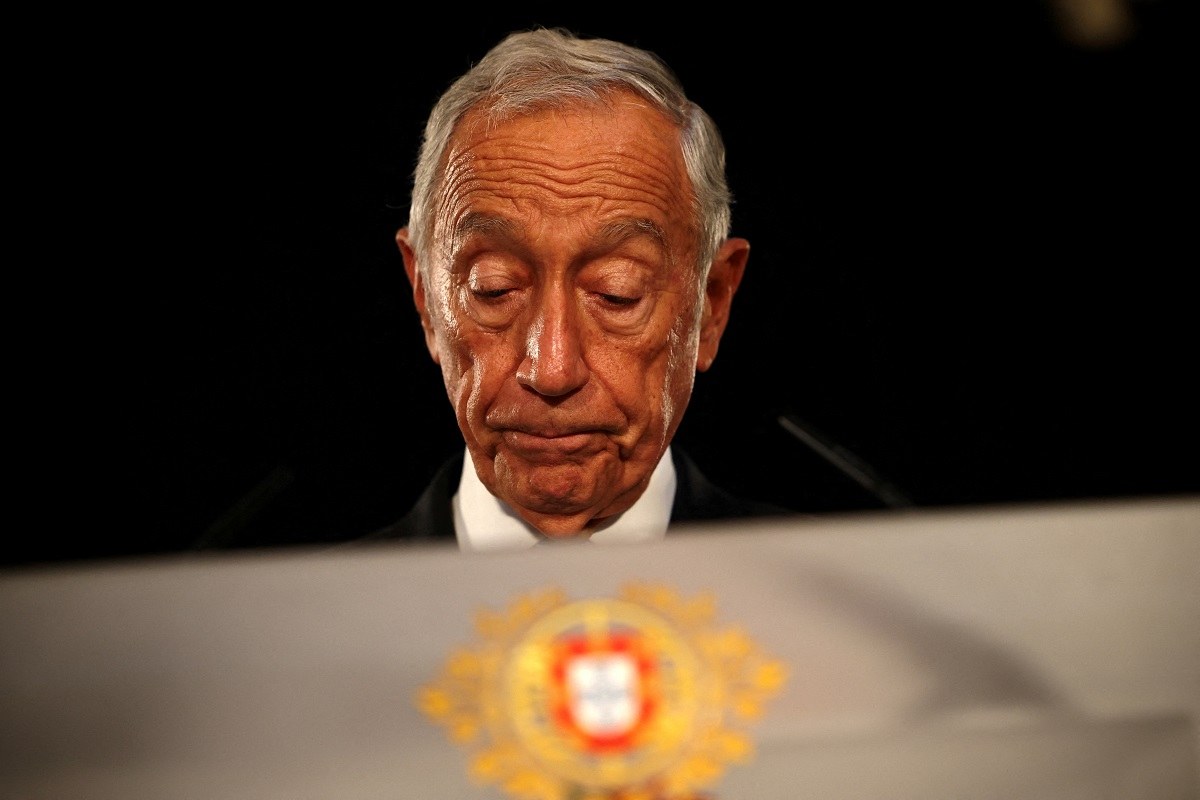
Portugal’s President Marcelo Rebelo de Sousa addresses the nation from Belem Palace to announce his decision to dissolve parliament triggering snap general elections on March 10th, after Prime Minister Antonio Costa resigned due to an ongoing investigation on the alleged corruption in multi-billion dollar lithium, green hydrogen and data centre deals, in Lisbon, Portugal, November 9, 2023.
13:00 JST, April 28, 2024
LISBON (Reuters) – Portugal’s government said on Saturday it refuses to initiate any process to pay reparations for atrocities committed during transatlantic slavery and the colonial era, contrary to earlier comments from President Marcelo Rebelo de Sousa.
From the 15th to the 19th century, 6 million Africans were kidnapped and forcibly transported across the Atlantic by Portuguese vessels and sold into slavery, primarily in Brazil.
Rebelo de Sousa had said on Saturday Portugal could use several methods to pay reparations, such as canceling the debt of former colonies and providing financing.
The government said in a statement sent to the Portuguese news agency Lusa it wants to “deepen mutual relations, respect for historical truth and increasingly intense and close cooperation, based on the reconciliation of brotherly peoples.”
But it added it had “no process or program of specific actions” for paying reparations, noting this line was followed by previous governments.
It called relations with former colonies “truly excellent” and cited cooperation in areas such as education, language, culture, health, in addition to financial, budgetary and economic cooperation.
On Tuesday, the president suggested a need for reparations, sparking strong criticism from right-wing parties, including the junior partner of the Democratic Alliance government coalition, CDS-Popular Party, and the far-right Chega.
“We cannot put this under the carpet or in a drawer. We have an obligation to pilot, to lead this process (of reparations),” the president told reporters on Saturday.
Portugal’s colonial era lasted more than five centuries, with Angola, Mozambique, Brazil, Cape Verde, Sao Tome and Principe, East Timor and some territories in Asia subject to Portuguese rule.
Decolonisation of the African countries and the end of empire in Africa only happened months after Portugal’s “Carnation Revolution” on April 25, 1974, toppled the longest fascist dictatorship in Europe and ushered in democracy.






Most Read
Popular articles in the past 24 hours
-
Tokyo Spends Big on Children, Wins Over Parents
-

Nidec Chairman Resigns Amid Accounting Scandal at Major Japanese ...
-

Japan’s Miura, Kihara Announce Withdrawal from Figure Skating Wor...
-

Japan's Opposition Parties Largely Absent from Social Security-Re...
-
Hokkaido's Shiretoko Peninsula Offers Unique Drift Ice Walking To...
-

Trump’s Address: Confront the Dead End that Authoritarianism Has ...
-
6 of Japan's Remote Islands to Be Added to Govt List for Priority...
-

JR Kyushu Mulls Using Trains for Concertgoer Lodgings; Performanc...
Popular articles in the past week
-

Producer Behind Pop Group XG Arrested for Cocaine Possession
-

Nepal Bus Crash Kills 19 People, Injures 25 Including One Japanes...
-

Tokyo Skytree's Elevator Stops, Trapping 20 People; All Rescued (...
-

Milano Cortina 2026: Japanese Gold Medalist Figure Skater Miura S...
-

Japan’s Major Real Estate Firms Expanding Overseas Businesses to ...
-

Reciprocal Tariffs Ruled Illegal: Judiciary Would Not Tolerate Pr...
-
Japanese High School Student Aims to Share Kaiten History Through...
-

Milano Cortina 2026: Miura-Kihara Duo, Other Japanese Figure Skat...
Popular articles in the past month
-
Producer Behind Pop Group XG Arrested for Cocaine Possession
-

Japan PM Takaichi’s Cabinet Resigns en Masse
-

Man Infected with Measles Reportedly Dined at Restaurant in Tokyo...
-

Israeli Ambassador to Japan Speaks about Japan’s Role in the Reco...
-

Videos Plagiarized, Reposted with False Subtitles Claiming ‘Ryuky...
-

Man Infected with Measles May Have Come in Contact with Many Peop...
-

Prudential Life Insurance Plans to Fully Compensate for Damages C...
-

Woman with Measles Visited Hospital in Tokyo Multiple Times Befor...
Top Articles in News Services
-
Survey Shows False Election Info Perceived as True
-
Hong Kong Ex-Publisher Jimmy Lai’s Sentence Raises International Outcry as China Defends It
-

Japan’s Nikkei Stock Average Touches 58,000 as Yen, Jgbs Rally on Election Fallout (UPDATE 1)
-
Japan’s Nikkei Stock Average Falls as US-Iran Tensions Unsettle Investors (UPDATE 1)
-
Japan’s Nikkei Stock Average Rises on Tech Rally and Takaichi’s Spending Hopes (UPDATE 1)
JN ACCESS RANKING
-
Producer Behind Pop Group XG Arrested for Cocaine Possession
-
Japan PM Takaichi’s Cabinet Resigns en Masse
-
Man Infected with Measles Reportedly Dined at Restaurant in Tokyo Station
-
Israeli Ambassador to Japan Speaks about Japan’s Role in the Reconstruction of Gaza
-
Videos Plagiarized, Reposted with False Subtitles Claiming ‘Ryukyu Belongs to China’; Anti-China False Information Also Posted in Japan