
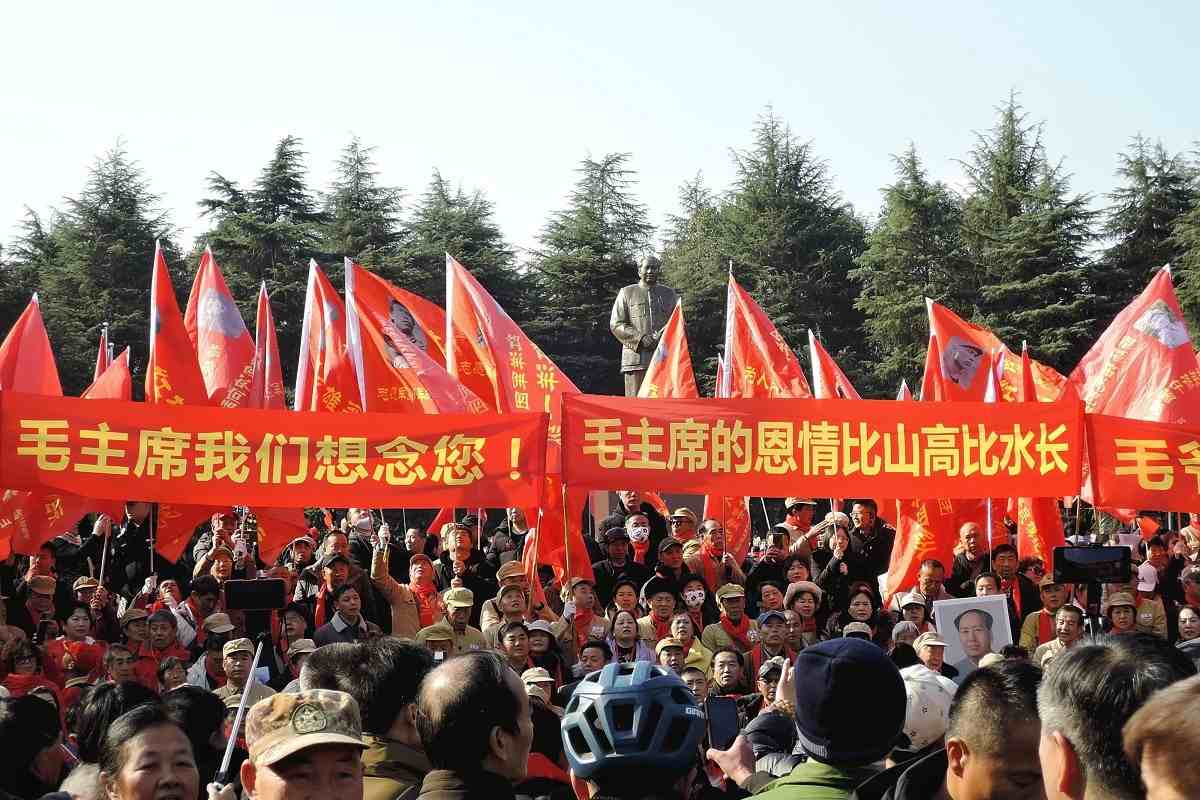
Supporters of late Chinese leader Mao Zedong gather in Mao Zedong Square in his hometown of Shaoshan, Hunan Province, on Tuesday.
17:34 JST, December 27, 2023
SHAOSHAN, Hunan Province — Leadership figures from the administration of Chinese President Xi Jinping on Tuesday marked the 130th anniversary of the birth of late Chinese leader Mao Zedong, regarded as the founding father of the People’s Republic of China.
All top seven members of the Chinese Communist Party visited the Chairman Mao Memorial Hall in Tiananmen Square, Beijing, which houses Mao’s body, according to China’s state-run Xinhua News Agency.
The Xi administration is keen to cash in on Mao’s charisma to help boost Xi’s authority but remains cautious regarding potential developments tied to enthusiastic supporters of the former leader.
At a symposium held after the visit, Xi praised Mao’s achievements, referring to him as a “great patriot” and a “hero of the people.”
Xi also expressed his determination to lay the groundwork for the unification of Taiwan with mainland China — something Mao was unable to achieve. “Realizing China’s complete reunification is an inevitable trend,” Xinhua quoted Xi as saying.
The Xi administration has been promoting campaigns that appear to put Mao and Xi on an equal footing.
A leading party theoretical journal, Qiushi, ran text this month praising Mao’s achievements. The text also praised President Xi, saying having him at the core of the party, and being the leader (“lingxiu” in Chinese) of the people and the top commander of the military is good for the party, the country, the public and the Chinese nation.
The Chinese word “lingxiu” is traditionally used when referring to Mao in a complimentary manner.
The current administration has recently been trying to interleave Xi with Mao by stressing the significance of the “Fengqiao experience,” a social control system that spread across the country under Mao’s rule. The system is designed to have members of the public watch over each other.
Mao remains highly popular in China despite the country falling into deep turmoil during the Cultural Revolution from 1966 to 1976 while under his rule.
On Monday night, excited supporters from across the nation flocked to Mao’s birthplace — Shaoshan in Hunan Province — thronging a local plaza that bears a statue of the former Chinese leader.
As late as midnight, people were still chanting “Long live Chairman Mao!” and singing “The East is Red,” a revolutionary song that praises Mao. People visited the site the following day, too, with many offering flowers.
A 68-year-old local man who brings flowers to the site each year, said he continued to look back fondly on Mao’s rule, which he said respected equality. “There was no disparity of wealth,” the man opined. “Although our livelihoods weren’t great, we felt secure.”
Meanwhile, a fourth-year university student who grew up after the Mao era expressed frustration over the current situation, saying, “Corruption continues to proliferate, even as the economy deteriorates, and young people find it difficult to land jobs.”
As the wealth gap grows, Chinese authorities are apparently concerned that support for Mao could develop into criticism against the current administration and lead to social unrest.
A number of policemen were present in the plaza, keeping a careful eye on proceedings at the voluntarily attended event.




Most Read
Popular articles in the past 24 hours
-
Business Hotels Expanding into Regional Areas in Japan, Aiming to...
-
6 Injured at Naked Festival in Japan’s Okayama Prefecture; Police...
-

Fiji Defense Minister Hopes Japan Will Support Stabilization of P...
-

Space One Delays Launch of No. 3 Kairos Rocket; Company to Announ...
-

Milano Cortina 2026: Malinin Highlights Dangers of Social Media i...
-

Reciprocal Tariffs Ruled Illegal: Judiciary Would Not Tolerate Pr...
-
3rd Japan Pacific Islands Defense Dialogue to Begin in Tokyo on S...
-

Japanese Film, Anymart, Wins Critics’ Award at International Film...
Popular articles in the past week
-

Japan PM Takaichi’s Cabinet Resigns en Masse
-

Man Infected with Measles Reportedly Dined at Restaurant in Tokyo...
-

Sanae Takaichi Elected Prime Minister of Japan; Keeps All Cabinet...
-

Japan's Govt to Submit Road Map for Growth Strategy in March, PM ...
-

Bus Carrying 40 Passengers Catches Fire on Chuo Expressway; All E...
-

Milano Cortina 2026: Figure Skaters Riku Miura, Ryuichi Kihara Pa...
-

Japan, U.S. Name 3 Inaugural Investment Projects; Reached Agreeme...
-

U.S. Firm to Build Training Hub in Fukushima N-plant for Debris R...
Popular articles in the past month
-
Japan PM Takaichi’s Cabinet Resigns en Masse
-

Japan Institute to Use Domestic Commercial Optical Lattice Clock ...
-

Israeli Ambassador to Japan Speaks about Japan’s Role in the Reco...
-
Man Infected with Measles Reportedly Dined at Restaurant in Tokyo...
-

Videos Plagiarized, Reposted with False Subtitles Claiming ‘Ryuky...
-

Man Infected with Measles May Have Come in Contact with Many Peop...
-

Prudential Life Insurance Plans to Fully Compensate for Damages C...
-

Woman with Measles Visited Hospital in Tokyo Multiple Times Befor...
Top Articles in World
-
Israeli Ambassador to Japan Speaks about Japan’s Role in the Reconstruction of Gaza
-
Videos Plagiarized, Reposted with False Subtitles Claiming ‘Ryukyu Belongs to China’; Anti-China False Information Also Posted in Japan
-
North Korea Possibly Launches Ballistic Missile
-
Chinese Embassy in Japan Reiterates Call for Chinese People to Refrain from Traveling to Japan; Call Comes in Wake of ¥400 Mil. Robbery
-
Russia: Visa Required for Visiting Graves in Northern Territories, Lifting of Sanctions Also Necessary
JN ACCESS RANKING
-
Japan PM Takaichi’s Cabinet Resigns en Masse
-
Japan Institute to Use Domestic Commercial Optical Lattice Clock to Set Japan Standard Time
-
Israeli Ambassador to Japan Speaks about Japan’s Role in the Reconstruction of Gaza
-
Man Infected with Measles Reportedly Dined at Restaurant in Tokyo Station
-
Videos Plagiarized, Reposted with False Subtitles Claiming ‘Ryukyu Belongs to China’; Anti-China False Information Also Posted in Japan