
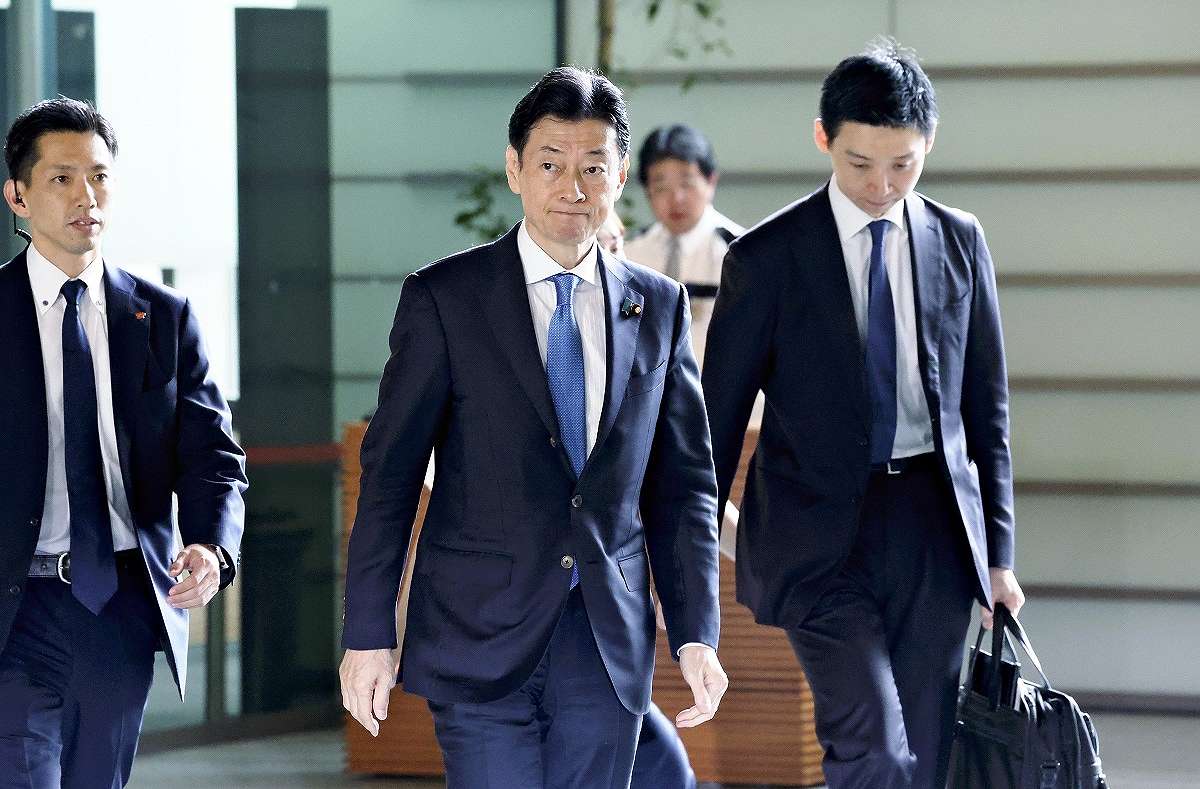
Economy, Trade and Industry Minister Yasutoshi Nishimura
20:00 JST, September 15, 2023
The government is set to sign a memorandum of understanding with Canada on storage batteries used to power electric vehicles (EVs), among other purposes, it has been learned.
With the move — slated to be inked later this month — Tokyo aims to promote Canada-based battery manufacturing by Japanese companies. The two nations intend to strengthen supply chains for such batteries, which are expected to see increasing global demand amid the ongoing decarbonization trend.
Economy, Trade and Industry Minister Yasutoshi Nishimura will visit Canada and sign memorandums of understanding with Minister for Innovation, Science and Industry Francois-Philippe Champagne, among others, on Sept. 21.
Nishimura will be accompanied on the trip by executives of Mitsubishi Corp., Panasonic Energy Co. and other companies involved in resource development and battery production, with the aim of exchanging related information with Canadian firms.
The memorandum is expected to include a bilateral commitment to publicly support and encourage Japanese bodies to invest in Canada. It is also expected to say that regulatory authorities in both nations will work together to facilitate necessary licensing procedures — including development-related environmental impact assessments — while promoting relationships between Japanese companies and Canada’s Indigenous peoples, especially in resource-rich areas.
Japan relies heavily on imports from China and South America for many key minerals, including cobalt, graphite and lithium. For example, about 90% of Japan’s graphite comes from China.
By cooperating with graphite- and lithium-rich Canada, the Japanese government hopes to reduce its dependence on China, while strengthening Japan’s economic security.
Canada borders the United States — a key market for Japanese automakers — and as such, Canada-based production of battery and related products by Japanese firms could help swell this nation’s sales in North America.
Under the U.S. Inflation Reduction Act, Washington has favored companies that produce EVs and batteries in North America. The Japan-Canada memorandum is thought to also be aimed at helping Japanese entities expand their respective businesses in North America.
In its 2022 industrial strategy for storage batteries, the Japanese government set a goal of securing Japanese makers’ manufacturing capacity at 600 gigawatt-hours by 2030, representing a 20-fold time increase on 2020. To this end, the government has recently been deepening cooperation with African countries in a bid to secure necessary resources.
Japan and Canada also intend to sign a separate memorandum to strengthen cooperation in quantum technologies, such as quantum computers, an area in which Canada has acknowledged expertise.




Most Read
Popular articles in the past 24 hours
-
2 Unpublished Early Novellas by Japan's Kenzaburo Oe Discovered, ...
-
Prime Minister Sanae Takaichi to Visit Fukushima Pref. on 15th An...
-
Pass Rate for Overseas Driver's License Conversion Test in Japan ...
-
Tokyo High Court Upholds Unification Church Dissolution Order
-
How Trump Assassination Attempts Played into His Decision to Atta...
-

WBC to Begin: All the Pieces are in Place for Japan’s Second Stra...
-
Nikkei Average Sinks over 1,500 Points in Morning
-

Japanese Speedskater Takagi Announces Retirement
Popular articles in the past week
-
Milano Cortina 2026: Japanese Gold Medalist Figure Skater Miura S...
-
Tokyo Spends Big on Children, Wins Over Parents
-
Japan’s Miura, Kihara Announce Withdrawal from Figure Skating Wor...
-
Yokohama to Test Out Renewable-Powered Offshore Floating Data Cen...
-
BOJ Keeping Eye on Economy and Takaichi's ‘Proactive Fiscal Polic...
-
Tokyo Measles Patient Traveled to Fukuoka Aboard JAL Planes; Susp...
-

South Korea Tightens Rules on Foreigners Buying Homes in Seoul Me...
-
Nidec Chairman Resigns Amid Accounting Scandal at Major Japanese ...
Popular articles in the past month
-

Producer Behind Pop Group XG Arrested for Cocaine Possession
-

Japan PM Takaichi’s Cabinet Resigns en Masse
-

Man Infected with Measles Reportedly Dined at Restaurant in Tokyo...
-

Israeli Ambassador to Japan Speaks about Japan’s Role in the Reco...
-

Videos Plagiarized, Reposted with False Subtitles Claiming ‘Ryuky...
-

Prudential Life Insurance Plans to Fully Compensate for Damages C...
-

Woman with Measles Visited Hospital in Tokyo Multiple Times Befor...
-

iPS Treatments Pass Key Milestone, but Broader Applications Far f...
Top Articles in Politics
-
Japan PM Takaichi’s Cabinet Resigns en Masse
-

Sanae Takaichi Elected Prime Minister of Japan; Keeps All Cabinet Appointees from Previous Term
-

Japan’s Govt to Submit Road Map for Growth Strategy in March, PM Takaichi to Announce in Upcoming Policy Speech
-

LDP Wins Landslide Victory, Secures Single-party Majority; Ruling Coalition with JIP Poised to Secure Over 300 seats (UPDATE 1)
-

LDP Wins Historic Landslide Victory
JN ACCESS RANKING
-
Producer Behind Pop Group XG Arrested for Cocaine Possession
-
Japan PM Takaichi’s Cabinet Resigns en Masse
-
Man Infected with Measles Reportedly Dined at Restaurant in Tokyo Station
-
Israeli Ambassador to Japan Speaks about Japan’s Role in the Reconstruction of Gaza
-
Videos Plagiarized, Reposted with False Subtitles Claiming ‘Ryukyu Belongs to China’; Anti-China False Information Also Posted in Japan