
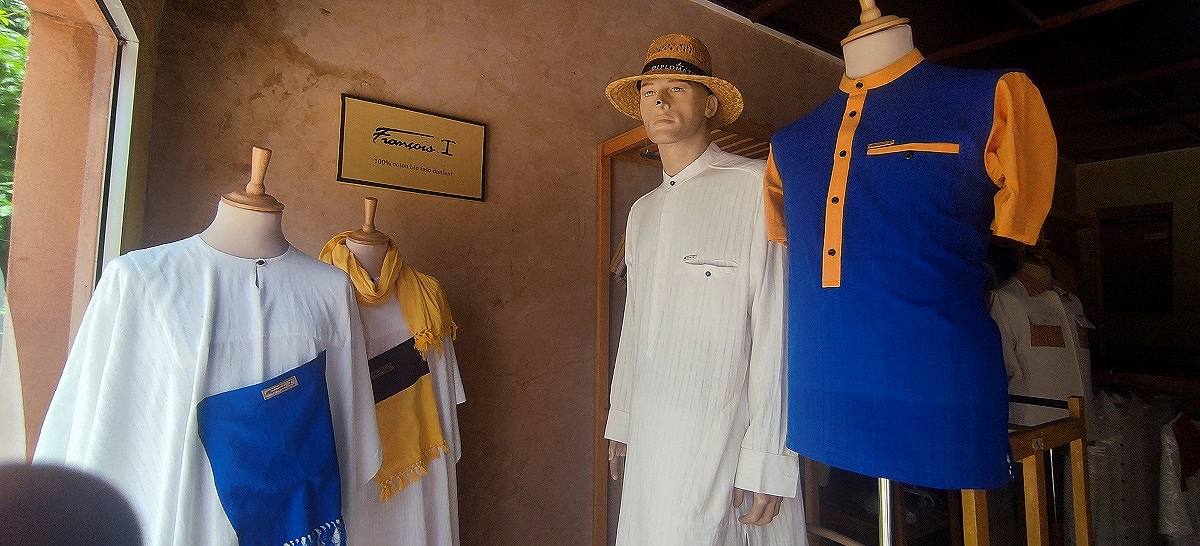
A collection by Burkina Faso fashion designer Francois Yameogo, who built a facility specializing in the production of Faso Danfani, the country’s traditional fabric, is exhibited in his workshop in Ouagadougou, Burkina Faso, on July 25.
17:30 JST, August 19, 2023
KOUDOUGOU, Burkina Faso (Reuters) — Amid the rhythmic clatter of traditional wooden looms, artisans at a workshop in rural Burkina Faso spin indigo-dyed cotton into sprawling lengths of cloth, destined for modern suits designed by the nation’s foremost couturier.
Twenty years ago, Paris-based fashion designer Francois Yameogo returned to his native Burkina Faso to build a facility to produce Faso Danfani, the country’s traditional fabric, for use in his signature indigo sport coats. That workshop is now at the center of a Faso Danfani resurgence, after a recent edict by the nation’s military leaders named the hand-woven material the official state dress, mandating its use at state functions and in school uniforms.
“We’ve been inundated with thrift store products … [but] our cotton is pure,” said Yameogo, sitting behind a cluttered workbench in his shop, about 100 kilometers west of the capital Ouagadougou. “It is up to us to value it and to use it.”
The West African country’s economy leans heavily on its cotton industry, often termed its “white gold” for employment opportunities and export revenues. But the import of used clothing from wealthier countries offers inexpensive alternatives to locally produced materials, effectively pricing them out of the market.
This keeps domestic fabric prices artificially low, deters investment in modern technology and exacerbates poverty, according to the United Nations food agency.
Yameogo, a former intern under renowned American fashion designer Marc Jacobs, began integrating Faso Danfani into his collections in hopes of endowing them with a neo-contemporary flair capable of drawing the fabric into the global fashion spotlight and securing higher returns for local artisans.
“We process only 3% of our cotton locally, but we want to reach 20 to 25%,” he said. “I think we’re going to get there.”
The ruling junta’s Faso Danfani mandate is already visible among officials sporting Yameogo’s creations, including the prime minister. The trend will intensify come October when schools reopen after summer vacation.
Meanwhile, the fabric’s international presence is expanding. Yameogo’s most recent collection was the highlight of a Faso Danfani-themed catwalk event in Paris in June, hailed by a diverse audience clothed in the age-old fabric.
“This fight is going to create jobs, create international sales for our country, and enable people to earn a decent income,” Yameogo said. “It’s a noble fight.”



Most Read
Popular articles in the past 24 hours
-

Strait of Hormuz Closure Shakes Markets; Prolonged Closure Could ...
-

Iran Situation: Japan Must Exert Diplomatic Efforts without Merel...
-
Milano Cortina 2026: Japanese Figure Skater Miura Returns to Home...
-
2 of Japan's Opposition Parties Submit Bill to Revise Political F...
-

Takayama Among World's Top 10 Most Welcoming Cities for 2026; 2nd...
-
Chiba Police to Arrest Japanese National in Midair; Man Accused o...
-

Trump Pursues Iranian Decapitation without a Plan for What Comes ...
-

Bank of Japan and Markets: High Oil Prices Increase Difficulty of...
Popular articles in the past week
-
Milano Cortina 2026: Japanese Gold Medalist Figure Skater Miura S...
-
Tokyo Spends Big on Children, Wins Over Parents
-

Japan’s Miura, Kihara Announce Withdrawal from Figure Skating Wor...
-

Yokohama to Test Out Renewable-Powered Offshore Floating Data Cen...
-
BOJ Keeping Eye on Economy and Takaichi's ‘Proactive Fiscal Polic...
-
Tokyo Measles Patient Traveled to Fukuoka Aboard JAL Planes; Susp...
-
Japan’s Takaichi Speaks on New U.S. Tariff in Upper House, Says P...
-
Nidec Chairman Resigns Amid Accounting Scandal at Major Japanese ...
Popular articles in the past month
-

Producer Behind Pop Group XG Arrested for Cocaine Possession
-

Japan PM Takaichi’s Cabinet Resigns en Masse
-

Man Infected with Measles Reportedly Dined at Restaurant in Tokyo...
-

Israeli Ambassador to Japan Speaks about Japan’s Role in the Reco...
-

Videos Plagiarized, Reposted with False Subtitles Claiming ‘Ryuky...
-

Prudential Life Insurance Plans to Fully Compensate for Damages C...
-

Woman with Measles Visited Hospital in Tokyo Multiple Times Befor...
-

iPS Treatments Pass Key Milestone, but Broader Applications Far f...
Top Articles in World
-
Israeli Ambassador to Japan Speaks about Japan’s Role in the Reconstruction of Gaza
-
Videos Plagiarized, Reposted with False Subtitles Claiming ‘Ryukyu Belongs to China’; Anti-China False Information Also Posted in Japan
-

Nepal Bus Crash Kills 19 People, Injures 25 Including One Japanese National
-

China, India Tapping into Promising African Market; Beijing Announces Tariff Cuts, Both Countries Aim to Expand Exports
-

Ukrainian Ambassador Closely Watching Japan’s Revision of Defense Export Rules, Hopes for Future Arms Support
JN ACCESS RANKING
-
Producer Behind Pop Group XG Arrested for Cocaine Possession
-
Japan PM Takaichi’s Cabinet Resigns en Masse
-
Man Infected with Measles Reportedly Dined at Restaurant in Tokyo Station
-
Israeli Ambassador to Japan Speaks about Japan’s Role in the Reconstruction of Gaza
-
Videos Plagiarized, Reposted with False Subtitles Claiming ‘Ryukyu Belongs to China’; Anti-China False Information Also Posted in Japan