
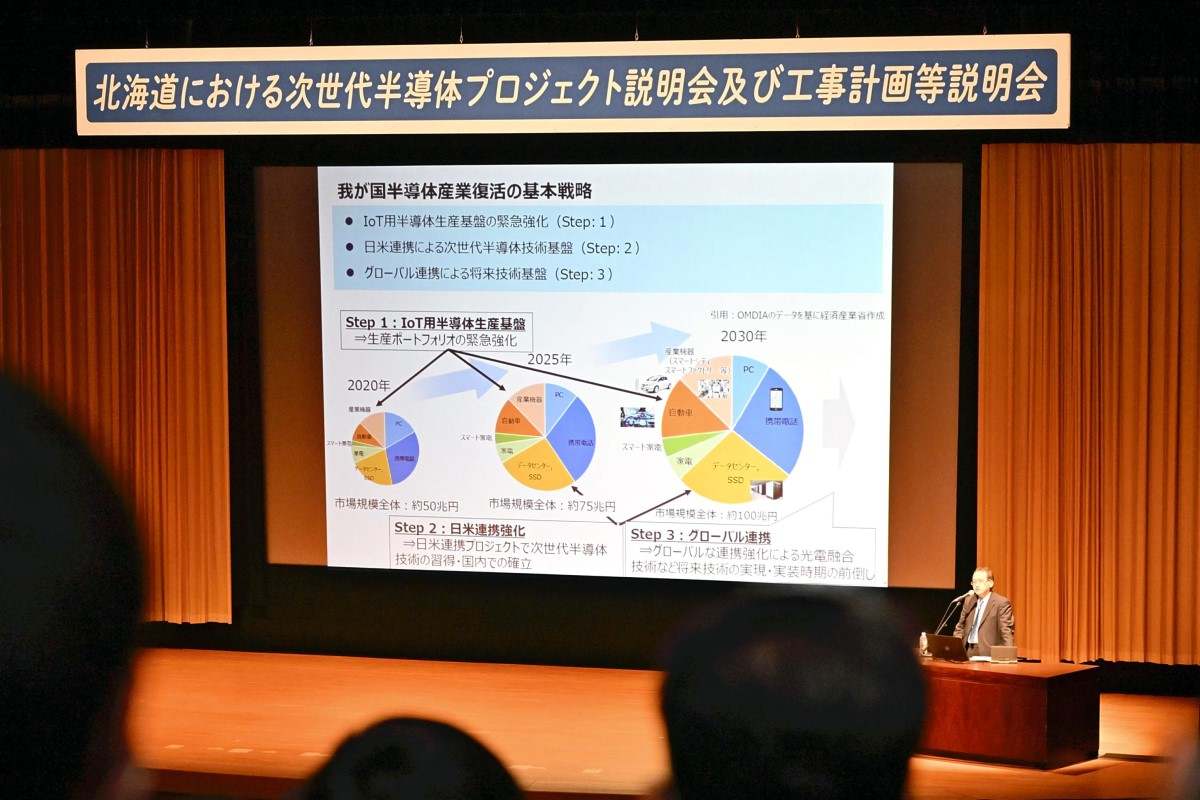
A briefing relating to the construction of a Rapidus plant is held in Chitose, Hokkaido, in May.
13:06 JST, July 31, 2023
The government must step in to support the ailing semiconductor industry.
Previously, the government took the lead in aiding the electronics industry in cooperation with domestic companies. However, its efforts have not yet had a significant impact on competitiveness within that realm.
Looking to the history of the semiconductor industry — an arena once dominated by Japanese companies — Elpida Memory Inc. was formed in 1999 through a merger of the semiconductor memory divisions of Hitachi Ltd. and NEC Corp.
But following the recession triggered by the collapse of U.S. investment bank Lehman Brothers, Elpida’s performance deteriorated, and the company went bankrupt in 2012.
Meanwhile, Japan Display Inc., which utilized a public-private fund to consolidate small and midsize liquid crystal display businesses, is currently being restructured.
Although both Elpida and JDI boasted advanced technologies, they lagged firms in China, South Korea and Taiwan. Japanese companies were reluctant to invest during the nation’s prolonged deflation. Conversely, foreign firms boosted investment in development and production with help from large government subsidies and other sources.
In the semiconductor field — now considered critical to economic security — a new Japanese company, Rapidus Corp., has been established under the auspices of the government with the aim of producing next-generation semiconductors.
A Rapidus plant will be built in Hokkaido by 2027 to mass-produce 2-nanometer generation semiconductors with investment from Toyota Motor Corp., NTT Corp. and Sony Group Corp., among others.
To manufacture its advanced semiconductors, Rapidus will require ¥2 trillion to establish the technology and ¥3 trillion for mass production. Continuous investment will be crucial if the firm is to remain competitive.
Tokyo University of Science Prof. Hideki Wakabayashi said: “The goal [of unified public and private sector efforts] was to save a specific industry. But putting together loser companies only created a loser group.”
Wakabayashi further opined that the government must provide financial support and promote human resources based on economic security and domestic digitization if it is to foster domestic industries.







Most Read
Popular articles in the past 24 hours
-

Artisans from Disaster-Hit Areas Work Together to Keep Memories o...
-

Japan Tourist Spot's Capsule Toys Made from Recycled Materials Pr...
-

Japan’s Space One Kairos 3rd Flight Rocket Launched, but Mission ...
-

Person Apparently Caught in Avalanche on Mt. Kamifurano in Hokkai...
-
NTT Docomo to Discontinue 3G Service in March
-

Space One's No. 3 Kairos Rocket Terminates Mid-Flight
-

Former Unification Church: Proceed Steadily with Liquidation to P...
-

LCC Greater Bay Airlines to Launch Regular Service on Fukuoka-Hon...
Popular articles in the past week
-

Tokyo Spends Big on Children, Wins Over Parents
-

South Korea Tightens Rules on Foreigners Buying Homes in Seoul Me...
-

Japan’s Miura, Kihara Announce Withdrawal from Figure Skating Wor...
-

2 Unpublished Early Novellas by Japan's Kenzaburo Oe Discovered, ...
-

Strait of Hormuz Closure Shakes Markets; Prolonged Closure Could ...
-

Nidec Chairman Resigns Amid Accounting Scandal at Major Japanese ...
-

Tourists Ignore Safety Barriers Near Famous Zao ‘Snow Monsters’ i...
-

Iran Situation: Japan Must Exert Diplomatic Efforts without Merel...
Popular articles in the past month
-

Producer Behind Pop Group XG Arrested for Cocaine Possession
-

Japan PM Takaichi’s Cabinet Resigns en Masse
-

Man Infected with Measles Reportedly Dined at Restaurant in Tokyo...
-

Israeli Ambassador to Japan Speaks about Japan’s Role in the Reco...
-

Videos Plagiarized, Reposted with False Subtitles Claiming ‘Ryuky...
-

Prudential Life Insurance Plans to Fully Compensate for Damages C...
-

Woman with Measles Visited Hospital in Tokyo Multiple Times Befor...
-

iPS Treatments Pass Key Milestone, but Broader Applications Far f...
Top Articles in Business
-
Prudential Life Insurance Plans to Fully Compensate for Damages Caused by Fraudulent Actions Without Waiting for Third-Party Committee Review
-

Japan, U.S. Name 3 Inaugural Investment Projects; Reached Agreement After Considerable Difficulty
-

Japan’s Major Real Estate Firms Expanding Overseas Businesses to Secure Future Growth, Focusing on Europe, U.S., Asia
-

SoftBank Launches AI Service for Call Centers That Converts Harsh Customer Voices into Softer Voices
-

Transport Companies See Opportunity in Narita Expansion; Airlines, Railways Prepare to Meet Expected Growth in Demand
JN ACCESS RANKING
-
Producer Behind Pop Group XG Arrested for Cocaine Possession
-
Japan PM Takaichi’s Cabinet Resigns en Masse
-
Man Infected with Measles Reportedly Dined at Restaurant in Tokyo Station
-
Israeli Ambassador to Japan Speaks about Japan’s Role in the Reconstruction of Gaza
-
Videos Plagiarized, Reposted with False Subtitles Claiming ‘Ryukyu Belongs to China’; Anti-China False Information Also Posted in Japan