
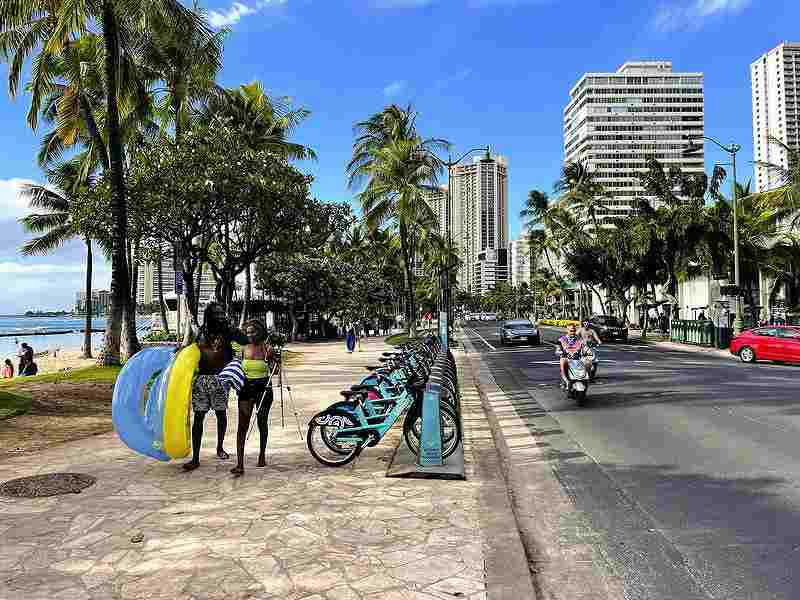
Kalakaua Avenue, part of the Honolulu Marathon course that runs along the beach, is seen Friday.
December 9, 2021
HONOLULU — Fewer than half the usual number of people have signed up to run in the Honolulu Marathon, to be held Sunday on the island of Oahu, largely because of a decline in Japanese runners.
Although the event will be held for the first time in two years, the latest tally of registered participants is only about 14,500. The number of Japanese, who usually account for nearly half of the total, has fallen to about 450, due to the novel coronavirus crisis. The local tourism industry is expected to suffer a severe blow.
The Honolulu Marathon Association expects the number of participants to drop further because of concerns about the impact of the omicron coronavirus variant.
The Hawaii State Department of Health announced Dec. 2 that a resident of Oahu had been found to be infected with the omicron variant. The resident had not received a vaccine but had been previously infected with the coronavirus. As the resident has no recent travel history, the infection is suspected to be a community-acquired case.
Last year’s Honolulu Marathon was canceled due to the pandemic. It was decided in October that this year’s event would be held without any restrictions on the number of participants, and online registration closed in November. According to the association, roughly 8,000 to 9,000 registrations were carried over from last year, so the actual number of participants could be as low as 5,000 to 7,000.
The marathon began in 1973. Anyone aged 7 or over who wants to participate is allowed to run the course along the coast. There is no time limit for running. The number of participants has been around 33,000 since 2013, with nearly half of them Japanese.
The economic impact of the event generated from accommodations, food and beverages amounts to about $140 million (about ¥15.8 billion) per year, of which 70% to 80% is spent by Japanese.
According to the Hawaii Tourism Authority, Japanese participants stay an average of 4.5 nights and spend about $250 per person per day.
As to why the event was not canceled for the second year in a row, the association’s president, Jim Barahar, 69, said, “We felt it was important to send the message that Hawaii was open and that an outdoor, healthy event could be conducted here safely.”







Most Read
Popular articles in the past 24 hours
-
Milano Cortina 2026: Kaori Sakamoto Wins Silver, Ami Nakai Takes ...
-
Approval of Takaichi Cabinet Stands at 73%; Yomiuri Survey Finds ...
-

New Japanese Animated Film ‘A New Dawn’ Applauded at Berlin Inter...
-

Baby Monkey Punch Captures Hearts at Chiba Pref. Zoo, on Social M...
-

Ex-ROK President Yoon Gets Life Sentence: Declaration of Martial ...
-
Early-Blooming Cherry Blossoms Adorn Former Samurai Residences in...
-

CARTOON OF THE DAY (February 20)
-

Milano Cortina 2026: Russian Skating Dynasty Leaves Milan with No...
Popular articles in the past week
-

Japan PM Takaichi’s Cabinet Resigns en Masse
-

Man Infected with Measles Reportedly Dined at Restaurant in Tokyo...
-

Videos Plagiarized, Reposted with False Subtitles Claiming ‘Ryuky...
-

Sanae Takaichi Elected 105th Prime Minister of Japan; Keeps All C...
-

Japan's Govt to Submit Road Map for Growth Strategy in March, PM ...
-

Milano Cortina 2026: Figure Skaters Riku Miura, Ryuichi Kihara Pa...
-

Bus Carrying 40 Passengers Catches Fire on Chuo Expressway; All E...
-

Tokyo’s New Record-Breaking Fountain Named ‘Tokyo Aqua Symphony’
Popular articles in the past month
-
Japan PM Takaichi’s Cabinet Resigns en Masse
-

Japan Institute to Use Domestic Commercial Optical Lattice Clock ...
-

Israeli Ambassador to Japan Speaks about Japan’s Role in the Reco...
-
Man Infected with Measles Reportedly Dined at Restaurant in Tokyo...
-

Man Infected with Measles May Have Come in Contact with Many Peop...
-
Videos Plagiarized, Reposted with False Subtitles Claiming ‘Ryuky...
-

Prudential Life Insurance Plans to Fully Compensate for Damages C...
-

Woman with Measles Visited Hospital in Tokyo Multiple Times Befor...
Top Articles in World
-
Israeli Ambassador to Japan Speaks about Japan’s Role in the Reconstruction of Gaza
-
Videos Plagiarized, Reposted with False Subtitles Claiming ‘Ryukyu Belongs to China’; Anti-China False Information Also Posted in Japan
-
North Korea Possibly Launches Ballistic Missile
-

Chinese Embassy in Japan Reiterates Call for Chinese People to Refrain from Traveling to Japan; Call Comes in Wake of ¥400 Mil. Robbery
-

Pentagon Foresees ‘More Limited’ Role in Deterring North Korea
JN ACCESS RANKING
-
Japan PM Takaichi’s Cabinet Resigns en Masse
-
Japan Institute to Use Domestic Commercial Optical Lattice Clock to Set Japan Standard Time
-
Israeli Ambassador to Japan Speaks about Japan’s Role in the Reconstruction of Gaza
-
Man Infected with Measles Reportedly Dined at Restaurant in Tokyo Station
-
Man Infected with Measles May Have Come in Contact with Many People in Tokyo, Went to Store, Restaurant Around When Symptoms Emerged