
The inauguration of Donald Trump as the 47th president of the United States topped the list of international news events for 2025 as selected by Yomiuri Shimbun readers.
Next was China’s backlash against Prime Minister Sanae Takaichi’s remark regarding a survival-threatening situation in connection with a Taiwan contingency, followed by “reciprocal tariffs” introduced by the Trump administration.
A total of 16,750 votes were received during the polling period from Nov. 26 to Dec. 11, of which 15,769 were valid. There were no voters whose choices matched the overall top 10 results.
***
1. Trump begins second term as U.S. president
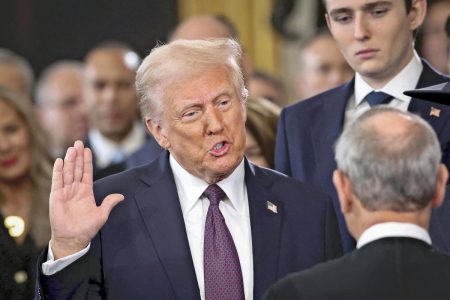
U.S. President Donald Trump takes the oath of office during his inauguration at the Rotunda at the U.S. Capitol in Washington on Jan. 20.
Donald Trump was inaugurated as the 47th president of the United States on Jan. 20, marking the start of his second term. Under the banner of “America First,” he moved forward with a series of unprecedented policies that exerted a profound influence both domestically and internationally.
On his first day in office, he signed executive orders withdrawing the United States from the Paris Agreement on climate change and the World Health Organization, systematically dismantling the policies of international cooperation emphasized by the Biden administration.
Regarding foreign and security policy, he championed “Peace Through Strength,” launching attacks on Iranian nuclear facilities in June. Conversely, as a self-described “peacemaker,” he mediated peace negotiations for conflicts in the Gaza Strip and Ukraine — the latter still facing Russian aggression. In August, he held a face-to-face summit with Russian President Vladimir Putin in Alaska.
In terms of domestic affairs, he identified curbing illegal immigration as his administration’s top priority. He increased enforcement measures and deployed National Guard troops to cities in which Democrats have a strong presence under the guise of maintaining public order. Meanwhile, the partisan gridlock in Congress intensified as both parties refused to compromise on spending bills, resulting in a partial government shutdown in October. The shutdown lasted a record-breaking 43 days.
2. China’s backlash against Takaichi’s ‘Taiwan’ remarks
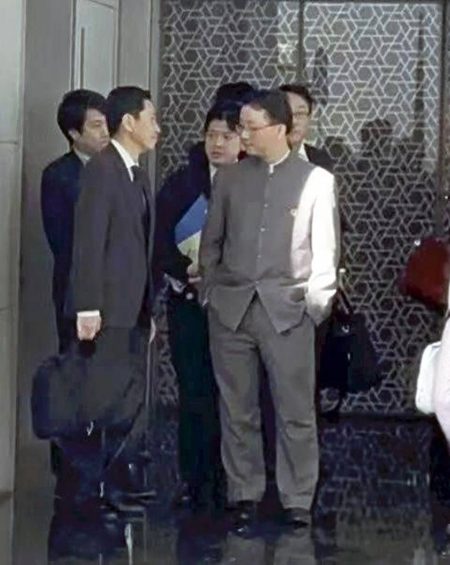
Masaaki Kanai, front left, director general of the Foreign Ministry’s Asian and Oceanian Affairs Bureau, talks with his Chinese counterpart Liu Jinsong, right, after their meeting in Beijing on Nov. 18.
Prime Minister Sanae Takaichi stated that a Taiwan contingency could constitute a “survival-threatening situation,” warranting the exercise of Japan’s right to collective self-defense, on Nov. 7. In response, the administration of Chinese President Xi Jinping demanded a retraction and intensified its economic pressure, urging its citizens to refrain from traveling to Japan and halting imports of Japanese seafood products.
The impact was far-reaching. Flights between Japan and China were reduced, performances by Japanese artists in China were canceled and exchanges between regional cities stagnated. On Dec. 6, Chinese military aircraft directed their radar at Air Self-Defense Force fighter jets twice over international waters southeast of Okinawa Island.
The Chinese government, which places the Taiwan issue “at the core of its core interests,” is intensifying efforts to assert its stance to the international community, with an eye to isolating Japan. China’s U.N. mission sent two letters to the U.N. secretary general demanding that Japan retract the remark, asserting that the international community should be highly vigilant against Japan’s ambition to overturn the postwar international order.
3. Implementation of ‘reciprocal tariffs’
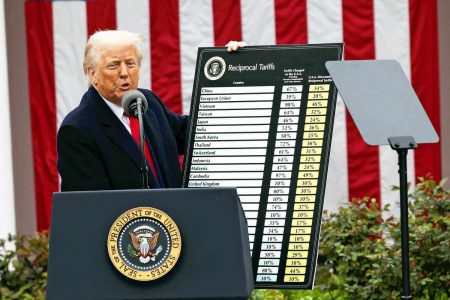
U.S. President Donald Trump delivers remarks on tariffs in the Rose Garden at the White House in Washington on April 2.
In an effort to bring manufacturing back to the United States and eliminate trade deficits, the Trump administration launched the first phase of its “reciprocal tariffs” on April 5, imposing a universal 10% duty on nearly all countries and regions. Additional surcharges enacted on April 9 were immediately suspended to allow for individual trade negotiations with specific nations and territories.
In August, the new reciprocal tariff rates took effect, imposing duties ranging from 10% to 50% on imports from about 70 countries and regions. Tariffs on Japan, the European Union and South Korea were set at 15%, while Brazil and India were set at 50%.
Tariffs on China were slashed from 145% to 30% in May, eventually settling at 20% following an agreement at the U.S.-China summit on Oct. 30.
Sector-specific tariffs on steel and aluminum products, copper, timber and automobiles, as well as other imports, are not part of the reciprocal tariffs framework. Upcoming duties on pharmaceuticals and semiconductors are expected to follow the same protocol.
Furthermore, Canada and Mexico, which are already facing tariffs aimed at curbing the influx of synthetic drugs like fentanyl, are excluded from these new reciprocal measures.
4. Los Angeles fires burn for 24 days
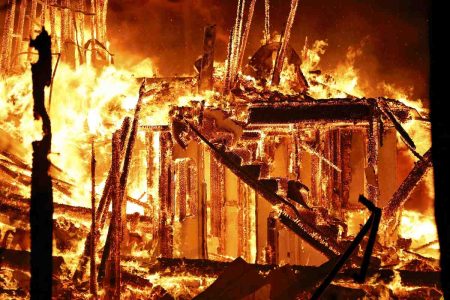
Flames engulf a structure in California on Jan. 7
Several wildfires began burning in and around Los Angeles on Jan. 7. Among them, the Pacific Palisades fire in western Los Angeles and the Altadena fire to the city’s east killed a total of 31 people. Both fires burned for 24 days, devastating an area of more than 150 square kilometers and destroying 16,000 structures.
As a result of the sheer devastation caused by the blazes, announcement of the nominations for this year’s Academy Awards was postponed and several NBA pro basketball games had to be rescheduled. Many luxury homes were among the razed structures, with the total economic loss estimated to be $65 billion (about ¥10 trillion), making it the costliest wildfire disaster in history. After the disaster, insurance premiums soared.
5. Theft at Louvre causes €88 million in losses
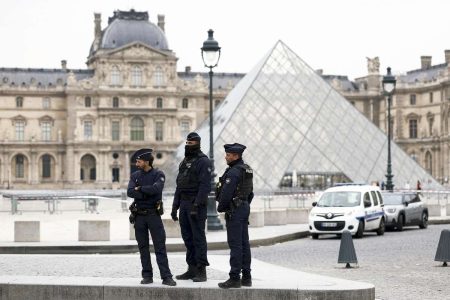
Police officers stand near the pyramid of the Louvre in Paris after reports of a robbery on Oct. 19.
On Oct. 19, two people arrived at the Louvre in Paris in a crane truck. They gained access to a balcony, where they broke a window and entered the museum. The pair made their way to a room displaying jewelry associated with the French royal family and stole nine pieces from the display cases. They then fled on motorcycles with two accomplices who were waiting outside. The audacious heist, carried out just after the museum opened, took about seven minutes.
Prosecutors had arrested and charged four suspects by Nov. 28.
Among the stolen items, a crown was recovered near the museum shortly after the incident. The other eight pieces remain missing. The stolen items all have high historical value, including a tiara and brooch belonging to Empress Eugenie, wife of Napoleon III. The total value of the loss amounted to €88 million (about ¥16 billion).
The incident also highlighted deficiencies in the museum’s security measures.
6. Huge quake kills over 3,700 in Myanmar
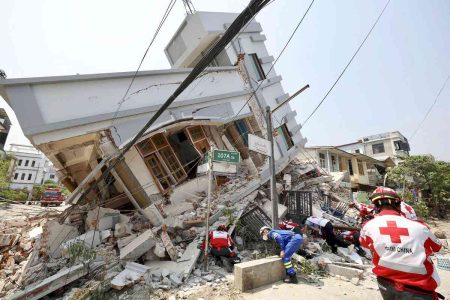
Members of the Chinese Red Cross International Emergency Response Team work at a collapsed residential building following an earthquake in Mandalay, Myanmar, on March 31.
A magnitude 7.7 earthquake struck near Mandalay in central Myanmar on March 28, killing more than 3,700 people, including a Japanese national, and injuring over 5,100.
Fighting between the Myanmar military and pro-democracy forces continues. In the aftermath of the earthquake, the military restricted relief efforts and aid deliveries in affected areas outside its control. On April 2, a temporary ceasefire was announced, with the earthquake response cited as a reason, yet airstrikes continued throughout the ceasefire period.
Strong tremors were also felt in neighboring Thailand. In Bangkok, a high-rise building under construction collapsed, killing over 60 people.
7. War in Ukraine hits 3-year mark
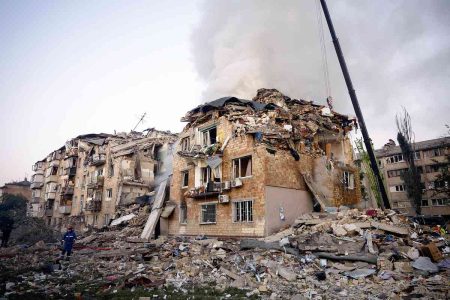
Buildings that were hit by a Russian strike are seen in Kyiv on Aug. 28.
Feb. 24 marked the third anniversary of Russia’s aggression against Ukraine. Although former U.S. President Donald Trump expressed a strong desire to mediate the conflict upon returning to power, the prospects for achieving peace remain uncertain amid fierce ongoing fighting.
On Feb. 28, Ukrainian President Volodymyr Zelenskyy met with Trump at the White House, where he was berated in front of the press. This led to a breakdown in talks.
Between May and July, Russia and Ukraine held three rounds of direct negotiations in Turkey, though no ceasefire was reached. In August, during a summit in Alaska, Russian President Vladimir Putin demanded that Trump facilitate the withdrawal of Ukrainian forces from the Donbas region and its subsequent handover to Russia, proposing a ceasefire along the existing front lines.
The United States showed Ukraine a 28-point peace plan incorporating these Russian demands as a working draft. In December, Ukraine presented a new version of the draft plan with 20 points that was agreed on by U.S. and Ukrainian negotiators.
8. Pope Leo XIV elected
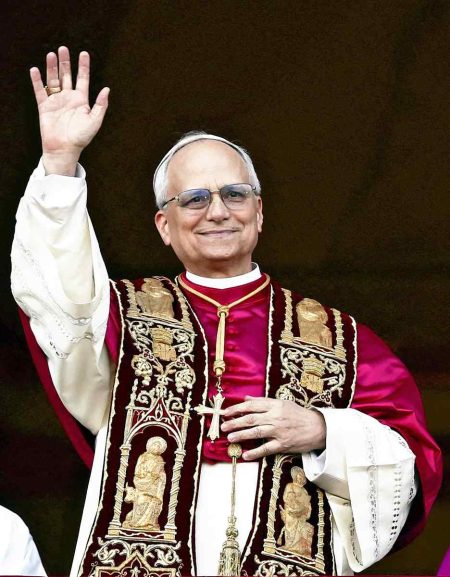
Pope Leo XIV
Pope Francis, head of the Catholic Church, died at age 88 on April 21 due to a stroke and other health issues. On May 8, the conclave assembly of cardinals selected Chicago-born Cardinal Robert Prevost to be the 267th pope on the fourth ballot. The first pontiff born in the United States took the name Pope Leo XIV.
Leo spent many years working as a missionary in Peru and served as the Vatican’s prefect of the Dicastery for Bishops from 2023. Passionate about facing issues related to poverty and immigration, Leo’s approach is similar to that adopted by Francis, who was a reformer. However, Leo also has a conservative stance on doctrinal issues, so his selection was a nod to maintaining balance and avoiding division within the church.
9. Yoon becomes first sitting S. Korean president to be arrested
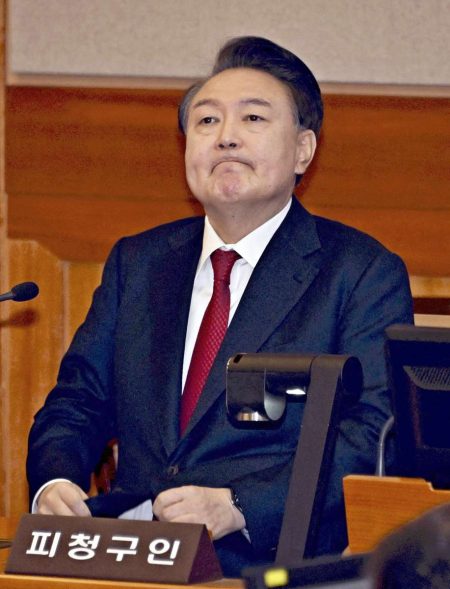
Former South Korean President Yoon Suk Yeol
Former South Korean President Yoon Suk Yeol was arrested by investigative authorities on Jan. 19 on such charges as insurrection in connection with his declaration of martial law in December 2024. On Jan. 26, 2025, prosecutors indicted Yoon for allegedly masterminding an attempted rebellion and other crimes.
During an urgent announcement made when he declared martial law, Yoon claimed the reasons he took action included the then opposition party’s filing a series of impeachment motions against high-ranking government officials. During his ongoing trial, Yoon continues to insist that the declaration was made to alert citizens about the nation’s political crisis.
10. Unification Church leader in S. Korea arrested
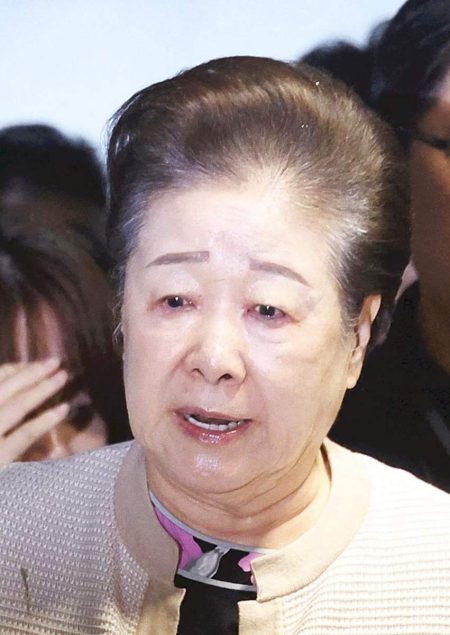
Han Hak-ja, leader of the Unification Church
Han Hak-ja, 82, leader of the Unification Church, was arrested on Sept. 23 on suspicion of giving cash and goods to the wife and an aide of former South Korean President Yoon Suk Yeol.
At Han’s first hearing at the Seoul Central District Court on Dec. 1, her legal team denied the charges and insisted Han was a “spiritual leader” and “had no involvement in political activities.” Prosecutors said Han had committed a “grave crime” that used illegal funds and personal connections in an attempt to influence the running of governmental affairs.
EXTRA: High-rise fire kills at least 160 in Hong Kong
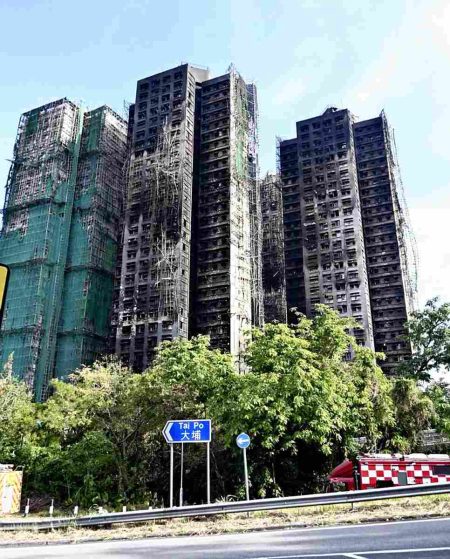
Burned apartment buildings are seen in Hong Kong on Nov. 28.
A fire broke out at an apartment complex in northern Hong Kong on Nov. 26, engulfing seven 32-story buildings. Hong Kong authorities have confirmed at least 160 deaths as of Dec. 19. It was the deadliest fire since Hong Kong’s handover to China in 1997.
Major renovation work had been underway at the buildings. Protective netting surrounding the structures was reportedly an inexpensive product that did not meet fire safety standards, and highly flammable polystyrene foam had been installed around window frames. These factors are believed to have contributed to the rapid spread of the fire.
While the cause of the fire is under investigation, Hong Kong newspapers have reported on eyewitness accounts from residents stating that they saw workers smoking on-site on a daily basis. Furthermore, it has been discovered that the construction company would only use safety-compliant protective netting in areas likely to be inspected by authorities. It has also been revealed that fire alarms failed to sound in any of the buildings during the incident, heightening criticism that this was a “man-made disaster” caused by lax safety management.



Popular Articles
Popular articles in the past 24 hours
-
Speed Skater Miho Takagi Heads Japan Squad for Milan Cortina Wint...
-
Defense Ministry Seeks to Increase Post-Retirement Allowance for ...
-
Kayoko Ebina, Widow of Rakugoka Hayashiya Sanpei, Dies at 92
-
Southwest Japan's Challenges: Revitalization Efforts / Getting La...
-
Japan Medical Safety Body to Review All Accidental Death Reports ...
-

Kawasaki Releases Guide to Sheltering at Home During Disasters, w...
-
Year-end Holidays Bring Massive Traffic Jams to Expressways, Stre...
-
Top 10 Japanese News Stories of 2025; Reviewing Expo, Prime Minis...
Popular articles in the past week
-

Chinese Foreign Ministry Criticizes Japan’s Largest Ever Defense ...
-
Immersive Fort Tokyo to Close After Less Than 2 Years; Theme Park...
-

Return of Ueno Zoo's Twin Pandas Will Make Japan Panda-Less for F...
-
‘Fiercest, Most Damaging Invasive Weed’ Spreading in Rivers, Lake...
-
UPDATE 1: Man Arrested After Mass Stabbing at Factory in Japan's ...
-
UPDATE 6: Massive Pileup in Gunma Pref. Kills 2, Injures 26; Slip...
-
‘Kokuho’ Creates Opening for Japan's Film Industry with Lavish De...
-
2_d58eordjrlisdn1datdg-250x128.jpg)
Boy Dies After Arm Trapped in Escalator at Hokkaido Ski Resort (U...
Popular articles in the past month
-
Tokyo Economic Security Forum to Hold Inaugural Meeting Amid Tens...
-
Keidanren Chairman Yoshinobu Tsutsui Visits Kashiwazaki-Kariwa Nu...
-
Imports of Rare Earths from China Facing Delays, May Be Caused by...
-
University of Tokyo Professor Discusses Japanese Economic Securit...
-
Japan Pulls out of Vietnam Nuclear Project, Complicating Hanoi's ...
-
Economic Security Panels Debate Supply Chains, Rare Earths; Parti...
-
Govt Aims to Expand NISA Program Lineup, Abolish Age Restriction
-
U.S. Senate Resolution Backs Japan, Condemns China's Pressure
"Society" POPULAR ARTICLE
-
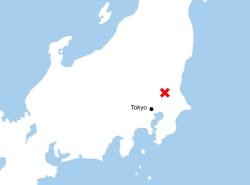
M4.9 Earthquake Hits Tokyo, Neighboring Prefectures
-
Israeli Tourists Refused Accommodation at Hotel in Japan’s Nagano Pref., Prompting Protest by Israeli Embassy and Probe by Prefecture
-
M7.5 Earthquake Hits Northern Japan; Tsunami Waves Observed in Hokkaido, Aomori and Iwate Prefectures
-
Tsukiji Market Urges Tourists to Avoid Visiting in Year-End
-
High School in Kyoto Says Students Shoplifted during Recent School Trip to Bali, Indonesia
JN ACCESS RANKING
-
Tokyo Economic Security Forum to Hold Inaugural Meeting Amid Tense Global Environment
-
Imports of Rare Earths from China Facing Delays, May Be Caused by Deterioration of Japan-China Relations
-
University of Tokyo Professor Discusses Japanese Economic Security in Interview Ahead of Forum
-
Japan Pulls out of Vietnam Nuclear Project, Complicating Hanoi’s Power Plans
-
Economic Security Panels Debate Supply Chains, Rare Earths; Participants Emphasize Importance of Cooperation Among Allies