
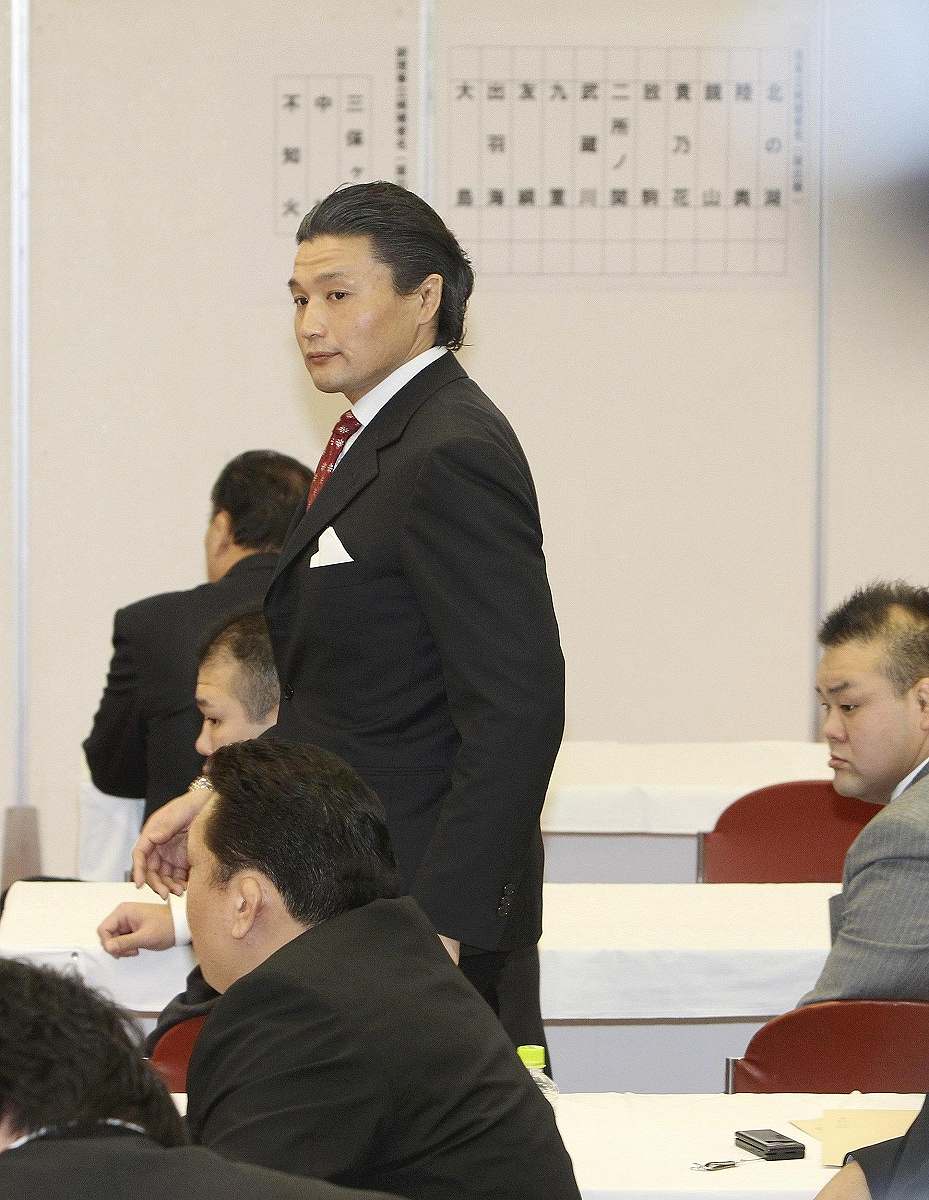
Former yokozuna Takanohana’s candidacy for a seat on the board of directors in 2010 was engulfed in controversy.
11:26 JST, January 24, 2024
The first grand tournament of the new year is in full swing, with the passion and excitement emanating each day from Tokyo’s Ryogoku Kokugikan. But as this event grinds on, the sumo world is in the midst of a “battle” of a different sort.
Once every two years, the Japan Sumo Association holds its election for new directors to its board.
As the New Year Tournament moves ahead, the entire group of stablemasters and other sumo elders are working to select 10 “candidates,” who will be officially approved by a special council in the spring in a largely ceremonial process.
Currently, three executive seats are held by notable persons from outside the sumo world. For a long time, the board, which controls all that goes on in the association, consisted solely of former wrestlers.
Even now, the directors are selected almost exclusively from among the stablemasters, and it is from that group that the chairman, who holds the highest position in the JSA, is chosen.
For the election, each of what are known as the “ichimon” — coalitions of stables that function as a single group for training and other matters — narrow down their choices of candidates. It is common practice in choosing the candidates to take into consideration such factors as seniority, ranking during their active career, and results of their current disciples.
There have been cases in which the number of candidates matches the number of openings, resulting in everyone getting a “safe seat.” But there have been other times when the election evolved into a fierce competition.
The most controversial election came in 2010. Former yokozuna Takanohana defied the wishes of his own Nishonoseki ichimon and put forth himself as a candidate, then tried to drum up support from other ichimon.
It became an election like never before. During his career, Takanohana, along with brother and fellow yokozuna Wakanohana, lifted sumo to unprecedented heights of popularity. But in this case, he was drawing attention for trying to throw a wrench into the long-established ichimon system.
Each and every elder throws himself fully into the intense competition during their time as active rikishi. And even after leaving the raised ring, they find themselves in a new struggle of trying to get ahead within the sumo association.
In baseball and other sports, it is not rare for the athletes to step away from the game after retiring and start second careers in an unrelated field.
But for the older members of sumo, the sport has been virtually their entire lives — they have been part of the association from joining a stable out of junior high school at 15 to reaching the mandatory retirement age of 70.
For that reason alone, to a sumo elder, the executive election probably becomes a battle that will affect him the rest of his life.
— Kamimura is a sumo expert.




Most Read
Popular articles in the past 24 hours
-

3 Brazilians Arrested for Stealing Toyota Land Cruiser; Trio Also...
-
Special Diet Session to Consider Budget, Proposed National Intell...
-

Japan’s Nikkei Stock Average Rises on Tech Rally and Takaichi's S...
-

Security Services Law Unconstitutional: Do Not Restrict Career Ch...
-
New Leader of Japan's CRA Opposition Party Faces Challenge of For...
-
Takaichi Expected to Express Desire for Constitutional Revision P...
-
Tokyo Exhibition Featuring VR Walk Through 2025 Osaka-Kansai Expo...
-
Japanese Man Living in Iraq Suspected of Illegally Entering U.S. ...
Popular articles in the past week
-

Japan PM Takaichi’s Cabinet Resigns en Masse
-

Man Infected with Measles Reportedly Dined at Restaurant in Tokyo...
-

Videos Plagiarized, Reposted with False Subtitles Claiming ‘Ryuky...
-

Sanae Takaichi Elected 105th Prime Minister of Japan; Keeps All C...
-

Japan's Govt to Submit Road Map for Growth Strategy in March, PM ...
-

Milano Cortina 2026: Figure Skaters Riku Miura, Ryuichi Kihara Pa...
-

Tokyo’s New Record-Breaking Fountain Named ‘Tokyo Aqua Symphony’
-

Bus Carrying 40 Passengers Catches Fire on Chuo Expressway; All E...
Popular articles in the past month
-
Japan PM Takaichi’s Cabinet Resigns en Masse
-

Japan Institute to Use Domestic Commercial Optical Lattice Clock ...
-

Israeli Ambassador to Japan Speaks about Japan’s Role in the Reco...
-
Man Infected with Measles Reportedly Dined at Restaurant in Tokyo...
-

Man Infected with Measles May Have Come in Contact with Many Peop...
-

Prudential Life Insurance Plans to Fully Compensate for Damages C...
-
Videos Plagiarized, Reposted with False Subtitles Claiming ‘Ryuky...
-

Woman with Measles Visited Hospital in Tokyo Multiple Times Befor...
Top Articles in Sports
-
Aonishiki Tops Atamifuji in Playoff to Win New Year Grand Sumo Tournament in Ozeki Debut
-
Milano Cortina 2026: Figure Skaters Riku Miura, Ryuichi Kihara Pair Win Gold; Dramatic Comeback from 5th Place in SP
-
Milano Cortina 2026: Kokomo Murase Comes Out on Top After Overcoming Obstacles, Aiming for Greater Heights in Competition
-

Milano Cortina 2026: Olympics-Torch Arrives in Co-Host Cortina on Anniversary of 1956 Games
-
Milano Cortina 2026: Japan’s Athletes Arrive in Italy for Milano Cortina Winter Olympics; Other Athletes to Arrive from Now
JN ACCESS RANKING
-
Japan PM Takaichi’s Cabinet Resigns en Masse
-
Japan Institute to Use Domestic Commercial Optical Lattice Clock to Set Japan Standard Time
-
Israeli Ambassador to Japan Speaks about Japan’s Role in the Reconstruction of Gaza
-
Man Infected with Measles Reportedly Dined at Restaurant in Tokyo Station
-
Man Infected with Measles May Have Come in Contact with Many People in Tokyo, Went to Store, Restaurant Around When Symptoms Emerged