
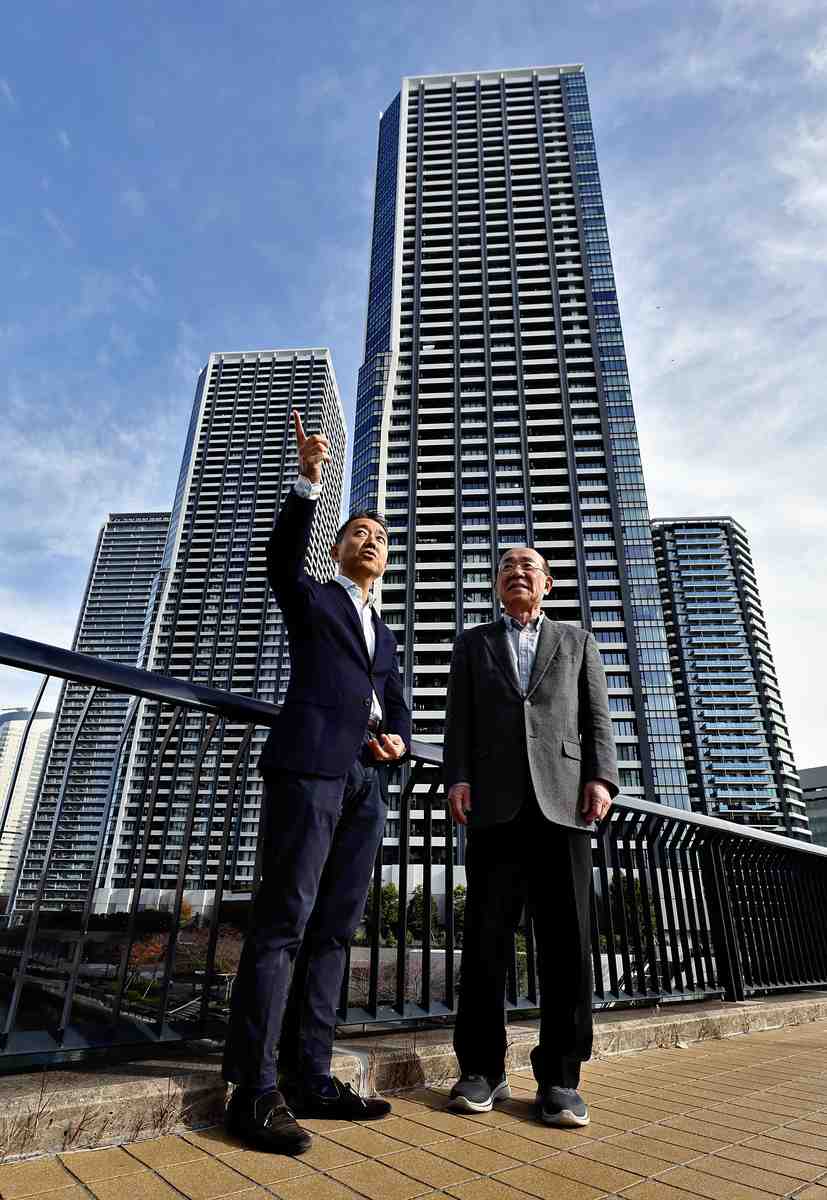
The chairperson of a citizens’ disaster prevention group, right, stands with the high-rise Deux Tours condominium in the background in Chuo Ward, Tokyo, on Dec. 10.
7:00 JST, December 21, 2025
The recently released damage estimates of a Tokyo earthquake highlight the importance of disaster prevention measures for high-rise condominiums, as well as measures to help foreign residents.
The report, which has been released by the government for the first time in 10 years, provides damage estimates from a major earthquake directly beneath Tokyo. Local governments and others are working to address these and other issues, but challenges still remain.
Staying home
The number of condominiums that are at least 15 stories tall in Tokyo and its neighboring prefectures increased by 30% to about 504,000 in the 10 years until 2023.
The latest report points out the importance of disaster prevention measures for high-rise condominiums and recommends that residents stay in their homes after a disaster.
It also calls for high-rise condominiums to make preparations so that residents will be able to stay home for a period of time after a disaster. This is because if a large number of residents living in high-rise condominiums leave for evacuation centers, those centers could quickly become overwhelmed.
Deux Tours, a 52-story condominium with about 1,600 units in Chuo Ward, Tokyo, calls for residents to stockpile a week’s worth of food so that they will be able to stay home in the event of a disaster. A person on each floor has been selected to be in charge of disaster response, and a storage facility has been set up in the condominium to store emergency toilets, as well as three days’ worth of drinking water and rice porridge.
Securing temporary accommodations
After the 2011 Great East Japan Earthquake, people had difficulty returning to their homes.
In the previous damage estimates, released in 2013, it said that up to 4.9 million people would have difficulty returning home. The Tokyo metropolitan government and other local governments have asked companies to secure stockpiles of food and drinking water and to discourage employees from returning home immediately after a disaster.
Furthermore, local governments in Tokyo have jointly established disaster prevention councils with private-sector firms, such as railway companies and relevant businesses, to secure facilities where people, who cannot immediately return home, can temporarily stay.
As of July, there were 1,302 such facilities in Tokyo to accommodate 501,714 people.
However, according to the latest estimates, out of the 4.8 million people in Tokyo that will have difficulty returning home, 850,000 will have to utilize such temporary accommodation facilities because their workplaces or schools are too far or because they are on a trip.
The head of the disaster prevention department in Tokyo’s Meguro Ward office said, “We will continue to call for cooperation to secure temporary accommodation facilities and make efforts to create a system that can respond flexibly to disasters with limited staff and resources.”
Assisting foreign residents
There is also an urgent need for measures to help foreign residents.
According to the Tokyo metropolitan government, there were more than 770,000 foreign residents living in Tokyo as of Oct. 1, a 90% increase compared to the 410,000 residents there were in 2011 when the Great East Japan Earthquake occurred.
The latest report states that the number of evacuees that will require special consideration at evacuation facilities has increased due to the rise in the number of foreign residents.
The Tokyo Metropolitan Foundation “Tsunagari,” which is a Shinjuku Ward-based group that works to support the daily lives of foreign residents, shares disaster prevention information, including about evacuation centers and how to protect oneself, on its site and its social media in up to 76 languages.
However, it’s X account only has about 2,738 followers.
“When a disaster occurs, false rumors tend to spread quickly on social media,” said an acting manager of the foundation’s multicultural and diversity department. “Delivering accurate information in a timely manner is a challenge.”
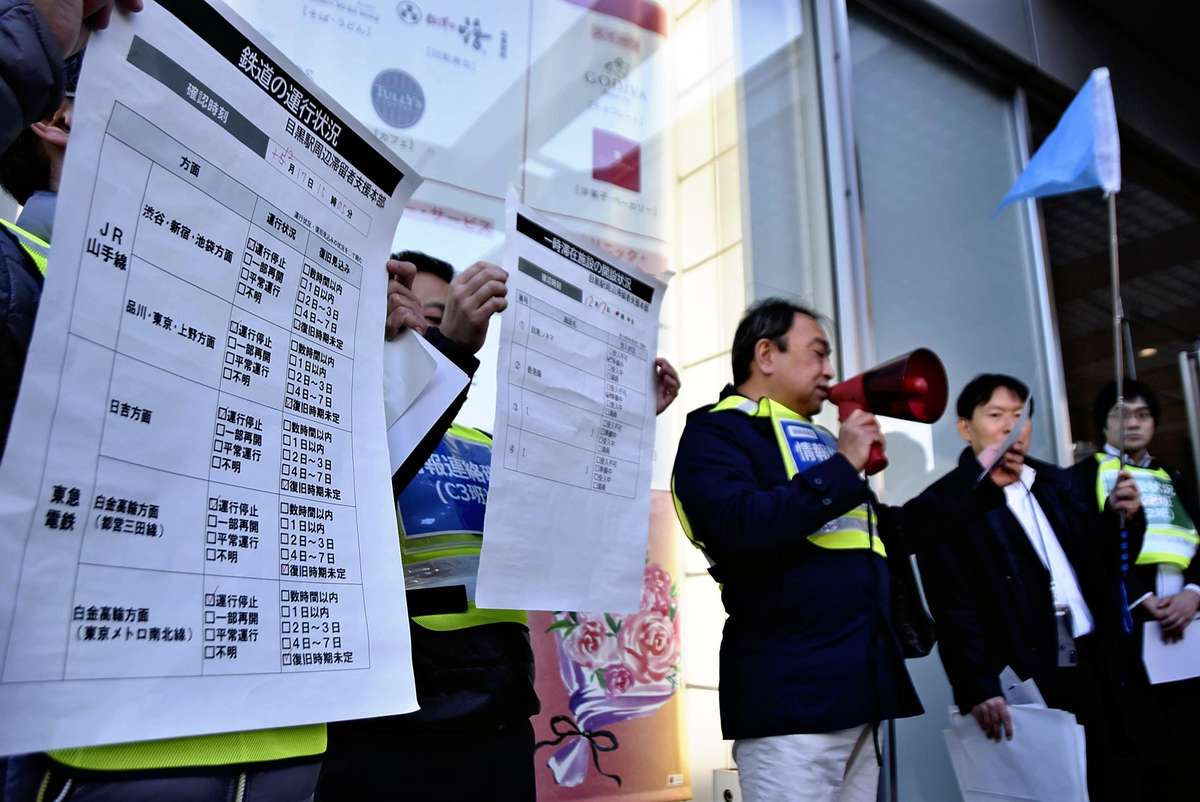
Members of a council related to disaster response conduct an exercise in which they inform passersby near Meguro Station about train operation information on Wednesday.
Meanwhile, the Tokyo metropolitan government is always accepting volunteers who can speak different languages to help foreign residents. As of April 1, the Tokyo metropolitan government had 599 active volunteers, and assistance is provided in 15 languages.
In Tokyo’s Kita Ward, all 56 designated evacuation centers have tablets that can translate 13 languages, and Chiyoda Ward has stockpiled halal food, which is food that has been processed in accordance with Islamic law.
Members of a council related to disaster response conduct an exercise in which they inform passersby near Meguro Station about train operation information on Wednesday.


Related Tags

Most Read
Popular articles in the past 24 hours
-

Artisans from Disaster-Hit Areas Work Together to Keep Memories o...
-
Japan Tourist Spot's Capsule Toys Made from Recycled Materials Pr...
-

Japan’s Space One Kairos 3rd Flight Rocket Launched, but Mission ...
-

Space One's No. 3 Kairos Rocket Terminates Mid-Flight
-
Person Apparently Caught in Avalanche on Mt. Kamifurano in Hokkai...
-
NTT Docomo to Discontinue 3G Service in March
-

Former Unification Church: Proceed Steadily with Liquidation to P...
-
LCC Greater Bay Airlines to Launch Regular Service on Fukuoka-Hon...
Popular articles in the past week
-
Tokyo Spends Big on Children, Wins Over Parents
-
South Korea Tightens Rules on Foreigners Buying Homes in Seoul Me...
-

Japan’s Miura, Kihara Announce Withdrawal from Figure Skating Wor...
-
2 Unpublished Early Novellas by Japan's Kenzaburo Oe Discovered, ...
-

Strait of Hormuz Closure Shakes Markets; Prolonged Closure Could ...
-
Nidec Chairman Resigns Amid Accounting Scandal at Major Japanese ...
-
Tourists Ignore Safety Barriers Near Famous Zao ‘Snow Monsters’ i...
-

Iran Situation: Japan Must Exert Diplomatic Efforts without Merel...
Popular articles in the past month
-

Producer Behind Pop Group XG Arrested for Cocaine Possession
-

Japan PM Takaichi’s Cabinet Resigns en Masse
-

Man Infected with Measles Reportedly Dined at Restaurant in Tokyo...
-

Israeli Ambassador to Japan Speaks about Japan’s Role in the Reco...
-

Videos Plagiarized, Reposted with False Subtitles Claiming ‘Ryuky...
-

Prudential Life Insurance Plans to Fully Compensate for Damages C...
-

Woman with Measles Visited Hospital in Tokyo Multiple Times Befor...
-

iPS Treatments Pass Key Milestone, but Broader Applications Far f...
Top Articles in Society
-
Producer Behind Pop Group XG Arrested for Cocaine Possession
-
Man Infected with Measles Reportedly Dined at Restaurant in Tokyo Station
-
Woman with Measles Visited Hospital in Tokyo Multiple Times Before Being Diagnosed with Disease
-

Bus Carrying 40 Passengers Catches Fire on Chuo Expressway; All Evacuate Safely
-
Tokyo Skytree’s Elevator Stops, Trapping 20 People; All Rescued (Update 1)
JN ACCESS RANKING
-
Producer Behind Pop Group XG Arrested for Cocaine Possession
-
Japan PM Takaichi’s Cabinet Resigns en Masse
-
Man Infected with Measles Reportedly Dined at Restaurant in Tokyo Station
-
Israeli Ambassador to Japan Speaks about Japan’s Role in the Reconstruction of Gaza
-
Videos Plagiarized, Reposted with False Subtitles Claiming ‘Ryukyu Belongs to China’; Anti-China False Information Also Posted in Japan