
Aomori Quake Occurs in Area Hit by M7, M8 Earthquakes in Past, Hypocenter Located in Region of Anticipated Japan Trench Quake
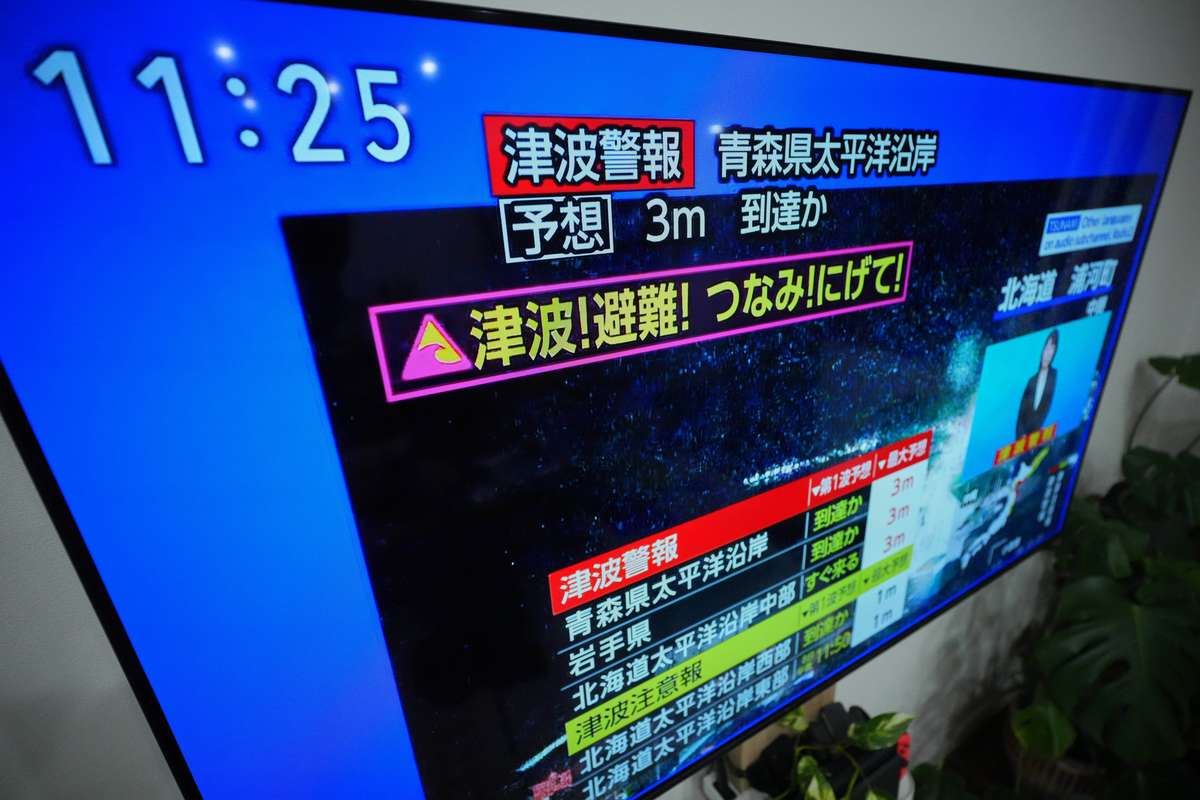
A tsunami warning is seen on a television in Yokohama on Monday after a strong earthquake rocked the Tohoku region and Hokkaido.
15:46 JST, December 10, 2025
The powerful earthquake that struck late on Monday, with its epicenter off the east coast of Aomori Prefecture, occurred in an area that has been hit by quakes in the past measuring magnitude 7 and magnitude 8.
The hypocenter was located within the presumed focal region of an anticipated quake along the Japan Trench or Chishima Trench, which could result in at least 100,000 deaths. The government is on the alert because a larger follow-up earthquake may occur in the area.
The Monday earthquake occurred north of the epicenter of the magnitude 9 Great East Japan Earthquake that struck in 2011. It was a trench-type quake, like the March 2011 earthquake, occurring at the boundary between the Pacific Plate on the sea side and the North American Plate on the land side. The quake occurred as the Pacific Plate subducted beneath the North American Plate.
You may also like to read
Strong Tremors, Tsunami Warnings Remind Residents of 2011 Great East Japan EarthquakeMajor earthquakes, including the magnitude 8 Tokachi-oki Earthquake in 2003 and the magnitude 7.6 Sanriku-Haruka-oki Earthquake in 1994, occurred in the area and its surroundings. Since the Monday tremor occurred in a “void” with few recorded earthquakes of comparable magnitude, some experts suggest it may have taken place after part of a plate boundary, which had not entirely broken, was ruptured.
The government’s Earthquake Research Committee has estimated that earthquakes of about magnitude 7.9 could occur in the area once every 97 years. According to the long-term assessment, earthquakes with a magnitude 7 to magnitude 7.5, which are of a similar magnitude to Monday’s tremor, could occur once every 8.8 years, and there is an “at least 90% probability” of the occurrence within the next 30 years.
“It is possible that the plate boundary deep underground, which had not moved, largely shifted,” said Tohoku University Prof. Shinji Toda, a seismology and geology specialist. “We need to be vigilant for larger follow-up quakes.”


Related Tags

Most Read
Popular articles in the past 24 hours
-
Pass Rate for Overseas Driver's License Conversion Test in Japan ...
-

Milano Cortina 2026: Ceremony for Winter Paralympic Torch Relay T...
-

WBC to Begin: All the Pieces are in Place for Japan’s Second Stra...
-
Tokyo High Court Upholds Unification Church Dissolution Order
-

How Trump Assassination Attempts Played into His Decision to Atta...
-
PM Sanae Takaichi: Iran Situation Won’t Immediately Affect Electr...
-

Japanese Speedskater Takagi Announces Retirement
-
Trump's Asian Allies Fear Iran War Will Sap Defenses against Chin...
Popular articles in the past week
-
Tokyo Spends Big on Children, Wins Over Parents
-
Japan’s Miura, Kihara Announce Withdrawal from Figure Skating Wor...
-
BOJ Keeping Eye on Economy and Takaichi's ‘Proactive Fiscal Polic...
-
South Korea Tightens Rules on Foreigners Buying Homes in Seoul Me...
-
Tokyo Measles Patient Traveled to Fukuoka Aboard JAL Planes; Susp...
-
Nidec Chairman Resigns Amid Accounting Scandal at Major Japanese ...
-
Tourists Ignore Safety Barriers Near Famous Zao ‘Snow Monsters’ i...
-
Strait of Hormuz Closure Shakes Markets; Prolonged Closure Could ...
Popular articles in the past month
-

Producer Behind Pop Group XG Arrested for Cocaine Possession
-

Japan PM Takaichi’s Cabinet Resigns en Masse
-

Man Infected with Measles Reportedly Dined at Restaurant in Tokyo...
-

Israeli Ambassador to Japan Speaks about Japan’s Role in the Reco...
-

Videos Plagiarized, Reposted with False Subtitles Claiming ‘Ryuky...
-

Prudential Life Insurance Plans to Fully Compensate for Damages C...
-

Woman with Measles Visited Hospital in Tokyo Multiple Times Befor...
-

iPS Treatments Pass Key Milestone, but Broader Applications Far f...
Top Articles in Society
-
Producer Behind Pop Group XG Arrested for Cocaine Possession
-
Man Infected with Measles Reportedly Dined at Restaurant in Tokyo Station
-
Woman with Measles Visited Hospital in Tokyo Multiple Times Before Being Diagnosed with Disease
-
Bus Carrying 40 Passengers Catches Fire on Chuo Expressway; All Evacuate Safely
-
Tokyo Skytree’s Elevator Stops, Trapping 20 People; All Rescued (Update 1)
JN ACCESS RANKING
-
Producer Behind Pop Group XG Arrested for Cocaine Possession
-
Japan PM Takaichi’s Cabinet Resigns en Masse
-
Man Infected with Measles Reportedly Dined at Restaurant in Tokyo Station
-
Israeli Ambassador to Japan Speaks about Japan’s Role in the Reconstruction of Gaza
-
Videos Plagiarized, Reposted with False Subtitles Claiming ‘Ryukyu Belongs to China’; Anti-China False Information Also Posted in Japan