
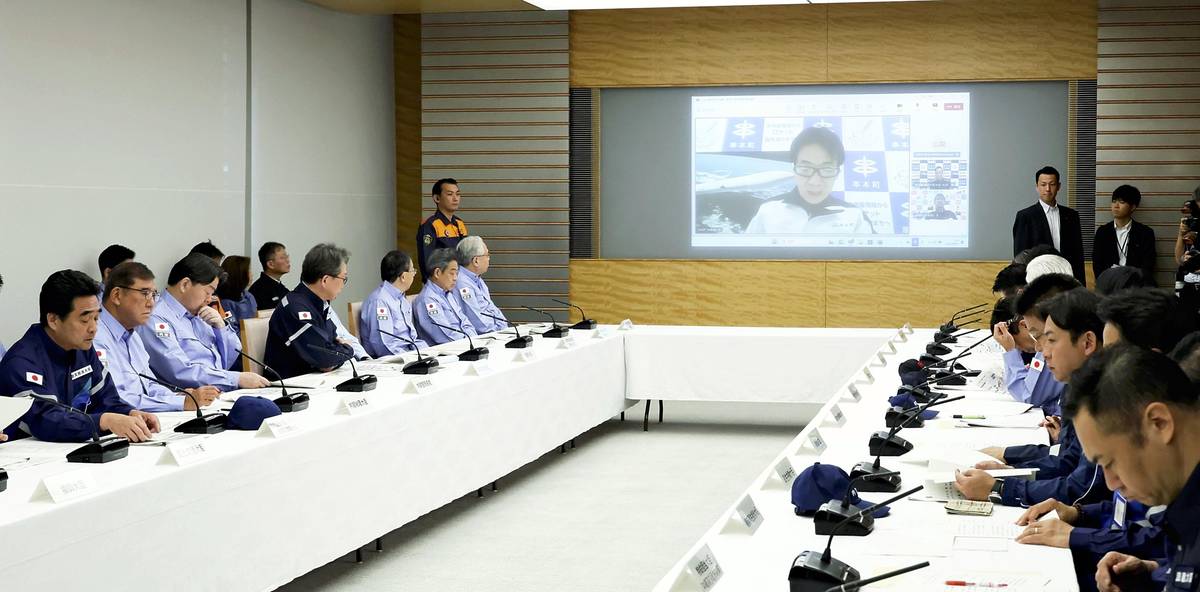
Prime Minister Shigeru Ishiba, second from left, listens to a situation report at the Prime Minister’s Office on Monday.
13:46 JST, September 1, 2025
The government conducted a comprehensive disaster drill for a Nankai Trough megaquake on Monday, coinciding with Disaster Prevention Day.
The probability of such an earthquake occurring within the next 30 years is estimated to be about 80%. Through the drill, authorities aimed to confirm how relevant agencies would respond to the disaster. They also aimed to strengthen their preparedness to minimize damage in the wake of a major quake.
During the drill, cabinet ministers wearing disaster-response uniforms arrived one after another on foot at the Prime Minister’s Office and convened a meeting of the emergency disaster response headquarters chaired by Prime Minister Shigeru Ishiba. The prime minister instructed the officials to “put the protection of human life first and use every available means to carry out emergency disaster response.”
This year’s drill assumed that a magnitude 9.1 earthquake had struck at 5:10 p.m. on Dec. 1 with its epicenter off the southern coast of Wakayama Prefecture. With a seismic intensity of 7 on the Japanese scale, shaking was assumed to have been recorded in ten prefectures across the Tokai, Kinki, Shikoku and Kyushu regions.
Drawing on the experience of the Noto Peninsula Earthquake in January last year, the scenario also presumed such adverse conditions as the coldest winter temperatures after sunset. During the meeting, officials held a video conference with Shizuoka Gov. Yasutomo Suzuki and others to hear reports on the damage.
The exercise further assumed the spread of false information and rumors on social media. “The malicious circulation of false information is absolutely unacceptable,” Ishiba emphasized at a mock press conference after the meeting. “I strongly urge people to refrain from circulating false information.”
Deaths caused directly by a Nankai Trough earthquake could reach as high as 298,000, while the number of buildings completely destroyed or burned down could total 2.35 million, according to the government’s latest estimates released in March.





Most Read
Popular articles in the past 24 hours
-

Ukrainian Ambassador Closely Watching Japan’s Revision of Defense...
-

Milano Cortina 2026: Sakamoto Serves as Flag Bearer; Japan Earns ...
-

Milano Cortina 2026: There Were Cheers across the Country, after ...
-

Emperor Turns 66 Ahead of Disaster Milestones
-

Luna Sea Drummer Shinya Dies at 56; Powerful Drummer Behind ‘Desi...
-

Milano Cortina 2026: ‘Magical’ Italian Games Close wi...
-

Milano Cortina 2026: Riku-Ryu Duo Stick Together During Closing C...
-

1.2 Mil. Rapeseed Flowers Attract Cute Birds, People in Aichi Pre...
Popular articles in the past week
-

Japan PM Takaichi’s Cabinet Resigns en Masse
-

Man Infected with Measles Reportedly Dined at Restaurant in Tokyo...
-

Sanae Takaichi Elected Prime Minister of Japan; Keeps All Cabinet...
-

Japan's Govt to Submit Road Map for Growth Strategy in March, PM ...
-

Bus Carrying 40 Passengers Catches Fire on Chuo Expressway; All E...
-

Milano Cortina 2026: Figure Skaters Riku Miura, Ryuichi Kihara Pa...
-

U.S. Firm to Build Training Hub in Fukushima N-plant for Debris R...
-

Japan, U.S. Name 3 Inaugural Investment Projects; Reached Agreeme...
Popular articles in the past month
-
Japan PM Takaichi’s Cabinet Resigns en Masse
-

Japan Institute to Use Domestic Commercial Optical Lattice Clock ...
-

Israeli Ambassador to Japan Speaks about Japan’s Role in the Reco...
-
Man Infected with Measles Reportedly Dined at Restaurant in Tokyo...
-

Videos Plagiarized, Reposted with False Subtitles Claiming ‘Ryuky...
-

Man Infected with Measles May Have Come in Contact with Many Peop...
-

Prudential Life Insurance Plans to Fully Compensate for Damages C...
-

Woman with Measles Visited Hospital in Tokyo Multiple Times Befor...
Top Articles in Society
-

Producer Behind Girls Group XG Arrested for Cocaine Possession
-
Man Infected with Measles Reportedly Dined at Restaurant in Tokyo Station
-
Man Infected with Measles May Have Come in Contact with Many People in Tokyo, Went to Store, Restaurant Around When Symptoms Emerged
-
Woman with Measles Visited Hospital in Tokyo Multiple Times Before Being Diagnosed with Disease
-
Australian Woman Dies After Mishap on Ski Lift in Nagano Prefecture
JN ACCESS RANKING
-
Japan PM Takaichi’s Cabinet Resigns en Masse
-
Japan Institute to Use Domestic Commercial Optical Lattice Clock to Set Japan Standard Time
-
Israeli Ambassador to Japan Speaks about Japan’s Role in the Reconstruction of Gaza
-
Man Infected with Measles Reportedly Dined at Restaurant in Tokyo Station
-
Videos Plagiarized, Reposted with False Subtitles Claiming ‘Ryukyu Belongs to China’; Anti-China False Information Also Posted in Japan