
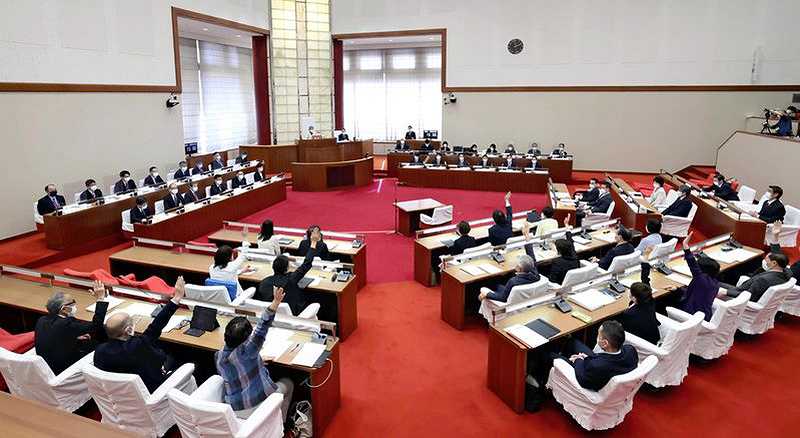
The Musashino, Tokyo, city assembly meeting on Tuesday
16:25 JST, December 22, 2021
A proposed ordinance in Musashino, Tokyo, that would have allowed foreign residents to vote in referendums sparked confrontation before it was voted down in the city assembly.
On Tuesday, the Musashino city assembly rejected the proposed ordinance at a plenary meeting, amid concerns about politically enfranchising foreigners more broadly. Prior to the meeting, the proposal had passed the assembly’s general affairs committee by a narrow 4-3 margin on Dec. 13.
After the city submitted the proposal to the assembly in November, strident emails were sent to assembly members from proponents of both sides, with messages such as “You will be finished as an assemblyman if you vote for the ordinance” or “It is discriminatory to oppose it.”
In Tuesday’s debate at the plenary meeting, opinions were split. One member said, “The draft ordinance could give the political franchise to foreigners in a broad sense,” while another argued, “Foreigners are part of the community.”
Assembly member Natsuho Honda, who had not previously expressed her stance, opposed the proposal because the city “has not gained public understanding of the [proposed] system.”
Honda told The Yomiuri Shimbun after the plenary meeting, “The issue could create division among residents.”
On Tuesday, 11 assembly members, including those from the Constitutional Democratic Party of Japan — which supports Mayor Reiko Matsushita in steering the assembly — and the Japanese Communist Party, voted in favor, claiming that a referendum is different from an election, and therefore it is “unnatural” to exclude foreigners.
Fourteen members, including those from the Liberal Democratic Party and Komeito, voted against, arguing that a distinct standard is necessary regarding the voting rights for foreigners.
In February of this year, the Musashino city government released a skeleton plan of the ordinance and then released its preliminary draft in August. Matsushita said she did her best to publicize it.
However, only a total of 13 citizens participated in public meetings held in March and August. After the proposed ordinance was rejected Tuesday, Matsushita said, “I take the result as a voice from the assembly to make the issue better known.”
There was a case similar to that of Musashino in the past. In 2015, the Akashi city government in Hyogo Prefecture submitted a proposal to its assembly to allow foreigners living in Japan for three years or longer to have the right to vote, but it was rejected on the grounds that the notion of allowing foreigners to vote was inconceivable.
Reitaku University Prof. Hidetsugu Yagi, who specializes in constitutional law, said that voting agendas can cover issues related to national interests, such as U.S. military bases and nuclear power plants, and it would become difficult for municipalities to ignore the results of a referendum.
“Allowing foreigners to vote would allow them to be involved in municipal affairs and could effectively give them [a broader] political franchise,” he said.






Most Read
Popular articles in the past 24 hours
-
Tokyo Skytree's Elevator Stops, Trapping 20 People; All Rescued (...
-

China, India Tapping into Promising African Market; Beijing Annou...
-

Japan’s Major Real Estate Firms Expanding Overseas Businesses to ...
-

Ukrainian Ambassador Closely Watching Japan’s Revision of Defense...
-
Emperor Turns 66 Ahead of Disaster Milestones
-

Milano Cortina 2026: Sakamoto Serves as Flag Bearer; Japan Earns ...
-

Milano Cortina 2026: There Were Cheers across the Country, after ...
-
Luna Sea Drummer Shinya Dies at 56; Powerful Drummer Behind ‘Desi...
Popular articles in the past week
-

Japan PM Takaichi’s Cabinet Resigns en Masse
-

Man Infected with Measles Reportedly Dined at Restaurant in Tokyo...
-

Sanae Takaichi Elected Prime Minister of Japan; Keeps All Cabinet...
-

Japan's Govt to Submit Road Map for Growth Strategy in March, PM ...
-

Bus Carrying 40 Passengers Catches Fire on Chuo Expressway; All E...
-

Milano Cortina 2026: Figure Skaters Riku Miura, Ryuichi Kihara Pa...
-
Japan, U.S. Name 3 Inaugural Investment Projects; Reached Agreeme...
-

U.S. Firm to Build Training Hub in Fukushima N-plant for Debris R...
Popular articles in the past month
-
Japan PM Takaichi’s Cabinet Resigns en Masse
-

Japan Institute to Use Domestic Commercial Optical Lattice Clock ...
-

Israeli Ambassador to Japan Speaks about Japan’s Role in the Reco...
-
Man Infected with Measles Reportedly Dined at Restaurant in Tokyo...
-

Videos Plagiarized, Reposted with False Subtitles Claiming ‘Ryuky...
-

Man Infected with Measles May Have Come in Contact with Many Peop...
-

Prudential Life Insurance Plans to Fully Compensate for Damages C...
-

Woman with Measles Visited Hospital in Tokyo Multiple Times Befor...
Top Articles in Society
-
Man Infected with Measles Reportedly Dined at Restaurant in Tokyo Station
-
Man Infected with Measles May Have Come in Contact with Many People in Tokyo, Went to Store, Restaurant Around When Symptoms Emerged
-
Woman with Measles Visited Hospital in Tokyo Multiple Times Before Being Diagnosed with Disease
-
Australian Woman Dies After Mishap on Ski Lift in Nagano Prefecture
-
Foreign Snowboarder in Serious Condition After Hanging in Midair from Chairlift in Nagano Prefecture
JN ACCESS RANKING
-
Japan PM Takaichi’s Cabinet Resigns en Masse
-
Japan Institute to Use Domestic Commercial Optical Lattice Clock to Set Japan Standard Time
-
Israeli Ambassador to Japan Speaks about Japan’s Role in the Reconstruction of Gaza
-
Man Infected with Measles Reportedly Dined at Restaurant in Tokyo Station
-
Videos Plagiarized, Reposted with False Subtitles Claiming ‘Ryukyu Belongs to China’; Anti-China False Information Also Posted in Japan