
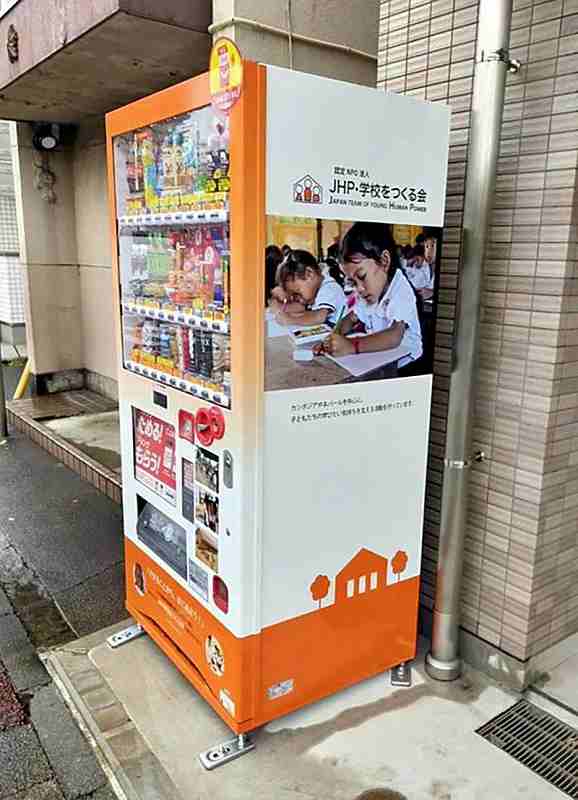
A donation-type vending machine wrapped with the name of a charitable organization
November 16, 2021
Japan’s ubiquitous vending machines are now being tapped as a convenient way for consumers to change the world with their pocket change.
“Donation-type vending machines” have been popping up on street corners in recent years, as a new business model that has owners donate a portion of sales proceeds to charitable organizations.
Operators hope the initiative will be a win-win for both society and business, by providing consumers an added incentive to select their machines over the many others in the vending machine capital of the world.
In September, Kazuki Hirose, the 42-year-old president of KY, an HVAC contractor in Yokohama, installed a charity vending machine on the first floor of his building.
“Neighbors have approached me to express their delight at being able to contribute back to society [through the vending machine],” Hirose said.
The company has chosen to donate proceeds earned from the machine to Japan Team of Young Human Power (JHP), a Tokyo-based nonprofit organization working to build schools mainly in Cambodia. Since the company has to foot the bill for electricity and other costs, the amount donated comes out to only ¥1 per bottle sold. But it has still attracted many supporters, including some who travel long distances specifically to buy drinks from the machine.
The company received its SDGs (Sustainable Development Goals) accreditation from the city in June, and had been looking for further ways to contribute to society.
“It’s helped raise our company’s profile,” Hirose said. “We would like to consider donating more per bottle in the future.”
Interest in charity vending machines is on the rise, according to a Tokyo nonprofit group that connects charities with companies that want to participate in the initiative. The group said the number of charity vending machines it helped install tripled from about 80 in 2015 to about 270 in 2020.
To make donation-type machines stand out on the street, they are wrapped with graphics advertising the name and activities of the charity in question. Beneficiaries of the system have said they are grateful for both the donations and the extra exposure.
The wrapping is handled by beverage manufacturers.
“The vending machine market has reached a saturation point. Between that and the continuing increase in the number of convenience stores, business has been struggling,” said an official of a beverage maker. “But being able to explain the social value of the charity vending machines has made it easier to encourage people to install more machines.”
Other groups have also been working to promote the initiative.
In fiscal 2020, the Nippon Foundation installed 486 new charity vending machines at social welfare organizations and other entities, bringing the total to 8,110. The foundation donates ¥10 per bottle of beverage — funneling about ¥280 million to support children with terminal diseases and others in the same fiscal year alone.
“We would like to cultivate a donation culture by getting more people involved little by little,” said a foundation official.
“When people see and use charity vending machines on a daily basis, it becomes a catalyst for them to think about social contribution in their daily lives,” pointed out Kobe University professor and beverage marketing expert Kei Kuriki. “It will also connect to a greater movement to solve issues in the community as a whole.”



Most Read
Popular articles in the past 24 hours
-
6 Injured at Naked Festival in Japan’s Okayama Prefecture; Police...
-

Reciprocal Tariffs Ruled Illegal: Judiciary Would Not Tolerate Pr...
-

Fiji Defense Minister Hopes Japan Will Support Stabilization of P...
-

Space One Delays Launch of No. 3 Kairos Rocket; Company to Announ...
-

Japanese Film, Anymart, Wins Critics’ Award at International Film...
-

3rd Japan Pacific Islands Defense Dialogue to Begin in Tokyo on S...
-

India, Brazil Sign Mining Pact As Modi Targets $20 Billion Trade ...
-

I Am Surprised by My Mother’s Increased Drinking
Popular articles in the past week
-

Japan PM Takaichi’s Cabinet Resigns en Masse
-

Man Infected with Measles Reportedly Dined at Restaurant in Tokyo...
-

Sanae Takaichi Elected Prime Minister of Japan; Keeps All Cabinet...
-

Japan's Govt to Submit Road Map for Growth Strategy in March, PM ...
-

Bus Carrying 40 Passengers Catches Fire on Chuo Expressway; All E...
-

Milano Cortina 2026: Figure Skaters Riku Miura, Ryuichi Kihara Pa...
-

Japan, U.S. Name 3 Inaugural Investment Projects; Reached Agreeme...
-
U.S. Firm to Build Training Hub in Fukushima N-plant for Debris R...
Popular articles in the past month
-
Japan PM Takaichi’s Cabinet Resigns en Masse
-

Japan Institute to Use Domestic Commercial Optical Lattice Clock ...
-

Israeli Ambassador to Japan Speaks about Japan’s Role in the Reco...
-
Man Infected with Measles Reportedly Dined at Restaurant in Tokyo...
-

Videos Plagiarized, Reposted with False Subtitles Claiming ‘Ryuky...
-

Man Infected with Measles May Have Come in Contact with Many Peop...
-

Prudential Life Insurance Plans to Fully Compensate for Damages C...
-

Woman with Measles Visited Hospital in Tokyo Multiple Times Befor...
Top Articles in Society
-
Man Infected with Measles Reportedly Dined at Restaurant in Tokyo Station
-
Man Infected with Measles May Have Come in Contact with Many People in Tokyo, Went to Store, Restaurant Around When Symptoms Emerged
-
Woman with Measles Visited Hospital in Tokyo Multiple Times Before Being Diagnosed with Disease
-
Australian Woman Dies After Mishap on Ski Lift in Nagano Prefecture
-
Foreign Snowboarder in Serious Condition After Hanging in Midair from Chairlift in Nagano Prefecture
JN ACCESS RANKING
-
Japan PM Takaichi’s Cabinet Resigns en Masse
-
Japan Institute to Use Domestic Commercial Optical Lattice Clock to Set Japan Standard Time
-
Israeli Ambassador to Japan Speaks about Japan’s Role in the Reconstruction of Gaza
-
Man Infected with Measles Reportedly Dined at Restaurant in Tokyo Station
-
Videos Plagiarized, Reposted with False Subtitles Claiming ‘Ryukyu Belongs to China’; Anti-China False Information Also Posted in Japan