
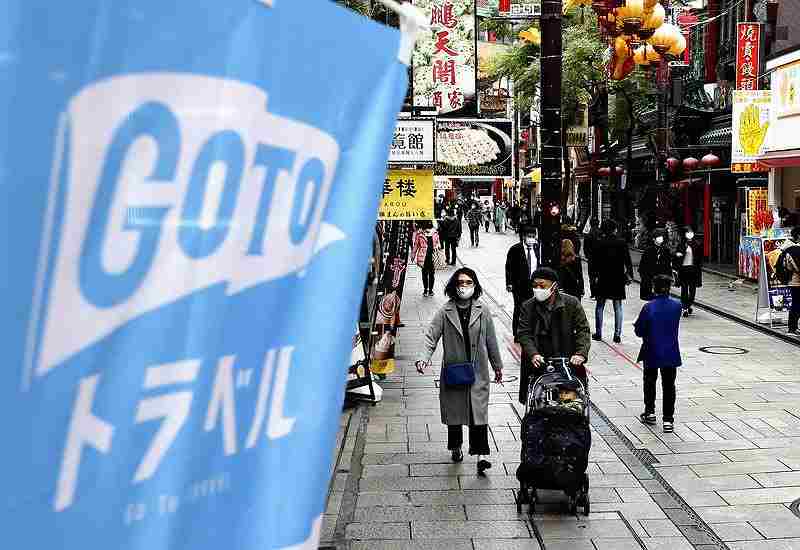
An unusually small number of people are seen in Yokohama’s Chinatown in this photo taken in December 2020.
November 14, 2021
The government is making arrangements to resume as early as mid-January the Go To Travel campaign, a project designed to support the tourism industry but which has been suspended since late 2020.
Daily discounts on travel and accommodations within Japan are expected to be lowered to a maximum of ¥10,000 from the previous level of ¥14,000. The timing of the restart will be finalized based on an assessment of new infections with the novel coronavirus and how well treatments are working, according to several government sources.
Under the previous system, people traveling within Japan could receive up to 35% off travel and accommodations, for a maximum savings of ¥14,000 per person per night. However, it was noted that people tended to use the discounts to stay at relatively expensive hotels, resulting in only limited benefit for small and medium-sized hotels and ryokan traditional inns.
The government is therefore considering lowering the maximum discount to 30%, for a maximum daily savings of ¥10,000.
Coupons were also included in the original program that people could use at souvenir shops and elsewhere around where they stayed overnight, worth the equivalent of 15% of their travel and accommodation costs for a maximum savings of ¥6,000 per day. These are likely to be changed to fixed sums of ¥3,000 on weekdays and ¥1,000 on weekends and holidays.
The government intends to change the Go To Travel system so that people will be encouraged to travel more on weekdays, rather than on crowded weekends and holidays.
Discounts will not be available during the holiday-studded Golden Week period from late April to early May, and will be gradually lowered after that to end before the start of the summer break in the latter half of July.
The Cabinet led by then Prime Minister Yoshihide Suga was subject to a barrage of criticism as the government continued the campaign even as infections were spreading rapidly, forcing it to be suspended across the country in late December.
About 200,000 doses of oral medicine for the coronavirus are expected to be supplied to hospitals and other medical institutions within this year, but the government is keeping a close watch for any sign of a surge in infections, or the onset of a so-called sixth wave.
Prime Minister Fumio Kishida told a press conference Wednesday, “I want to decide on when [to resume the campaign] after carefully ascertaining the situation involving infections.”



Most Read
Popular articles in the past 24 hours
-
6 Injured at Naked Festival in Japan’s Okayama Prefecture; Police...
-

Reciprocal Tariffs Ruled Illegal: Judiciary Would Not Tolerate Pr...
-

Fiji Defense Minister Hopes Japan Will Support Stabilization of P...
-

Space One Delays Launch of No. 3 Kairos Rocket; Company to Announ...
-
Japanese Film, Anymart, Wins Critics’ Award at International Film...
-

3rd Japan Pacific Islands Defense Dialogue to Begin in Tokyo on S...
-

India, Brazil Sign Mining Pact As Modi Targets $20 Billion Trade ...
-

I Am Surprised by My Mother’s Increased Drinking
Popular articles in the past week
-

Japan PM Takaichi’s Cabinet Resigns en Masse
-

Man Infected with Measles Reportedly Dined at Restaurant in Tokyo...
-

Sanae Takaichi Elected Prime Minister of Japan; Keeps All Cabinet...
-

Japan's Govt to Submit Road Map for Growth Strategy in March, PM ...
-

Bus Carrying 40 Passengers Catches Fire on Chuo Expressway; All E...
-

Milano Cortina 2026: Figure Skaters Riku Miura, Ryuichi Kihara Pa...
-

Japan, U.S. Name 3 Inaugural Investment Projects; Reached Agreeme...
-

U.S. Firm to Build Training Hub in Fukushima N-plant for Debris R...
Popular articles in the past month
-
Japan PM Takaichi’s Cabinet Resigns en Masse
-

Japan Institute to Use Domestic Commercial Optical Lattice Clock ...
-

Israeli Ambassador to Japan Speaks about Japan’s Role in the Reco...
-
Man Infected with Measles Reportedly Dined at Restaurant in Tokyo...
-

Videos Plagiarized, Reposted with False Subtitles Claiming ‘Ryuky...
-

Man Infected with Measles May Have Come in Contact with Many Peop...
-

Prudential Life Insurance Plans to Fully Compensate for Damages C...
-

Woman with Measles Visited Hospital in Tokyo Multiple Times Befor...
Top Articles in Society
-
Man Infected with Measles Reportedly Dined at Restaurant in Tokyo Station
-
Man Infected with Measles May Have Come in Contact with Many People in Tokyo, Went to Store, Restaurant Around When Symptoms Emerged
-
Woman with Measles Visited Hospital in Tokyo Multiple Times Before Being Diagnosed with Disease
-
Australian Woman Dies After Mishap on Ski Lift in Nagano Prefecture
-
Foreign Snowboarder in Serious Condition After Hanging in Midair from Chairlift in Nagano Prefecture
JN ACCESS RANKING
-
Japan PM Takaichi’s Cabinet Resigns en Masse
-
Japan Institute to Use Domestic Commercial Optical Lattice Clock to Set Japan Standard Time
-
Israeli Ambassador to Japan Speaks about Japan’s Role in the Reconstruction of Gaza
-
Man Infected with Measles Reportedly Dined at Restaurant in Tokyo Station
-
Videos Plagiarized, Reposted with False Subtitles Claiming ‘Ryukyu Belongs to China’; Anti-China False Information Also Posted in Japan