
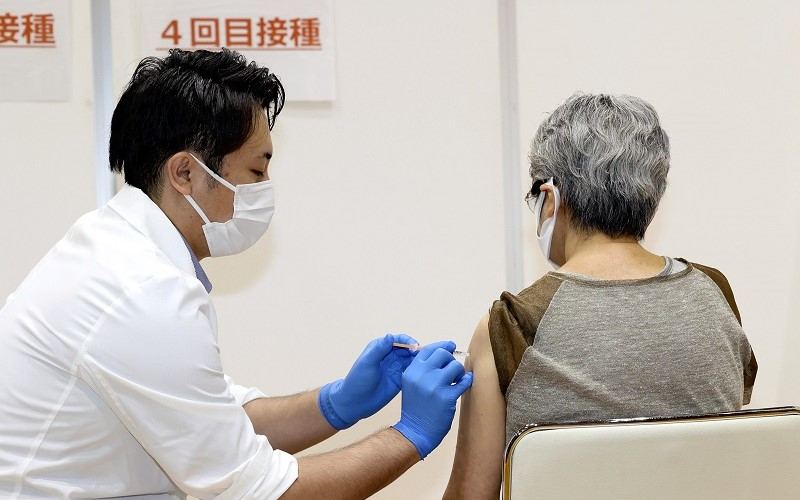
A person receives a fourth dose of COVID vaccine in Minato Ward, Tokyo, in May.
17:15 JST, August 30, 2022
The government is preparing to roll out booster shots of new COVID-19 vaccines that are effective against the omicron variant as early as September, accelerating its initial plan to do so from mid-October.
“We are coordinating with the pharmaceutical companies and are working to start inoculations as soon as possible,” Chief Cabinet Secretary Hirokazu Matsuno said at a press conference Tuesday.
According to the announcement by Health, Labor and Welfare Minister Katsunobu Kato on the day, the booster rollout is intended for people aged 18 or older who have received at least two doses of COVID vaccine.
The official decision will be made after deliberations by an expert panel and approval of the new vaccines by the health ministry. The government plans to provide the booster shots for free.
Aiming to prevent people from developing serious symptoms, the government’s current rollout of fourth doses is limited to people aged 60 or older and those aged 18 or older with underlying medical conditions.
Eligibility for booster shots will be significantly expanded with the new vaccines, as the upcoming rollout targets everyone aged 18 or older who has had at least two doses already.
The new vaccines are “bivalent vaccines.” They combine elements of the current vaccines, which are based on the original novel coronavirus that was first detected in Wuhan, China, with elements that target the omicron variant’s BA.1 strain, which was prevalent in the early stages of the omicron variant’s spread.
“They’re expected to help prevent infection and the onset of symptoms, including among the generations who are actively working,” an expert said about the new vaccines.
U.S. pharmaceutical companies Pfizer Inc. and Moderna, Inc. have each applied for approval from the health ministry. The government plans to start importing the vaccines in September, as soon as they are approved, and promptly establish a framework for the rollout.
Since the new vaccines are expected to have a certain level of efficacy against BA.5, which is the currently dominant subvariant of the omicron variant, the government has prioritized using these vaccines, which are readily available.
Both companies recently submitted applications to the U.S. Food and Drug Administration requesting authorization for emergency use of their bivalent COVID vaccines, which are also adapted for omicron BA.5 strain.
According to the Cabinet Secretariat, the vaccination rate for the first two doses was high at 81.1% as of Sunday, but dropped to 64.3% for the third dose. For the fourth dose, with limited target, the rate was 53.6% for people aged 60 or older.





Most Read
Popular articles in the past 24 hours
-

Strait of Hormuz Closure Shakes Markets; Prolonged Closure Could ...
-

Iran Situation: Japan Must Exert Diplomatic Efforts without Merel...
-
Measles Patient Visited Hospital in Bunkyo Ward, Tokyo, Metropoli...
-

Milano Cortina 2026: Japanese Figure Skater Miura Returns to Home...
-

Takayama Among World's Top 10 Most Welcoming Cities for 2026; 2nd...
-
2 of Japan's Opposition Parties Submit Bill to Revise Political F...
-
Chiba Police to Arrest Japanese National in Midair; Man Accused o...
-
Former Nomura Securities Employee Given 18-year Prison Sentence f...
Popular articles in the past week
-
Milano Cortina 2026: Japanese Gold Medalist Figure Skater Miura S...
-
Tokyo Spends Big on Children, Wins Over Parents
-

Japan’s Miura, Kihara Announce Withdrawal from Figure Skating Wor...
-

Yokohama to Test Out Renewable-Powered Offshore Floating Data Cen...
-

BOJ Keeping Eye on Economy and Takaichi's ‘Proactive Fiscal Polic...
-
Tokyo Measles Patient Traveled to Fukuoka Aboard JAL Planes; Susp...
-
Japan’s Takaichi Speaks on New U.S. Tariff in Upper House, Says P...
-
Nidec Chairman Resigns Amid Accounting Scandal at Major Japanese ...
Popular articles in the past month
-

Producer Behind Pop Group XG Arrested for Cocaine Possession
-

Japan PM Takaichi’s Cabinet Resigns en Masse
-

Man Infected with Measles Reportedly Dined at Restaurant in Tokyo...
-

Israeli Ambassador to Japan Speaks about Japan’s Role in the Reco...
-

Videos Plagiarized, Reposted with False Subtitles Claiming ‘Ryuky...
-

Prudential Life Insurance Plans to Fully Compensate for Damages C...
-

Woman with Measles Visited Hospital in Tokyo Multiple Times Befor...
-

iPS Treatments Pass Key Milestone, but Broader Applications Far f...
Top Articles in Society
-
Producer Behind Pop Group XG Arrested for Cocaine Possession
-
Man Infected with Measles Reportedly Dined at Restaurant in Tokyo Station
-
Woman with Measles Visited Hospital in Tokyo Multiple Times Before Being Diagnosed with Disease
-

Bus Carrying 40 Passengers Catches Fire on Chuo Expressway; All Evacuate Safely
-

Tokyo Skytree’s Elevator Stops, Trapping 20 People; All Rescued (Update 1)
JN ACCESS RANKING
-
Producer Behind Pop Group XG Arrested for Cocaine Possession
-
Japan PM Takaichi’s Cabinet Resigns en Masse
-
Man Infected with Measles Reportedly Dined at Restaurant in Tokyo Station
-
Israeli Ambassador to Japan Speaks about Japan’s Role in the Reconstruction of Gaza
-
Videos Plagiarized, Reposted with False Subtitles Claiming ‘Ryukyu Belongs to China’; Anti-China False Information Also Posted in Japan