
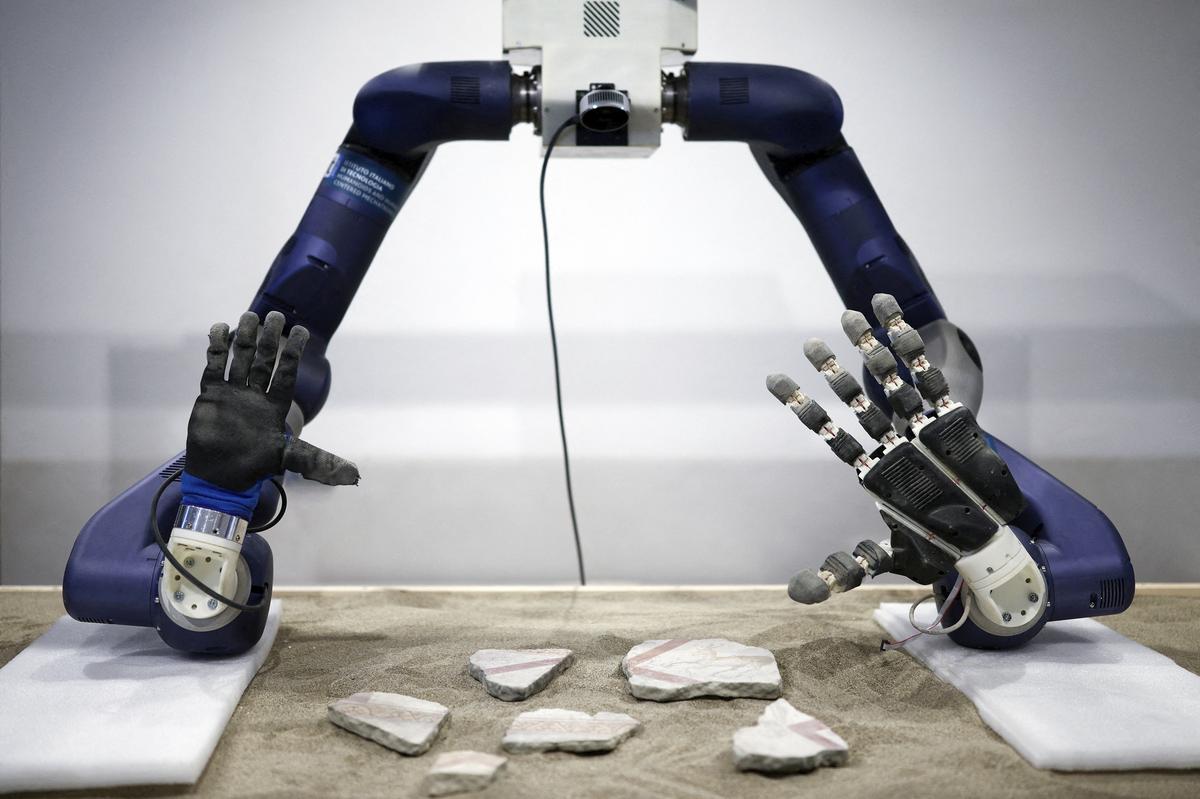
A robotic system that will support archaeologists is tested.
11:40 JST, December 20, 2025
POMPEII, Italy (Reuters) — Pompeii’s ancient Roman frescoes, shattered and buried for centuries, could get a second life thanks to a pioneering robotic system designed to support archaeologists in one of their most painstaking tasks: reassembling fragmented artefacts. The technology, developed under an EU-funded project called RePAIR, combines advanced image recognition, AI-driven puzzle-solving and ultra-precise robotic hands to accelerate traditionally slow and often frustrating restoration work.
Launched in 2021 and coordinated by Venice’s Ca’ Foscari University, the robotic project showcased in Pompeii on Nov. 27 brought together international research teams that have used the archaeological site as their testing ground.
The experimental project “actually started from a very concrete necessity to recompose fragments of frescoes that had been destroyed during the Second World War,” said the site’s director Gabriel Zuchtriegel.
Researchers believe the technology could transform restoration practices worldwide.
The robot uses twin arms equipped with flexible hands in two sizes and vision sensors to identify, grip and assemble fragments without damaging their delicate surfaces.
The once-thriving city of Pompeii, near Naples, and its surrounding countryside were submerged by volcanic ash when Mount Vesuvius exploded in A.D. 79.
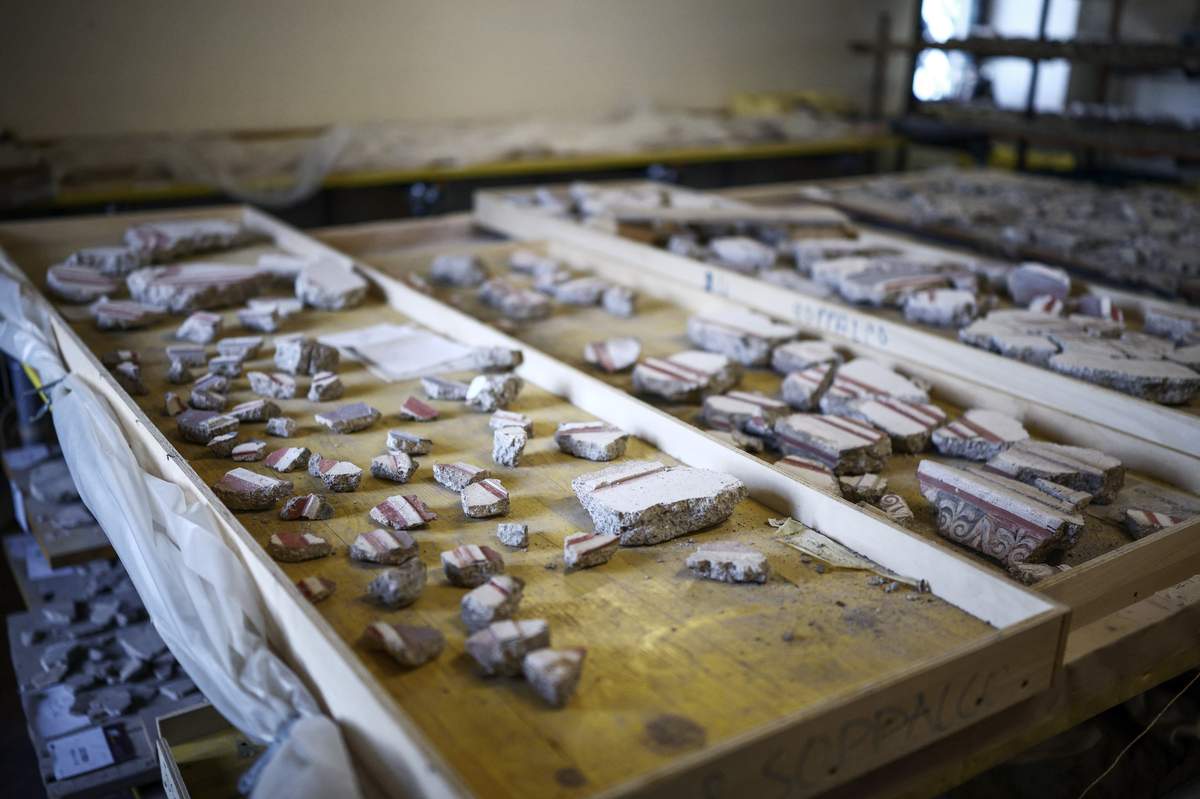
Archaeological finds are seen at the site.
Researchers focused on frescoes preserved in a fragmentary state in Pompeii’s storerooms — two large ceiling paintings which were damaged during the initial eruption and later shattered by bombing in World War II, and frescoes from the so-called “House of the Gladiators” which collapsed in 2010.
Replicas were created during this initial testing phase to avoid risking the original pieces.
While the robotics teams worked on designing and building the system, experts in artificial intelligence and machine learning developed algorithms to reconstruct the frescoes, matching colors and patterns that may not be visible to the human eye. Experts say the task is similar to solving a giant jigsaw puzzle, with extra difficulties such as missing pieces and no reference image of the final result.
“It’s like you buy four or five boxes of jigsaw puzzles. You mix everything together, then you throw away the boxes and try to solve four or five puzzles at the same time,” said Marcello Pelillo, the Venice university professor who coordinated the project.






Most Read
Popular articles in the past 24 hours
-

Ransomware Attacks Hitting Japan's Small, Midsize Firms
-

German Journalist Traces Footsteps of Great-Grandfather Who Was P...
-

10 Foreign Tourists Sustain Injuries After Fire at Capsule Hotel ...
-

World Baseball Classic: Venezuela Beats Japan in Nail-biting Back...
-

Rapid Services on JR Chuo Line Suspended; Accident at Kokubunji S...
-

Rapid Services Resume on JR Chuo Line; Suspension Caused by Accid...
-

World Baseball Classic: Red Sox’s Abreu Hits 3-run Homer, Giving ...
-

World Baseball Classic: Venezuela Beats Japan in Back-and-Forth Q...
Popular articles in the past week
-

Japan Figure Skating Legend Yuzuru Hanyu Is Proud Disaster Surviv...
-
15 Measles Patients Confirmed in Tokyo in Past 6 Days; 1 May Have...
-
Massive Sewer Pipe Found Jutting Out of Highway in Osaka
-

Japan Govt to Tighten Requirements to Receive Permanent Residency...
-
Power Outage Forces About 980 Passengers in Yokohama to Walk to T...
-
JR Tokai Breaks Ground on Yamanashi Maglev Station; Will Be Part ...
-

Parents in Japan to Get Instagram Notifications When Teens Repeat...
-

Imperial Family Watches World Baseball Classic Game Against Austr...
Popular articles in the past month
-

Producer Behind Pop Group XG Arrested for Cocaine Possession
-

Japan PM Takaichi’s Cabinet Resigns en Masse
-

Man Infected with Measles Reportedly Dined at Restaurant in Tokyo...
-
Japan Figure Skating Legend Yuzuru Hanyu Is Proud Disaster Surviv...
-

iPS Treatments Pass Key Milestone, but Broader Applications Far f...
-

Sanae Takaichi Elected Prime Minister of Japan; Keeps All Cabinet...
-

South Korea Tightens Rules on Foreigners Buying Homes in Seoul Me...
-

Nepal Bus Crash Kills 19 People, Injures 25 Including One Japanes...
Top Articles in Science & Nature
-
iPS Treatments Pass Key Milestone, but Broader Applications Far from Guaranteed
-
Record 700 Startups to Gather at SusHi Tech Tokyo in April; Event Will Center on Themes Like Artificial Intelligence and Robotics
-
Parents in Japan to Get Instagram Notifications When Teens Repeatedly Search for Suicide Content
-
iPS Cell Products for Parkinson’s, Heart Disease OK’d for Commercialization by Japan Health Ministry Panel
-

Japan to Ban Use of Power Banks on Airplanes
JN ACCESS RANKING
-
Producer Behind Pop Group XG Arrested for Cocaine Possession
-
Japan PM Takaichi’s Cabinet Resigns en Masse
-
Man Infected with Measles Reportedly Dined at Restaurant in Tokyo Station
-
Japan Figure Skating Legend Yuzuru Hanyu Is Proud Disaster Survivor and Gold Medalist, Vows to Continue Support Efforts
-
iPS Treatments Pass Key Milestone, but Broader Applications Far from Guaranteed