
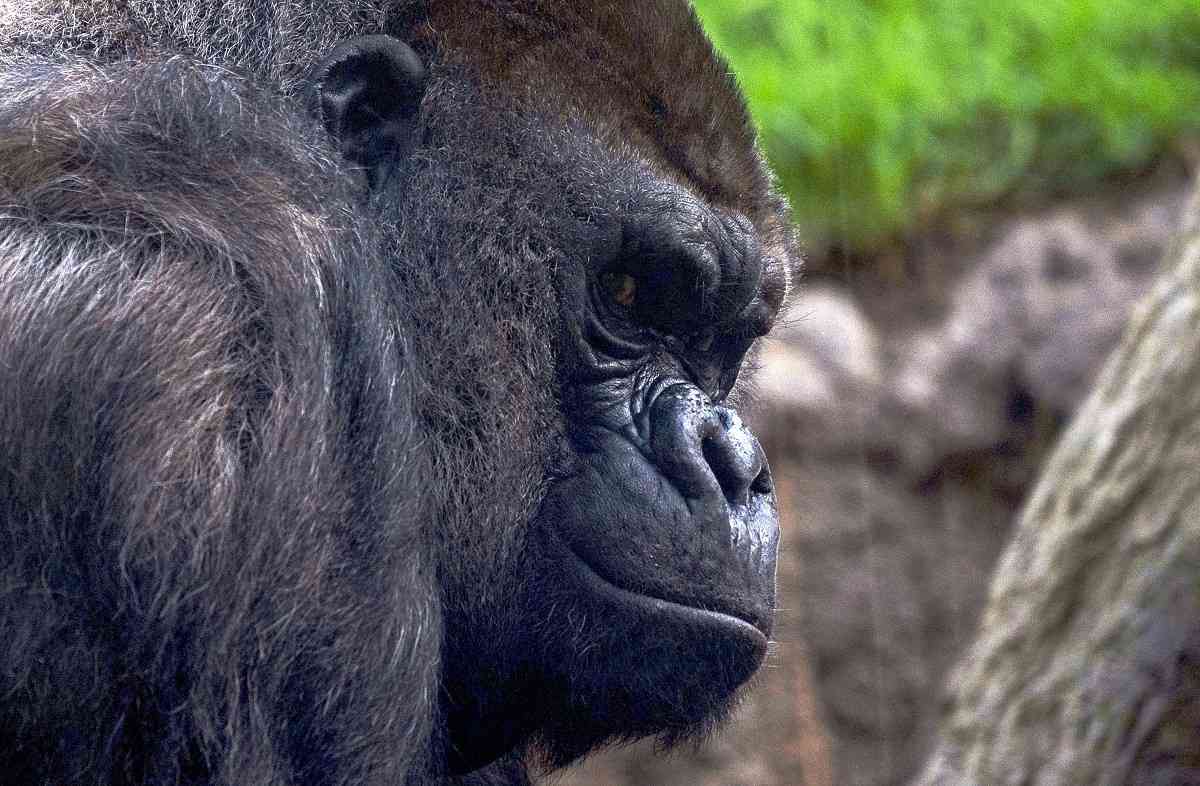
A gorilla is seen in its enclosure in Valencia’s Bioparc, in Spain, on Oct. 13.
12:29 JST, November 28, 2024
VILLENA, Spain (AFP-Jiji) — For decades Achille, 50, eked out a miserable existence living alone in wretched conditions in a cramped circus cage.
But better days could lie ahead for the chimpanzee and almost 150 great apes in Spain who stand to benefit from a pioneering bill that would strengthen laws safeguarding their well-being.
Animal rights activists hope the draft legislation will drive the debate on apes’ legal status — in Spain and beyond.
“Apes are like us, they are sociable animals,” said Olga Bellon, a primate expert at the Primadomus foundation that took in Achille.
Putting them through the treatment Achille suffered “is inhumane,” she told AFP.
The initiative could “change our perception” of the mammals, who are genetically very close to humans, and better appreciate their needs, added Bellon.
Spain’s left-wing government took a first step toward legislating on animal welfare last year with a law that increased prison sentences for mistreatment.
Now it is going further, with the pioneering draft law launched in July aiming to eradicate practices harming “the life, physical integrity, dignity and survival of great apes.”
Almost 150 primates including gorillas, orangutans and chimpanzees could benefit from the draft law, according to associations.
‘Non-human people’
The Primadomus shelter, located near the Mediterranean city of Alicante in eastern Spain and founded in 2009 by Dutch association Animal Advocacy and Protection (AAP), hosts around 60 primates.
Like Achille, they are taken from individuals or circuses and sometimes arrive traumatized or with behavioral disorders.
Great apes suffer stress and depression and can self-harm as humans do, explained Bellon. “Here, we want them to recover and feel well.”
Behind her, four chimpanzees frolicked in the trees and bushes, hunting for chickpeas lying scattered on the ground.
Lots of patience — sometimes years — is necessary before they recover their instincts, said Bellon.
Science shows that the animals are closer to humans than was thought and that justifies “a specific treatment,” said Jose Ramon Becerra, a senior civil servant coordinating the new initiative.
The bill could shift the terms of the debate on their legal status, “even beyond Spain,” Becerra told AFP.
Some schemes have been launched in recent years. In Argentina, a female orangutan and a chimpanzee were recognized as “non-human people” and authorities demanded their removal from cramped enclosures.
However, no country has granted this status to all great apes, said Pedro Pozas, executive director in Spain of the “Great Apes Project,” an international movement campaigning for the species’ basic rights.
Debate ‘moving forward’
In 2008, the Spanish parliament voted a resolution calling for the matter to be studied.
But with the country in the throes of a painful financial crisis, MPs never followed it up, and some were revolted at the idea of elevating primates to the same level as humans.
Becerra is convinced this time will be different because society is “more mature” and social sensibilities have changed.
In a sign of the great expectations, the social rights ministry Becerra belongs to has collected more than 300 contributions after consultations with experts and associations, a first step in the legislative process.
Among them are proposals to guarantee better living conditions in enclosures, banning the use of primates in films and shows or banning the separation of mothers from their children.
Others like the Jane Goodall Institute and the Great Apes Project want to go further by outlawing their reproduction in captivity, with a long-term objective of removing all great primates from zoos, said Rozas.
For Marta Merchan, public policy lead at AAP in Spain, great apes must live in their natural habitat with their species.
Although the goal of taking them out of zoos is a long way off, “what matters is that the debate moves forward,” she said.
The new bill is a “first step” that will “help raise awareness,” benefiting great apes and potentially all animals, Merchan added.








Most Read
Popular articles in the past 24 hours
-

Ransomware Attacks Hitting Japan's Small, Midsize Firms
-

German Journalist Traces Footsteps of Great-Grandfather Who Was P...
-

10 Foreign Tourists Sustain Injuries After Fire at Capsule Hotel ...
-

World Baseball Classic: Venezuela Beats Japan in Nail-biting Back...
-

Rapid Services on JR Chuo Line Suspended; Accident at Kokubunji S...
-

Rapid Services Resume on JR Chuo Line; Suspension Caused by Accid...
-

World Baseball Classic: Venezuela Beats Japan in Back-and-Forth Q...
-

World Baseball Classic: Red Sox’s Abreu Hits 3-run Homer, Giving ...
Popular articles in the past week
-

Japan Figure Skating Legend Yuzuru Hanyu Is Proud Disaster Surviv...
-
15 Measles Patients Confirmed in Tokyo in Past 6 Days; 1 May Have...
-

Massive Sewer Pipe Found Jutting Out of Highway in Osaka
-

Japan Govt to Tighten Requirements to Receive Permanent Residency...
-

Power Outage Forces About 980 Passengers in Yokohama to Walk to T...
-

JR Tokai Breaks Ground on Yamanashi Maglev Station; Will Be Part ...
-

Parents in Japan to Get Instagram Notifications When Teens Repeat...
-

'World's Oldest Bio-Business' Is Japan's Seed Koji Retailing, Mol...
Popular articles in the past month
-

Producer Behind Pop Group XG Arrested for Cocaine Possession
-

Japan PM Takaichi’s Cabinet Resigns en Masse
-

Man Infected with Measles Reportedly Dined at Restaurant in Tokyo...
-
Japan Figure Skating Legend Yuzuru Hanyu Is Proud Disaster Surviv...
-

iPS Treatments Pass Key Milestone, but Broader Applications Far f...
-

Sanae Takaichi Elected Prime Minister of Japan; Keeps All Cabinet...
-

South Korea Tightens Rules on Foreigners Buying Homes in Seoul Me...
-

Nepal Bus Crash Kills 19 People, Injures 25 Including One Japanes...
Top Articles in Science & Nature
-
iPS Treatments Pass Key Milestone, but Broader Applications Far from Guaranteed
-

Record 700 Startups to Gather at SusHi Tech Tokyo in April; Event Will Center on Themes Like Artificial Intelligence and Robotics
-
Parents in Japan to Get Instagram Notifications When Teens Repeatedly Search for Suicide Content
-

iPS Cell Products for Parkinson’s, Heart Disease OK’d for Commercialization by Japan Health Ministry Panel
-

Japan to Ban Use of Power Banks on Airplanes
JN ACCESS RANKING
-
Producer Behind Pop Group XG Arrested for Cocaine Possession
-
Japan PM Takaichi’s Cabinet Resigns en Masse
-
Man Infected with Measles Reportedly Dined at Restaurant in Tokyo Station
-
Japan Figure Skating Legend Yuzuru Hanyu Is Proud Disaster Survivor and Gold Medalist, Vows to Continue Support Efforts
-
iPS Treatments Pass Key Milestone, but Broader Applications Far from Guaranteed