
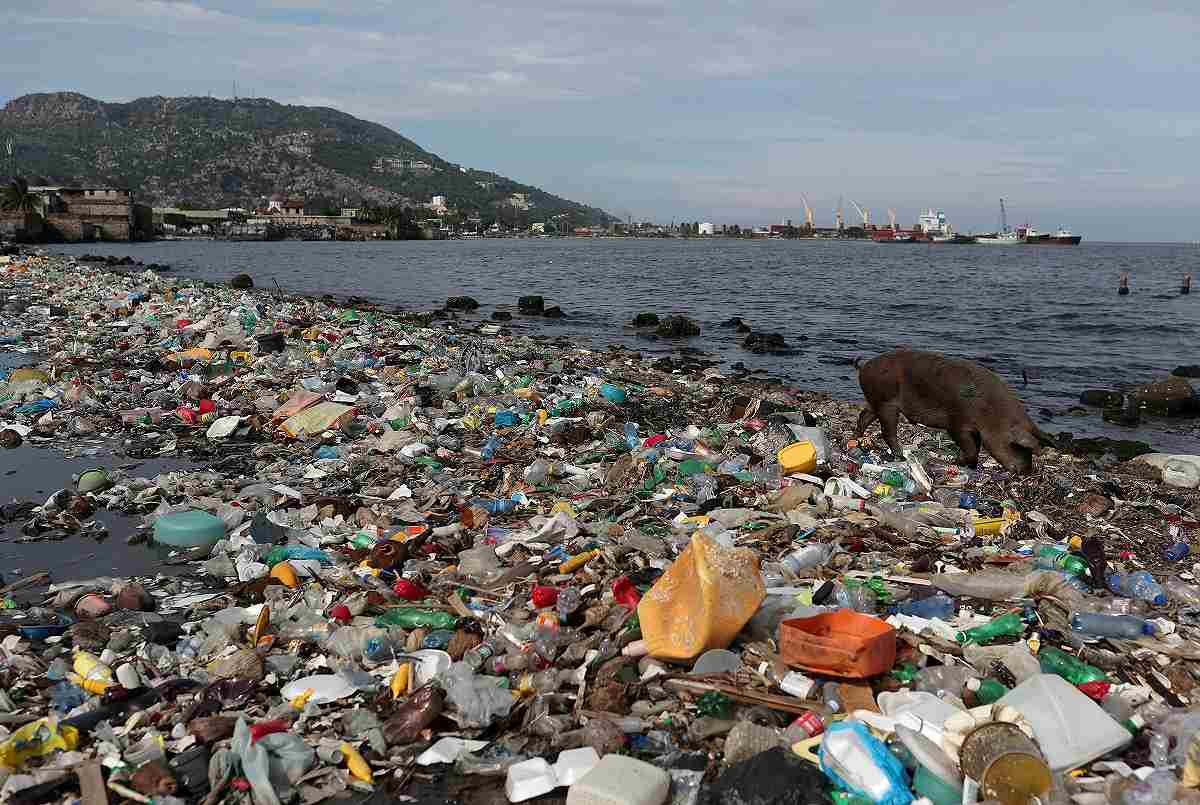
Plastic and other kinds of debris are seen on the shores of Cap Haitian Beach, Haiti, in October 2018.
16:17 JST, March 16, 2023
SINGAPORE (Reuters) — Plastics entering the world’s oceans have surged by an “unprecedented” amount since 2005 and could nearly triple by 2040 if no further action is taken, according to research published on March 8.
An estimated 171 trillion plastic particles were afloat in the oceans by 2019, according to peer-reviewed research led by the 5 Gyres Institute, a U.S. organization that campaigns to reduce plastic pollution.
Marine plastic pollution could rise 160% by 2040 if legally binding global policies are not introduced, it predicted.
The study looked at surface-level plastic pollution data from 11,777 ocean stations in six major marine regions covering the period from 1979 to 2019.
“We’ve found an alarming trend of exponential growth in microplastics in the global ocean since the millennium,” Marcus Eriksen, cofounder of the 5 Gyres Group said in a statement.
“We need a strong legally binding U.N. global treaty on plastic pollution that stops the problem at the source,” he added.
Microplastics are particularly hazardous to the oceans, not only contaminating water but also damaging the internal organs of marine animals, which mistake the plastic for food.
Experts said the study showed that the level of marine plastic pollution in the oceans has been underestimated.
“The numbers in this new research are staggeringly phenomenal and almost beyond comprehension,” said Paul Harvey, a scientist and plastics expert with Environmental Science Solutions, an Australian consultancy focused on pollution reduction.
The United Nations kicked off negotiations on an agreement to tackle plastic pollution in Uruguay in November, with the aim of drawing up a legally binding treaty by the end of next year.
Environmental group Greenpeace said that without a strong global treaty, plastic production could double within the next 10 to 15 years, and triple by 2050.
A separate international treaty was agreed on March 5 to help protect biodiversity in the world’s high seas.









Most Read
Popular articles in the past 24 hours
-
Japan's Budget on Track for Quick Passage, but Ruling Parties to ...
-

Japan-Based USS Tripoli, Marine Unit to Be Sent to Middle East, U...
-

Ransomware Attacks Hitting Japan's Small, Midsize Firms
-

7 Men Arrested Over Robbery of ¥423 Mil. on Tokyo Street; Members...
-

North Korea Fires about 10 Missiles toward Sea in Show of Force, ...
-

Milano Cortina 2026: Japan’s Daichi Oguri Wins Silver in Pa...
-

German Journalist Traces Footsteps of Great-Grandfather Who Was P...
-

Hiroshima: Yamato Museum to Reopen on April 23 after Major Renova...
Popular articles in the past week
-

Japan Figure Skating Legend Yuzuru Hanyu Is Proud Disaster Surviv...
-

Govt to Utilize ODA for Ensuring Economic Security; Securing Ener...
-
15 Measles Patients Confirmed in Tokyo in Past 6 Days; 1 May Have...
-

Massive Sewer Pipe Found Jutting Out of Highway in Osaka
-

Japan Govt to Tighten Requirements to Receive Permanent Residency...
-

Power Outage Forces About 980 Passengers in Yokohama to Walk to T...
-

JR Tokai Breaks Ground on Yamanashi Maglev Station; Will Be Part ...
-

Beckoning Cats Get Makeover to Fit Modern Lifestyles with Sleek D...
Popular articles in the past month
-

Producer Behind Pop Group XG Arrested for Cocaine Possession
-

Japan PM Takaichi’s Cabinet Resigns en Masse
-

Man Infected with Measles Reportedly Dined at Restaurant in Tokyo...
-
Japan Figure Skating Legend Yuzuru Hanyu Is Proud Disaster Surviv...
-

iPS Treatments Pass Key Milestone, but Broader Applications Far f...
-

Sanae Takaichi Elected Prime Minister of Japan; Keeps All Cabinet...
-

South Korea Tightens Rules on Foreigners Buying Homes in Seoul Me...
-

Nepal Bus Crash Kills 19 People, Injures 25 Including One Japanes...
Top Articles in Science & Nature
-
iPS Treatments Pass Key Milestone, but Broader Applications Far from Guaranteed
-

Record 700 Startups to Gather at SusHi Tech Tokyo in April; Event Will Center on Themes Like Artificial Intelligence and Robotics
-

Parents in Japan to Get Instagram Notifications When Teens Repeatedly Search for Suicide Content
-
iPS Cell Products for Parkinson’s, Heart Disease OK’d for Commercialization by Japan Health Ministry Panel
-

Japan to Ban Use of Power Banks on Airplanes
JN ACCESS RANKING
-
Producer Behind Pop Group XG Arrested for Cocaine Possession
-
Japan PM Takaichi’s Cabinet Resigns en Masse
-
Man Infected with Measles Reportedly Dined at Restaurant in Tokyo Station
-
Japan Figure Skating Legend Yuzuru Hanyu Is Proud Disaster Survivor and Gold Medalist, Vows to Continue Support Efforts
-
iPS Treatments Pass Key Milestone, but Broader Applications Far from Guaranteed