
Takaichi Cabinet Approval Holds at 72% as Voters Back Aggressive Fiscal Stimulus, Child Benefits
16:20 JST, November 24, 2025
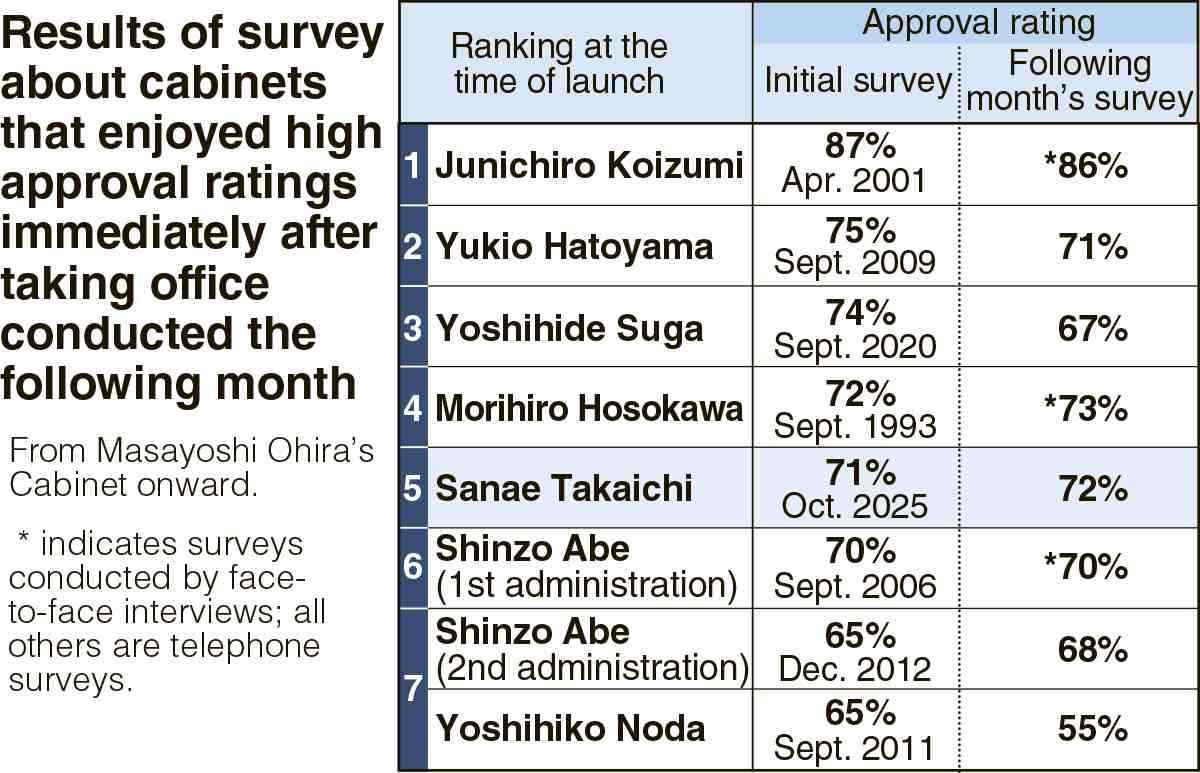
The approval rating for Prime Minister Sanae Takaichi’s Cabinet was essentially unchanged from when it launched, at 72%, according to a nationwide poll conducted by The Yomiuri Shimbun from Friday through Sunday.
The disapproval rating was 17%.
In the previous snap survey on Oct. 21–22, 71% supported the Cabinet, while 18% disapproved.
Since 1978, when Prime Minister Masayoshi Ohira’s Cabinet launched, a handful of administrations that debuted with high approval ratings have managed to see their ratings rise or at least hold steady in the following month’s survey, including Junichiro Koizumi’s Cabinet and Shinzo Abe’s second Cabinet.
The Takaichi Cabinet has now been added to that list.
Seventy-four percent of respondents said they “rate well” the prime minister’s pledge to pursue “responsible, active fiscal policy,” while only 17% said they “do not rate it well.”
Asked about the government’s latest economic package, which includes a one-time ¥20,000 payment per child and subsidies for winter electricity and gas bills, 63% said they evaluate it positively, outpacing the 30% who said they do not.
Regarding a plan to distribute “rice vouchers,” which can be used to purchase rice and related products, 49% expressed support, while 42% were opposed.
The Cabinet’s approval rating appears to be shored up by strong backing for the administration’s economic policies.
56% support stance toward China
On the diplomatic front, 56% said they “rate well” the Takaichi Cabinet’s stance toward China, while 29% said they do not.
As for the October summit meeting with U.S. President Donald Trump, 77% said they rate it well, far outstripping the 16% who said they do not.
Regarding the Cabinet’s policies on foreign residents, 62% said they “have good expectations,” compared with 25% who said they do not.
In contrast, regarding the government’s response to rising prices, only 33% said they rate it well, while 52% said they do not, indicating public dissatisfaction with how inflation is being handled.
On rice production policy, opinion was split over a shift away from the expansionary production line pursued under former Prime Minister Shigeru Ishiba’s Cabinet, with 44% backing the change and 37% opposing it.
In terms of party support, the Liberal Democratic Party stood unchanged at 32%, with Sanseito at 5% (down from 7%), the Constitutional Democratic Party of Japan at 5% (down from 6%), the Democratic Party for the People at 4% (down from 5%), the Japan Innovation Party at 4% (down from 5%) and Komeito unchanged at 4%.
Voters with no party affiliation accounted for 40% (up from 34%).
The survey was conducted on voters aged 18 or older using random digit dialing, a survey method in which landline and mobile phone numbers are generated at random by computer.
A total of 1,054 responses were received. For landlines, 426 people responded from among 682 households confirmed to have eligible voters, and for mobile phones, 628 people responded from among 1,840 people who answered the call. The response rates were 62% for landlines and 34% for mobile phones.
The results were weighted so that proportions by gender, age group and region matched the population structure published by the Internal Affairs and Communications Ministry.





Most Read
Popular articles in the past 24 hours
-

McDonald's Japan Raises Prices; Big Mac to Cost ¥500, Double Chee...
-

Nepal Bus Crash Kills 19 People, Injures 25 Including One Japanes...
-

Japan’s Nikkei Stock Average Rises as AI-Related Stocks Shine; Co...
-

Aggression against Ukraine: Malignant Precedent Must Not Be Set t...
-

Joruri Bunraku Narrative Performed in Honor of Donald Keene by La...
-

Kanto's 1st Spring Wind Blows as Tokyo Sees Unseasonably High Tem...
-

How Keri Russell's Suede Coach Boots Ended up in My Closet
-

Early-Blooming Kawazu Cherry Blossoms Create Sea of Pink at Park ...
Popular articles in the past week
-

Producer Behind Pop Group XG Arrested for Cocaine Possession
-

Japan PM Takaichi’s Cabinet Resigns en Masse
-

Sanae Takaichi Elected Prime Minister of Japan; Keeps All Cabinet...
-

Japan's Govt to Submit Road Map for Growth Strategy in March, PM ...
-

Bus Carrying 40 Passengers Catches Fire on Chuo Expressway; All E...
-

Japan, U.S. Name 3 Inaugural Investment Projects; Reached Agreeme...
-

Riku-Ryu Pair Wins Gold Medal: Their Strong Bond Leads to Major C...
-

iPS Treatments Pass Key Milestone, but Broader Applications Far f...
Popular articles in the past month
-
Producer Behind Pop Group XG Arrested for Cocaine Possession
-
Japan PM Takaichi’s Cabinet Resigns en Masse
-

Japan Institute to Use Domestic Commercial Optical Lattice Clock ...
-

Man Infected with Measles Reportedly Dined at Restaurant in Tokyo...
-

Israeli Ambassador to Japan Speaks about Japan’s Role in the Reco...
-

Videos Plagiarized, Reposted with False Subtitles Claiming ‘Ryuky...
-

Man Infected with Measles May Have Come in Contact with Many Peop...
-

Prudential Life Insurance Plans to Fully Compensate for Damages C...
Top Articles in Politics
-
Japan PM Takaichi’s Cabinet Resigns en Masse
-
Sanae Takaichi Elected Prime Minister of Japan; Keeps All Cabinet Appointees from Previous Term
-
Japan’s Govt to Submit Road Map for Growth Strategy in March, PM Takaichi to Announce in Upcoming Policy Speech
-

LDP Wins Historic Landslide Victory
-

LDP Wins Landslide Victory, Secures Single-party Majority; Ruling Coalition with JIP Poised to Secure Over 300 seats (UPDATE 1)
JN ACCESS RANKING
-
Producer Behind Pop Group XG Arrested for Cocaine Possession
-
Japan PM Takaichi’s Cabinet Resigns en Masse
-
Man Infected with Measles Reportedly Dined at Restaurant in Tokyo Station
-
Israeli Ambassador to Japan Speaks about Japan’s Role in the Reconstruction of Gaza
-
Videos Plagiarized, Reposted with False Subtitles Claiming ‘Ryukyu Belongs to China’; Anti-China False Information Also Posted in Japan