
Takaichi, Trump Make Good Diplomatic Start, Sharing Memories of Abe and Tough Line on Defense
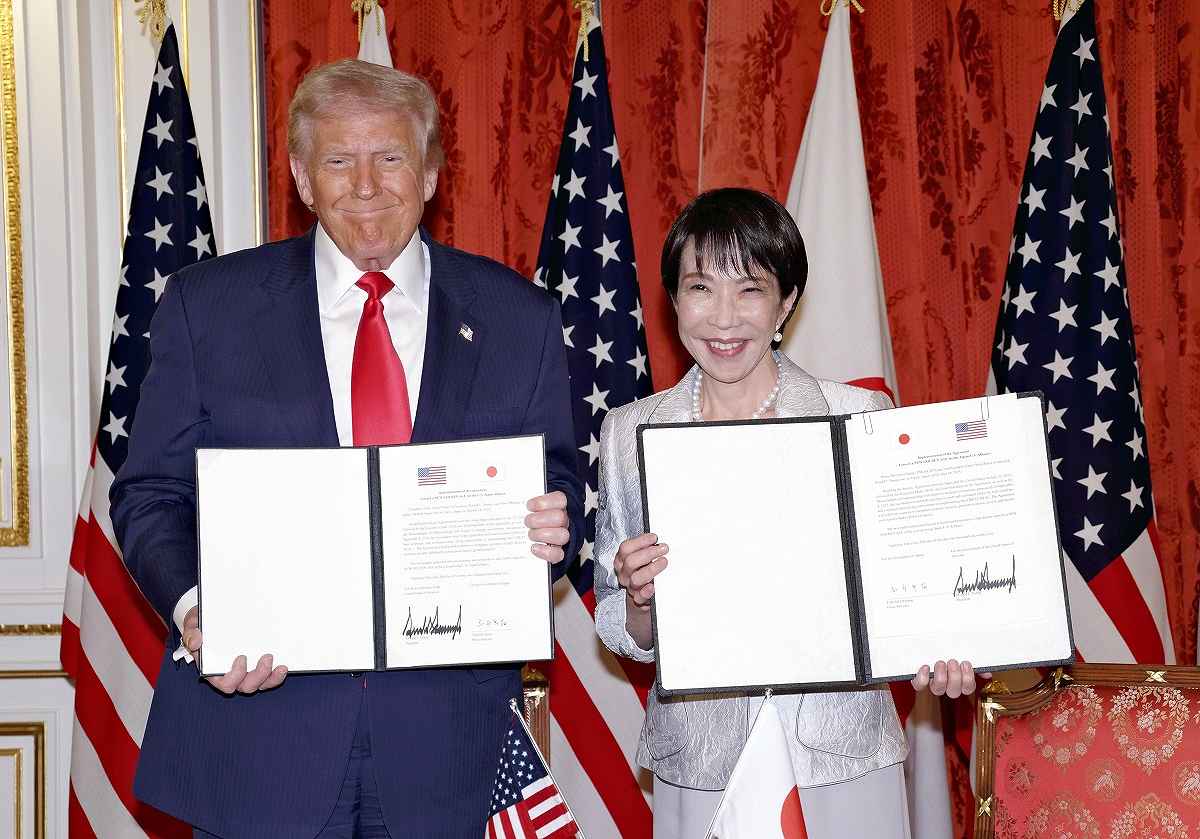
Prime Minister Sanae Takaichi, right, and U.S. President Donald Trump hold up signed documents at the State Guest House, in Minato Ward, Tokyo, on Tuesday.
16:59 JST, October 29, 2025
Prime Minister Sanae Takaichi swiftly closed the distance with U.S. President Donald Trump on Tuesday during their first face-to-face meeting since her inauguration, invoking their mutual political ally, the late former Prime Minister Shinzo Abe.
She achieved a successful debut in Japan-U.S. diplomacy, succeeding in securing Trump’s understanding by demonstrating a proactive stance, including on strengthening defense capabilities.
Thoughtful gift
“Thank you for the long-standing friendship you enjoyed with Prime Minister Abe. As a matter of fact, Mr. Abe often told me about your dynamic diplomacy,” Takaichi said at the start of the meeting, bringing up the topic of Abe, whom she regarded as a political mentor.
Trump still fondly remembers Abe, often affectionately referring to him as “Shinzo” when he speaks about him.
Trump had built a rock-solid personal relationship with Abe, particularly through their so-called “golf diplomacy” during his visits to Japan.
Trump quickly expressed confidence in the new prime minister, responding, “Shinzo Abe was a great friend of mine … He spoke so well of you long before we met.”
In stark contrast to former Prime Minister Shigeru Ishiba, who spent about two months preparing for the Japan-U.S. summit meeting in February, Takaichi met with Trump just one week after taking office.
Recognizing undeniable shortcomings in preparations for the meeting, her core strategy was to impress upon Trump that she was Abe’s “successor” and to close the distance between them.
As a gift, she prepared a golf putter that Abe had personally favored.
A senior government official familiar with the Abe-Trump dynamic advised her, “It is important not to read a script, but to speak in your own words.”
Abe occasionally served as an informal “advisor” to Trump on international affairs, gaining his trust by acting as an intermediary to prevent Trump from becoming isolated at the Group of Seven summit and other gatherings.
After attending a summit with the Association of Southeast Asian Nations, or ASEAN, on Sunday, Takaichi pored over relevant documents on her flight home.
The day before her summit with Trump, she personally rewrote the draft of her opening remarks prepared by officials, stating that she was determined to restore strong Japanese diplomacy to fully protect Japan’s national interests.
Flying on Marine One
Trump also showed consideration for Takaichi in their first meeting.
Trump, who had previously allowed Abe to ride aboard Air Force One during his visit to the United States, arranged for Takaichi to travel on Marine One, the presidential helicopter, to the U.S. Navy’s Yokosuka Base in Kanagawa Prefecture.
It is highly unusual for a foreign leader to ride aboard the presidential helicopter.
During his speech on a stage set up inside the aircraft carrier USS George Washington, Trump introduced Takaichi by saying, “This woman is a winner.”
Putting his arm around her shoulder, he stated, “I have a really great respect for the new and incredible prime minister.” Takaichi responded to the cheers by thrusting her right hand into the air and exclaiming, “Yay!”
“In terms of establishing a relationship, she achieved a perfect 100,” said a source close to Takaichi.
Deterring China
Trump stayed in Tokyo until Wednesday morning.
Japan is a high priority in Trump’s diplomatic strategy, as evidenced by his decision to spend three days in Tokyo during his trip to Asia.
Trump is scheduled to meet with Chinese President Xi Jinping, who is fiercely competing for hegemony, at the APEC summit in South Korea at the end of the month.
The U.S. side made a point of scheduling a visit to Japan immediately prior to the APEC meeting.
Yokosuka is home to the U.S. Navy’s Seventh Fleet, which is responsible for the Indo-Pacific region, where China is intensifying its military presence.
The strengthening of U.S.-Japan defense cooperation directly contributes to U.S. deterrence against China.
According to analysis on U.S. broadcaster CNN, Trump’s favorable treatment of Takaichi was more than just a political performance, and was driven by her long-standing push for increased defense spending, which aligns with Trump’s tough-line stance.


Related Tags
Most Read
Popular articles in the past 24 hours
-
‘Dry Bonsai’ Gives New Life to Withered Trees, Allows Free Artist...
-

McDonald's Japan Raises Prices; Big Mac to Cost ¥500, Double Chee...
-

Nepal Bus Crash Kills 19 People, Injures 25 Including One Japanes...
-

Japan’s Nikkei Stock Average Rises as AI-Related Stocks Shine; Co...
-

Aggression against Ukraine: Malignant Precedent Must Not Be Set t...
-
Joruri Bunraku Narrative Performed in Honor of Donald Keene by La...
-

Astellas Collaborates with Vir to Develop Its Experimental Prosta...
-

Early-Blooming Kawazu Cherry Blossoms Create Sea of Pink at Park ...
Popular articles in the past week
-

Producer Behind Pop Group XG Arrested for Cocaine Possession
-

Japan PM Takaichi’s Cabinet Resigns en Masse
-

Sanae Takaichi Elected Prime Minister of Japan; Keeps All Cabinet...
-
Japan's Govt to Submit Road Map for Growth Strategy in March, PM ...
-
Bus Carrying 40 Passengers Catches Fire on Chuo Expressway; All E...
-
Japan, U.S. Name 3 Inaugural Investment Projects; Reached Agreeme...
-

Riku-Ryu Pair Wins Gold Medal: Their Strong Bond Leads to Major C...
-
Tokyo Skytree's Elevator Stops, Trapping 20 People; All Rescued (...
Popular articles in the past month
-
Producer Behind Pop Group XG Arrested for Cocaine Possession
-
Japan PM Takaichi’s Cabinet Resigns en Masse
-

Japan Institute to Use Domestic Commercial Optical Lattice Clock ...
-

Man Infected with Measles Reportedly Dined at Restaurant in Tokyo...
-

Israeli Ambassador to Japan Speaks about Japan’s Role in the Reco...
-

Videos Plagiarized, Reposted with False Subtitles Claiming ‘Ryuky...
-

Man Infected with Measles May Have Come in Contact with Many Peop...
-

Prudential Life Insurance Plans to Fully Compensate for Damages C...
Top Articles in Politics
-
Japan PM Takaichi’s Cabinet Resigns en Masse
-
Sanae Takaichi Elected Prime Minister of Japan; Keeps All Cabinet Appointees from Previous Term
-
Japan’s Govt to Submit Road Map for Growth Strategy in March, PM Takaichi to Announce in Upcoming Policy Speech
-

LDP Wins Historic Landslide Victory
-

LDP Wins Landslide Victory, Secures Single-party Majority; Ruling Coalition with JIP Poised to Secure Over 300 seats (UPDATE 1)
JN ACCESS RANKING
-
Producer Behind Pop Group XG Arrested for Cocaine Possession
-
Japan PM Takaichi’s Cabinet Resigns en Masse
-
Japan Institute to Use Domestic Commercial Optical Lattice Clock to Set Japan Standard Time
-
Man Infected with Measles Reportedly Dined at Restaurant in Tokyo Station
-
Israeli Ambassador to Japan Speaks about Japan’s Role in the Reconstruction of Gaza