
DPFP Seeks Independent Path, Separate from Major Parties; Leader Tamaki Is Emboldened by Gains in Upper House Election
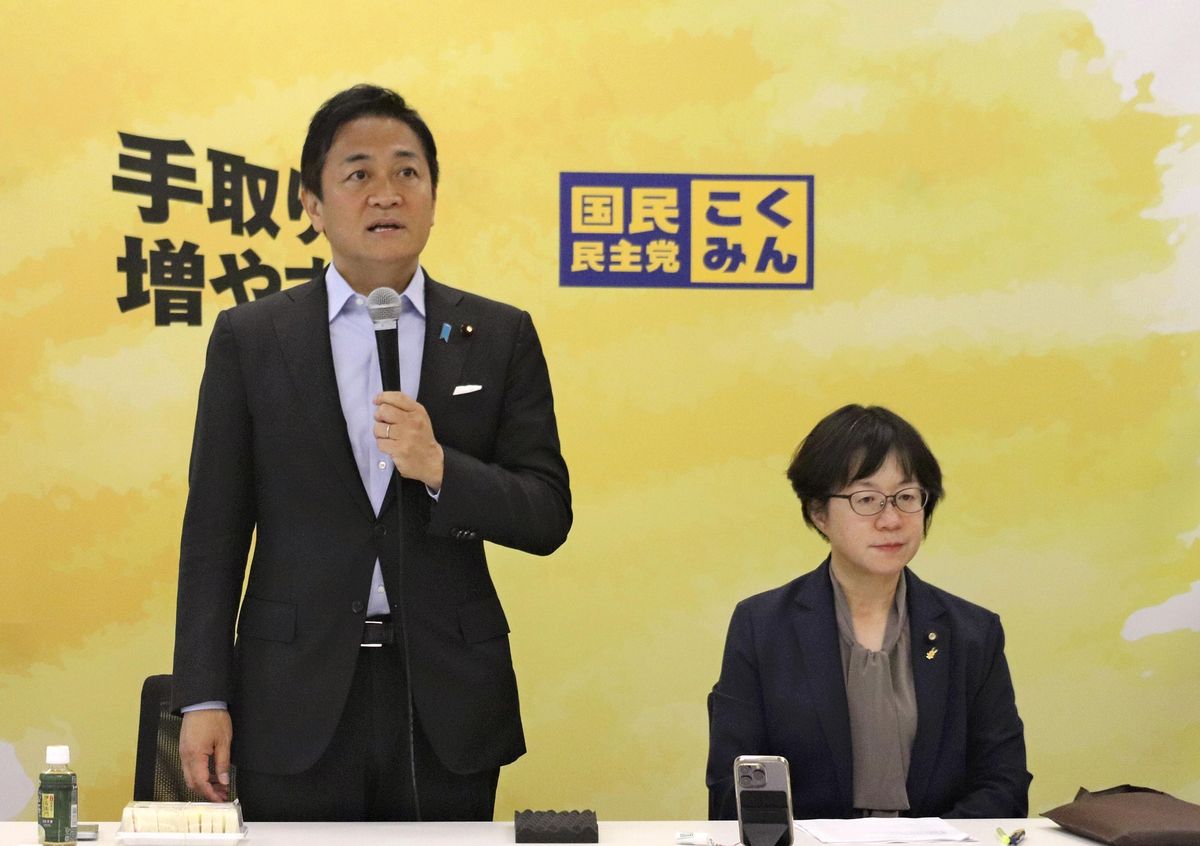
Yuichiro Tamaki speaks at a general meeting of the Democratic Party for the People Diet members of both houses at the Diet Building in Tokyo on Aug. 27.
16:36 JST, September 2, 2025
Yuichiro Tamaki, the leader of the Democratic Party for the People (DPFP), is pursuing an independent course that will keep the party at a distance from both the ruling and opposition parties.
He is taking this approach because his confidence in his approach of negotiating with other parties on a policy-by-policy basis was bolstered by the results of this year’s House of Councillors election, which saw his party significantly increase its seats.
With the ruling bloc now in the minority in both houses of the Diet, creating a parliamentary environment favorable to the opposition, Tamaki’s approach has drawn criticism from other opposition parties for hindering their cooperation efforts.
“The establishment of a two-party system has become nearly impossible. We have entered a multiparty era,” Tamaki said, analyzing the results of the upper house election during remarks delivered in Tokyo on Monday.
In the upper house election, the DPFP secured 17 seats, showing a momentum that is putting them within close range of the main opposition party, the Constitutional Democratic Party of Japan (CDPJ), which won 22 seats.
“We have become a new option, one that is neither the LDP nor the former Democratic Party of Japan,” he said, with obvious pride.
The summary document for the upper house election includes the line, “We must not become overly dependent on labor unions and fail to develop our own strength,” hinting at a growing distance between the DPFP and its supporting organization, the Japanese Trade Union Confederation (Rengo).
At a meeting with local assembly members in late August, Tamaki explained the party’s policy, stating, “We are maintaining an equal distance from all parties.”
Tamaki expressed a negative view of electoral cooperation with the CDPJ. “The notion that joining forces with that party will lead to victory is now just a fantasy,” he said.
Tamaki indicated his desire to collaborate with the Japan Innovation Party to review the “annual income barrier,” the level at which a person’s earnings become subject to income tax. However, when the JIP began to lean toward the Liberal Democratic Party, Tamaki was quick to criticize them, saying, “They brought up the policy of establishing a secondary capital for the sake of a coalition.”
The CDPJ intends to use the abolition of the provisional gasoline tax rate as a litmus test for opposition party collaboration during the extraordinary Diet session to be held in autumn. They will try to find points on which they can compromise with the ruling and other opposition parties, including the Japan Innovation Party.
One concerned JIP executive said, “If the DPFP fails to coordinate its stance, negotiations on the provisional tax rate will stall.”
The DPFP bridged the gap with Komeito, the LDP’s junior coalition partner, by jointly submitting a bill to establish an independent third-party oversight body for political funding during last year’s extraordinary Diet session. Both parties also worked together to compile a proposal to strengthen regulations on corporate and organizational donations.
On the other hand, momentum toward collaboration with the LDP has faded. Since the middle of the regular Diet session for this year, the DPFP has taken a more confrontational stance toward the Cabinet of Prime Minister Shigeru Ishiba.
While Tamaki has explicitly denied that the party would join a coalition under the Ishiba Cabinet, many within the DPFP believe that there would be no benefit to joining a coalition even if Ishiba is replaced with another prime minister.







Most Read
Popular articles in the past 24 hours
-

Tokyo Skytree's Elevator Stops, Trapping 20 People; All Rescued (...
-

China, India Tapping into Promising African Market; Beijing Annou...
-

Milano Cortina 2026: Miura-Kihara Duo, Other Japanese Figure Skat...
-

Japan’s Major Real Estate Firms Expanding Overseas Businesses to ...
-

Reciprocal Tariffs Ruled Illegal: Judiciary Would Not Tolerate Pr...
-
‘Storytellers’ Being Dispatched Overseas to Promote Japan; Events...
-

Fiji Defense Minister Hopes Japan Will Support Stabilization of P...
-

Japan, Pacific Island Nations to Work on Deepening Cooperation
Popular articles in the past week
-

Japan PM Takaichi’s Cabinet Resigns en Masse
-

Man Infected with Measles Reportedly Dined at Restaurant in Tokyo...
-

Sanae Takaichi Elected Prime Minister of Japan; Keeps All Cabinet...
-

Japan's Govt to Submit Road Map for Growth Strategy in March, PM ...
-

Bus Carrying 40 Passengers Catches Fire on Chuo Expressway; All E...
-

Milano Cortina 2026: Figure Skaters Riku Miura, Ryuichi Kihara Pa...
-

Japan, U.S. Name 3 Inaugural Investment Projects; Reached Agreeme...
-

U.S. Firm to Build Training Hub in Fukushima N-plant for Debris R...
Popular articles in the past month
-
Japan PM Takaichi’s Cabinet Resigns en Masse
-

Japan Institute to Use Domestic Commercial Optical Lattice Clock ...
-

Israeli Ambassador to Japan Speaks about Japan’s Role in the Reco...
-
Man Infected with Measles Reportedly Dined at Restaurant in Tokyo...
-

Videos Plagiarized, Reposted with False Subtitles Claiming ‘Ryuky...
-

Man Infected with Measles May Have Come in Contact with Many Peop...
-

Prudential Life Insurance Plans to Fully Compensate for Damages C...
-

Woman with Measles Visited Hospital in Tokyo Multiple Times Befor...
Top Articles in Politics
-
Japan PM Takaichi’s Cabinet Resigns en Masse
-
Sanae Takaichi Elected Prime Minister of Japan; Keeps All Cabinet Appointees from Previous Term
-
Japan’s Govt to Submit Road Map for Growth Strategy in March, PM Takaichi to Announce in Upcoming Policy Speech
-

LDP Wins Historic Landslide Victory
-

LDP Wins Landslide Victory, Secures Single-party Majority; Ruling Coalition with JIP Poised to Secure Over 300 seats (UPDATE 1)
JN ACCESS RANKING
-
Japan PM Takaichi’s Cabinet Resigns en Masse
-
Japan Institute to Use Domestic Commercial Optical Lattice Clock to Set Japan Standard Time
-
Israeli Ambassador to Japan Speaks about Japan’s Role in the Reconstruction of Gaza
-
Man Infected with Measles Reportedly Dined at Restaurant in Tokyo Station
-
Videos Plagiarized, Reposted with False Subtitles Claiming ‘Ryukyu Belongs to China’; Anti-China False Information Also Posted in Japan