
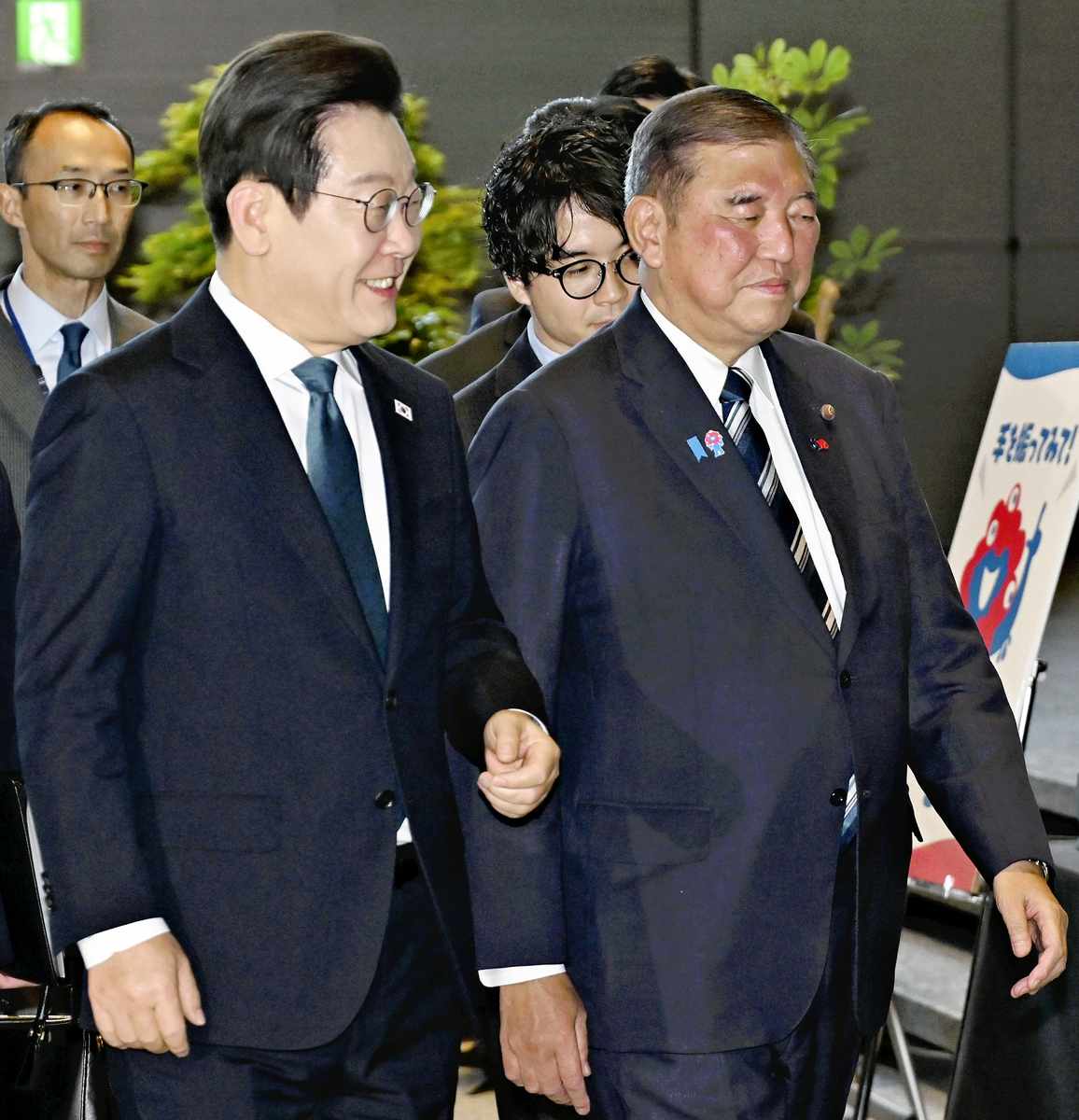
Prime Minister Shigeru Ishiba, right, welcomes South Korean President Lee Jae Myung at the Prime Minister’s Office on Saturday.
20:00 JST, August 24, 2025
A Japan-South Korea agreement released after Saturday’s summit talks reflected a shared understanding between the two countries, with Japan trying to avoid a possible pullback by Seoul’s new administration, and South Korea prioritizing diplomacy with its neighbor to deal with the administration of U.S. President Donald Trump.
Despite differences over historical issues, the two countries aim to show the public concrete results of cooperation at an early stage to stabilize relations.
Prime Minister Shigeru Ishiba welcomed South Korean President Lee Jae Myung on his visit to Japan, Lee’s first since taking office. This year marks the 60th anniversary of the normalization of diplomatic relations.
“I hope this summit will serve as an opportunity to give new impetus to the Japan-South Korea relationship, which marks 60 years [since the normalization of diplomatic ties],” Ishiba said at a joint press conference with Lee following Saturday’s bilateral talks.
Lee responded by saying he hopes that his visit “will mark the beginning of a new path toward building sincere trust between the two countries,” and firmly shook hands with Ishiba.
The left-leaning Lee in the past had called Japan a “hostile state.” His visit to Japan came only three months after the change of government from his conservative predecessor, Yoon Suk Yeol, who rebuilt diplomatic relations with Japan.
The Japanese side was hoping that the talks would help “lay common tracks so that the Lee administration will move forward in the same direction as Japan,” said a senior Japanese government official.
To set the stage, the agreement between the two leaders was put into writing and released as a joint press statement.
Achievement to some extent
Adjustments to the wording in the joint document continued until the day of its release, with the Japanese side strongly stressing the importance of confirming the “foundation” of Japan-South Korea relations by “both leaders.”
The foundation refers to the Agreement on the Settlement of Problems concerning Property and Claims and on Economic Cooperation between the two countries, which was signed at the same time as the normalization of diplomatic relations.
The 1965 agreement settled the issue of claims by wartime requisitioned workers, and laid out Japan’s economic cooperation, but many left-leaning South Koreans question its legitimacy partly because it was concluded under a military regime.
Given that this question of legitimacy has caused multiple disputes over historical issues, the fact that Japan was able to confirm the significance of the agreement with the left-leaning Lee is an achievement for the Japan side to some extent.
In a recent interview with The Yomiuri Shimbun before Saturday’s talks, Lee expressed his intention to uphold existing solutions and agreements on historical issues.
A senior Japanese Foreign Ministry official explained that both Japan and South Korea confirmed in the latest talks that the “foundation” of their ties also includes the agreement on so-called comfort women and the solution for requisitioned workers.
The joint press release also reflected consideration for South Korea. It stressed that the 1998 Japan-Republic of Korea Joint Declaration is part of the historical view upheld by successive Japanese cabinets, with the declaration clearly stating an apology and remorse for Japan’s colonial rule. The declaration is well-received in South Korea.
In 2023, former Prime Minister Fumio Kishida read out the same stance, but by putting it in writing this time, the government took a step forward.
Differing opinions
The two governments hope to continue their cooperation based on the common understanding reached by their leaders and aim to issue a new joint declaration to replace the 1998 statement. To that end, they need to carefully resolve the remaining sources of friction between Japan and South Korea.
This autumn, a memorial service will be held again for laborers at the Sado Island Gold Mines in Sado, Niigata Prefecture, after last year’s ceremony for the World Cultural Heritage site resulted in discord. The South Korean side, which protested that the memorial service for laborers from the Korean Peninsula was insufficient, may once again demand sincere words and actions from Japan based on the historical understanding confirmed in Saturday’s talks.
The press release did not incorporate a “free and open Indo-Pacific” vision aimed at cooperation against China. It is widely believed that this reflects South Korea’s wish to avoid provoking China.
There are also differing opinions on achieving the complete denuclearization of North Korea. South Korea accepts a phased denuclearization while Japan is skeptical.
“Despite differences in stance, Japan-South Korea ties will truly strengthen only by building a relationship of trust with a left-leaning administration,” said a senior Japanese Foreign Ministry official.
With the weakening of his political base, there is also the question of how far Ishiba can engage in summit diplomacy.






Most Read
Popular articles in the past 24 hours
-
Tokyo Skytree's Elevator Stops, Trapping 20 People; All Rescued (...
-

China, India Tapping into Promising African Market; Beijing Annou...
-

Milano Cortina 2026: Miura-Kihara Duo, Other Japanese Figure Skat...
-

Japan’s Major Real Estate Firms Expanding Overseas Businesses to ...
-

Reciprocal Tariffs Ruled Illegal: Judiciary Would Not Tolerate Pr...
-
‘Storytellers’ Being Dispatched Overseas to Promote Japan; Events...
-
Japan, Pacific Island Nations to Work on Deepening Cooperation
-

Space One Delays Launch of No. 3 Kairos Rocket; Company to Announ...
Popular articles in the past week
-

Japan PM Takaichi’s Cabinet Resigns en Masse
-

Man Infected with Measles Reportedly Dined at Restaurant in Tokyo...
-

Sanae Takaichi Elected Prime Minister of Japan; Keeps All Cabinet...
-

Japan's Govt to Submit Road Map for Growth Strategy in March, PM ...
-

Bus Carrying 40 Passengers Catches Fire on Chuo Expressway; All E...
-

Milano Cortina 2026: Figure Skaters Riku Miura, Ryuichi Kihara Pa...
-

Japan, U.S. Name 3 Inaugural Investment Projects; Reached Agreeme...
-
U.S. Firm to Build Training Hub in Fukushima N-plant for Debris R...
Popular articles in the past month
-
Japan PM Takaichi’s Cabinet Resigns en Masse
-

Japan Institute to Use Domestic Commercial Optical Lattice Clock ...
-

Israeli Ambassador to Japan Speaks about Japan’s Role in the Reco...
-
Man Infected with Measles Reportedly Dined at Restaurant in Tokyo...
-

Videos Plagiarized, Reposted with False Subtitles Claiming ‘Ryuky...
-

Man Infected with Measles May Have Come in Contact with Many Peop...
-

Prudential Life Insurance Plans to Fully Compensate for Damages C...
-

Woman with Measles Visited Hospital in Tokyo Multiple Times Befor...
Top Articles in Politics
-
Japan PM Takaichi’s Cabinet Resigns en Masse
-
Sanae Takaichi Elected Prime Minister of Japan; Keeps All Cabinet Appointees from Previous Term
-
Japan’s Govt to Submit Road Map for Growth Strategy in March, PM Takaichi to Announce in Upcoming Policy Speech
-

LDP Wins Historic Landslide Victory
-

LDP Wins Landslide Victory, Secures Single-party Majority; Ruling Coalition with JIP Poised to Secure Over 300 seats (UPDATE 1)
JN ACCESS RANKING
-
Japan PM Takaichi’s Cabinet Resigns en Masse
-
Japan Institute to Use Domestic Commercial Optical Lattice Clock to Set Japan Standard Time
-
Israeli Ambassador to Japan Speaks about Japan’s Role in the Reconstruction of Gaza
-
Man Infected with Measles Reportedly Dined at Restaurant in Tokyo Station
-
Videos Plagiarized, Reposted with False Subtitles Claiming ‘Ryukyu Belongs to China’; Anti-China False Information Also Posted in Japan