
PM Takaichi Leans Toward Cutting Consumption Tax on Food; LDP Members Cautious About Going Through with Tax Cut
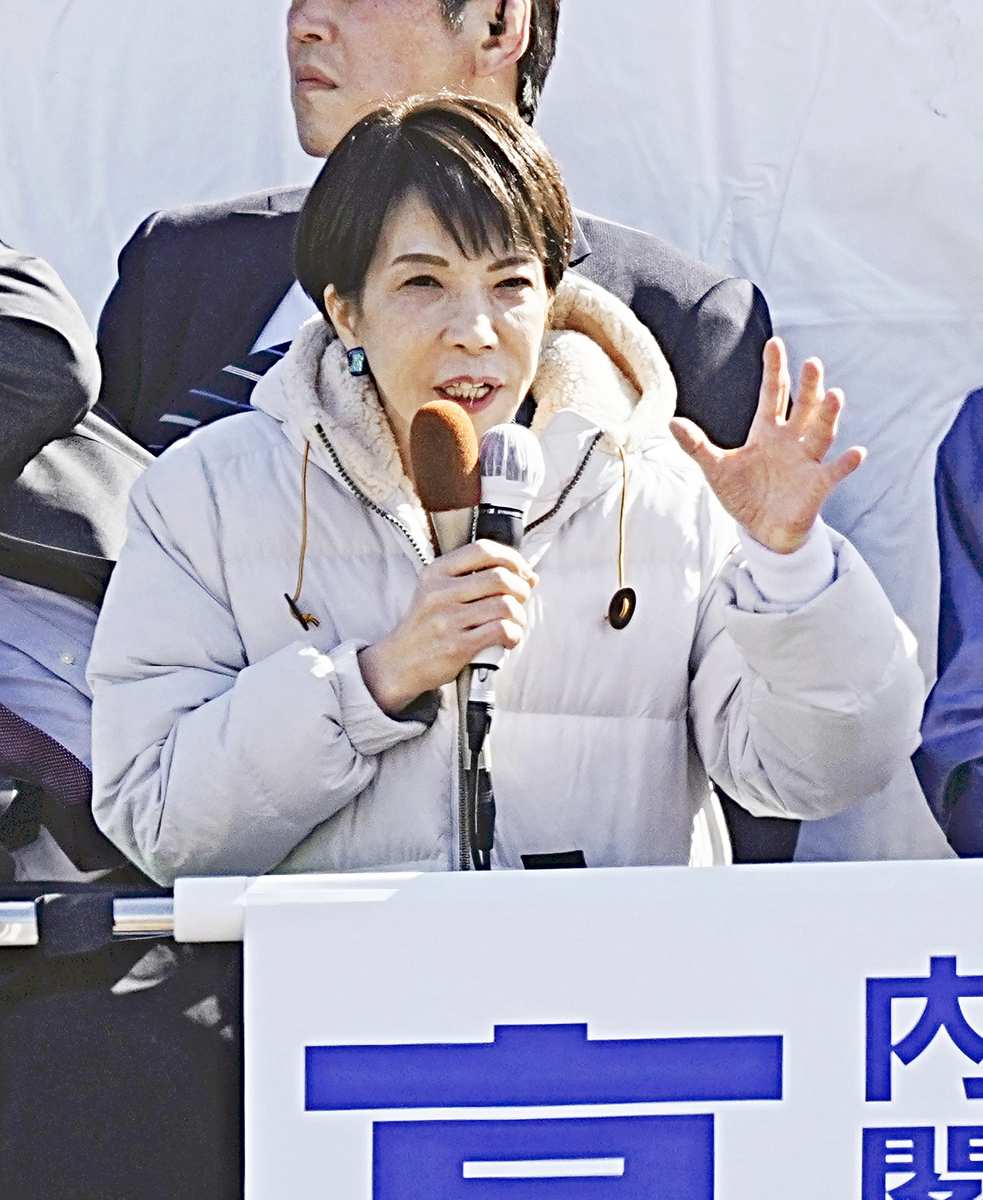
Prime Minister Sanae Takaichi makes an election campaign speech in Oita on Friday.
17:21 JST, January 31, 2026
The ruling Liberal Democratic Party and other major parties have been proposing consumption tax cuts during campaigning for the House of Representatives election.
The LDP has potential to secure a single-party majority in the lower house, according to a Yomiuri Shimbun survey conducted at the initial stages of the campaign. Meanwhile, there are concerns within the government and ruling party over Prime Minister Sanae Takaichi’s positive stance toward temporarily reducing the consumption tax on food to zero. Uncertainty remains over how such a system should be framed and if adequate financing can be secured.
“The fiscal policy [taken by the government] until now has been excessively austere,” Takaichi said during a speech in Oita on Friday. “I wanted to change that.”
During the speech, which lasted over 20 minutes, the prime minister repeatedly called on voters to support her signature “responsible and proactive public finances.”
However, Takaichi, who is also the LDP president, did not explain how she would fulfill her party’s campaign pledge to “accelerate the discussion” on reducing the consumption tax on food to zero, a measure which would be limited to two years.
During a party leaders’ debate on Jan. 26, the day before the election campaigning was officially kicked off, Takaichi asserted that she would aim to implement the tax cut “within fiscal 2026.”
However, since the election campaigning began, she has made no mentioned of the tax cut.
After the debate, a senior LDP member reportedly made it clear to her that she “should refrain from making any in-depth remarks [about the tax cut] from now on.”
Takaichi herself is “concerned about the effect on markets, such as a weaker yen,” according to a senior official at the Prime Minister’s Office.
The LDP included the wording “accelerate the discussion” in its campaign pledge, mostly as an “election tactic to neutralize” opposition parties’ campaign stances in favor of consumption tax cuts, according to an aide to the prime minister.
Within the party, senior members such as Vice President Taro Aso and Secretary General Shunichi Suzuki, both former finance ministers, have strongly voiced caution over the tax cut. The result has been an agreement to suspend judgment on the issue until it has been discussed at a national council, a suprapartisan group of Diet members to be created after the lower house election.
After that, however, Takaichi specified the timing for implementation, triggering a backlash within the LDP.
“She’s leaning too much toward cutting the tax, even though there has been no discussion whatsoever within the party,” one member said.
On Friday, a senior official at the Prime Minister’s Office emphasized that the tax cut could only be realized if a consensus were reached at the national council. “It will entirely depend on future discussions,” the official said, apparently to calm the situation.
At the national council, Takaichi intends to discuss the consumption tax cut alongside a “tax credit with cash payments” system, which would combine tax reductions with cash benefits, in the hope of finding a point of agreement with opposition parties.
However, each party has different policies on the tax cut, with the Centrist Reform Alliance, for instance, advocating for the consumption tax on food to be permanently scrapped. A consensus, therefore, will not be easy to reach.
Nevertheless, many believe that the prime minister is highly likely to hasten relevant discussions if the LDP is successful in the lower house election, based on the reasoning that such an outcome would mean the Japanese public is behind a consumption tax cut.
The prime minister has advocated for reducing the consumption tax on food items to zero since before she took office, describing it as a “long-held wish” at the press conference, in which she announced the lower house dissolution.
A source close to Takaichi said, “There’s no going back now for the prime minister.”
If the tax cut were to be implemented within fiscal 2026, the two-year period would expire in fiscal 2028. A House of Councillors election is also scheduled for that summer.
A senior government official, expressing apprehension toward the tax cut, said: “Even if it is limited to two years, once the tax is lowered to 0%, returning it to 8% would mean a massive tax hike. Politically, it won’t be easy to reverse.”


Related Tags



Most Read
Popular articles in the past 24 hours
-
Japan Govt to Tighten Requirements to Receive Permanent Residency...
-
‘King Kazu’ Discusses His Connection to Fukushima
-
JR Tokai Breaks Ground on Yamanashi Maglev Station; Will Be Part ...
-

Medical Care at Home and Disasters: Ensure Systems to Provide Con...
-

Metal Pipe That Protruded 13 Meters Above Ground in Osaka Sinks B...
-

White House Takes First Step toward Permanent Fix for Illegal Tar...
-
Japan to Extend Drone No-fly Zones Near Key Facilities to 1 km
-
The Japan News / Weekly Edition (3/13-3/19)
Popular articles in the past week
-

Japan Figure Skating Legend Yuzuru Hanyu Is Proud Disaster Surviv...
-

Nippon Life Insurance's U.S. Arm Sues OpenAI Over Legal Assistanc...
-
Govt to Utilize ODA for Ensuring Economic Security; Securing Ener...
-

Massive Sewer Pipe Found Jutting Out of Highway in Osaka
-

Beckoning Cats Get Makeover to Fit Modern Lifestyles with Sleek D...
-
Japan Govt Survey Finds Just 10% of Workers Want Working Hours to...
-

Japan's 2nd Round of U.S. Investments May Be Worth Over $100 Bill...
-

Imperial Family Watches World Baseball Classic Game Against Austr...
Popular articles in the past month
-

Producer Behind Pop Group XG Arrested for Cocaine Possession
-

Japan PM Takaichi’s Cabinet Resigns en Masse
-

Man Infected with Measles Reportedly Dined at Restaurant in Tokyo...
-

Videos Plagiarized, Reposted with False Subtitles Claiming ‘Ryuky...
-
Japan Figure Skating Legend Yuzuru Hanyu Is Proud Disaster Surviv...
-

iPS Treatments Pass Key Milestone, but Broader Applications Far f...
-

Sanae Takaichi Elected Prime Minister of Japan; Keeps All Cabinet...
-

Nepal Bus Crash Kills 19 People, Injures 25 Including One Japanes...
Top Articles in Politics
-
Japan PM Takaichi’s Cabinet Resigns en Masse
-
Sanae Takaichi Elected Prime Minister of Japan; Keeps All Cabinet Appointees from Previous Term
-

Japan’s Govt to Submit Road Map for Growth Strategy in March, PM Takaichi to Announce in Upcoming Policy Speech
-
LDP Begins Training New Lawmakers to Avoid Scandal, Gaffes; Historic Victory in Latest Election Heightens Focus on Party
-
Japan PM Sanae Takaichi Welcomes Peach Ambassadors Koga Momo Musume to Official Residence
JN ACCESS RANKING
-
Producer Behind Pop Group XG Arrested for Cocaine Possession
-
Japan PM Takaichi’s Cabinet Resigns en Masse
-
Man Infected with Measles Reportedly Dined at Restaurant in Tokyo Station
-
Videos Plagiarized, Reposted with False Subtitles Claiming ‘Ryukyu Belongs to China’; Anti-China False Information Also Posted in Japan
-
Japan Figure Skating Legend Yuzuru Hanyu Is Proud Disaster Survivor and Gold Medalist, Vows to Continue Support Efforts