
Upper House Election: Consumption Tax Rate Cut Finds Favor Even Among Ruling Parties; Changes to Imperial Succession Divides Opinion
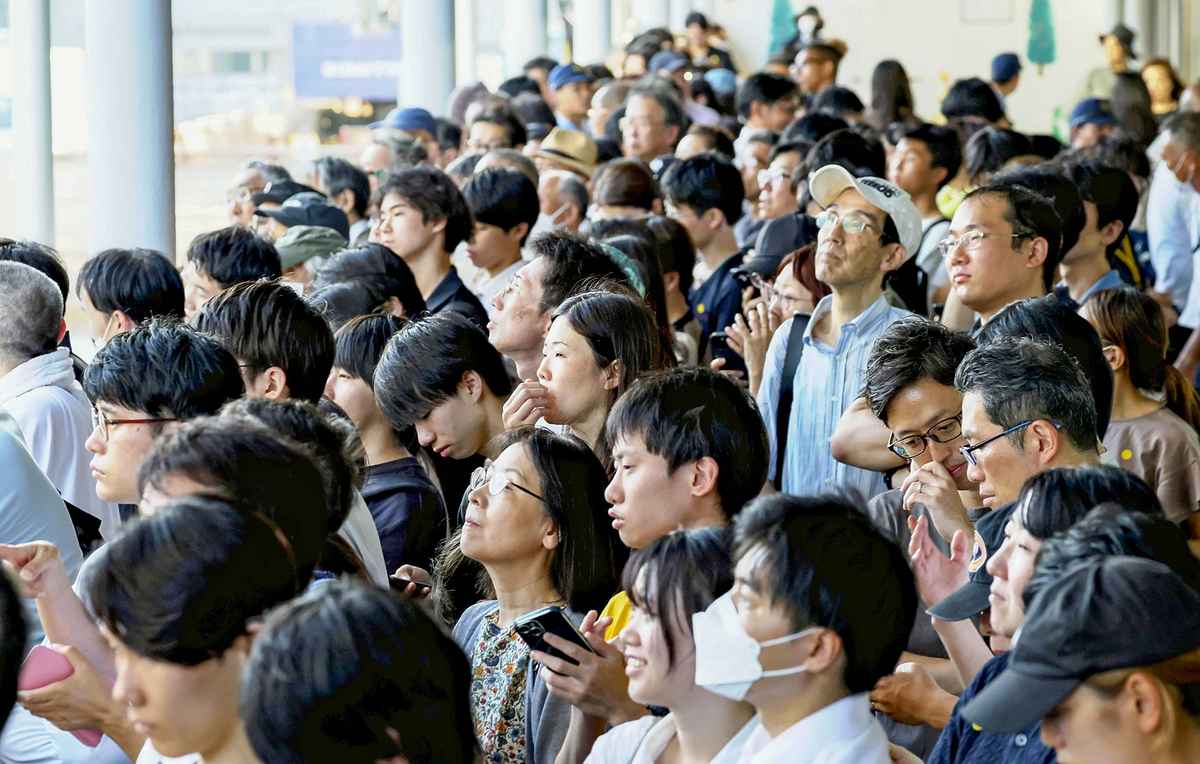
People listen to a candidate in this month’s House of Councillors election giving a speech in Funabashi, Chiba Prefecture, on Wednesday.
20:00 JST, July 11, 2025
Cutting the consumption tax rate has been a clarion call of opposition parties ahead of this month’s House of Councillors election, a view that has found purchase even within the ruling parties.
A Yomiuri Shimbun questionnaire that surveyed candidates in the election found that many aspirants from the Liberal Democratic Party and its ruling coalition partner, Komeito, support either cutting or abolishing the consumption tax.
The questionnaire also revealed that the views within parties are divided on the issue of Imperial succession, with a sizeable chunk of candidates supporting either allowing a female emperor from the paternal line or an emperor descended from the family’s maternal line.
Prime Minister Shigeru Ishiba, who also is LDP president, remains unswayed by calls to lower the consumption tax rate.
“Cutting the consumption tax rate would take time,” Ishiba said during a speech in Higashiomi, Shiga Prefecture, on Thursday. “That won’t do.”
Instead, Ishiba once again threw his weight behind the LDP’s pledge to provide a ¥20,000 cash handout per person as part of measures to combat rising prices. However, it would be a stretch to say the LDP’s handout policy has won over the public during the election campaign.
The LDP suffered a major setback and won its lowest-ever number of seats in the Tokyo metropolitan assembly election on June 22, which was held during the period the questionnaire was being conducted.
In a Yomiuri Shimbun survey conducted between June 27 and 29, 66% of respondents said they did “not support” the handouts.
A gloomy mood is seeping through the LDP as the election approaches. “We won’t be able to compete in this election unless we get the prime minister to at least say he ‘will think about trimming’ the consumption tax rate,” a senior official of the LDP’s members in the upper house told The Yomiuri Shimbun.
The questionnaire asked candidates what they thought about the consumption tax. A total of 27% LDP candidates replied that the rate should either be “reduced for a limited time” or “reduced permanently or abolished.” Among Komeito candidates, 62% supported reducing or abolishing the consumption tax, compared to just 29% who thought the rate should be maintained as it is.
Komeito initially considered including a pledge to reduce the consumption tax rate on foodstuffs in its election promises, but decided to shelve the plan and remain in lockstep with the LDP.
A majority of candidates in every opposition party expressed support for cutting or abolishing the consumption tax. During a speech in Niigata City on Thursday, Constitutional Democratic Party of Japan leader Yoshihiko Noda declared that his party would “remove the consumption tax from food items for a limited time.”
While many opposition party candidates selected the consumption tax as an issue they wanted to bring up during the election campaign, only 1% of LDP contestants felt the same way and not a single Komeito candidate wanted to mention this issue. The opposition camp is amplifying its call for cutting or eliminating the consumption tax and taking an increasingly adversarial stance on the issue, whereas ruling party candidates had apparently hoped to avoid having it become a major point of contention. However, they have gradually been dragged into a fight sought by the opposition bloc.
A majority of candidates from both sides indicated improving the economy was a priority, but there are concerns that discussions on sources of funding are being left aside. When asked whether fiscal stimulus measures should be prioritized to support the economy, 73% of all questionnaire respondents said their thinking was “close” or “somewhat close” to that view. By contrast, only 2% of candidates said their thinking was “close” to the view that fiscal reconstruction should be given priority and government debt should be reduced, and a further 4% replied they were “somewhat close” to that view.
Imperial succession divides opinion
The questionnaire also revealed that candidates hold a mix of views on Imperial succession. Candidates could only select one answer.
Under the current Imperial House Law, Imperial succession is limited to male offspring in the family’s paternal line. Overall, 38% of candidates selected the option of maintaining the current system. On the other hand, 27% of candidates picked the option of “accepting” a female emperor from a paternal line but not from a maternal line. An emperor whose mother was a member of the Imperial family but whose father is not was an option picked by 20% of candidates.
When candidates were broken down into their respective parties, support for maintaining the current system was the dominant view in parties including the Liberal Democratic Party (55%), Japan Innovation Party (68%), Democratic Party for the People (53%) and Sanseito (84%). All Conservative Party of Japan candidates backed the current succession system.
Those who said they would “accept” a female emperor accounted for 35% of LDP candidates, 28% of JIP candidates, 38% of DPFP candidates and 16% of Sanseito candidates. Among Komeito candidates, 75% said the same.
Acceptance of succession through a female line was prevalent among candidates from parties including the CDPJ (49%) and the Japanese Communist Party (94%).
Stances split on social media
Candidates from the emerging parties of Sanseito and the Conservative Party of Japan in general expressed more reluctance toward regulating the spread of misleading or erroneous information in election campaigns via social media as well as the monetization of social media posts. Candidates from established parties were more likely to say that some form of regulation is necessary.
In the survey, 85% of Sanseito candidates and all of the CPJ candidates said they were either mostly or somewhat of the view that regulations on misleading or erroneous information should be kept to a minimum. Both parties have actively used social media in their campaigns, and their stance on respecting the free use of social media was notable.
The percentage of candidates who said they were either mostly or somewhat of the view that regulations should be strengthened was 77% for the LDP, 83% for Komeito, 85% for the CDPJ, 52% for the Japan Innovation Party and 73% for the Japanese Communist Party.
Among the Democratic Party for the People, which made significant gains in last year’s House of Representatives election through the extensive utilization of social media, only 38% of its members at least somewhat supported stricter regulations, with 33% at least somewhat against and 30% undecided.
Similar trends were seen regarding regulations on monetization, with over half of Sanseito candidates and all CPJ candidates at least somewhat not in favor.
During the previous ordinary Diet session, an inter-party conference comprising seven ruling and opposition parties discussed regulations on social media related to elections, but concrete legislation was postponed due to conflicts with the “freedom of expression” guaranteed by the Constitution.


Related Tags




Most Read
Popular articles in the past 24 hours
-

Hawaii Museum on Tsunami Including Japan's 2011 Disaster at Risk ...
-

Japan Train Company to Increase Fares, Including in Tokyo Metropo...
-

Tail of ANA Plane Struck Runway During Landing in Houston; No Inj...
-

Japan Govt to Tighten Requirements to Receive Permanent Residency...
-

Samurai Japan Holds First Practice in Miami; Team Will Play again...
-

Iran Targets Busiest International Airport as Top UN Body Demands...
-

Japan to Face Venezuela in World Baseball Classic Quarterfinals
-

North Korean Leader Kim and His Daughter Try out New Pistols at S...
Popular articles in the past week
-

Japan Figure Skating Legend Yuzuru Hanyu Is Proud Disaster Surviv...
-

Nippon Life Insurance's U.S. Arm Sues OpenAI Over Legal Assistanc...
-

Ibaraki Pref.'s 1st Foreign Bus Driver Hired in Tsukuba
-

Govt to Utilize ODA for Ensuring Economic Security; Securing Ener...
-

Massive Sewer Pipe Found Jutting Out of Highway in Osaka
-

Amid Strait of Hormuz Blockade, Shipping Companies Scramble to Ge...
-

Beckoning Cats Get Makeover to Fit Modern Lifestyles with Sleek D...
-
Japan Govt Survey Finds Just 10% of Workers Want Working Hours to...
Popular articles in the past month
-

Producer Behind Pop Group XG Arrested for Cocaine Possession
-

Japan PM Takaichi’s Cabinet Resigns en Masse
-

Man Infected with Measles Reportedly Dined at Restaurant in Tokyo...
-

Videos Plagiarized, Reposted with False Subtitles Claiming ‘Ryuky...
-

iPS Treatments Pass Key Milestone, but Broader Applications Far f...
-

Sanae Takaichi Elected Prime Minister of Japan; Keeps All Cabinet...
-
Japan Figure Skating Legend Yuzuru Hanyu Is Proud Disaster Surviv...
-

Nepal Bus Crash Kills 19 People, Injures 25 Including One Japanes...
Top Articles in Politics
-
Japan PM Takaichi’s Cabinet Resigns en Masse
-
Sanae Takaichi Elected Prime Minister of Japan; Keeps All Cabinet Appointees from Previous Term
-

Japan’s Govt to Submit Road Map for Growth Strategy in March, PM Takaichi to Announce in Upcoming Policy Speech
-
LDP Begins Training New Lawmakers to Avoid Scandal, Gaffes; Historic Victory in Latest Election Heightens Focus on Party
-

Japan PM Sanae Takaichi Welcomes Peach Ambassadors Koga Momo Musume to Official Residence
JN ACCESS RANKING
-
Producer Behind Pop Group XG Arrested for Cocaine Possession
-
Japan PM Takaichi’s Cabinet Resigns en Masse
-
Man Infected with Measles Reportedly Dined at Restaurant in Tokyo Station
-
Videos Plagiarized, Reposted with False Subtitles Claiming ‘Ryukyu Belongs to China’; Anti-China False Information Also Posted in Japan
-
iPS Treatments Pass Key Milestone, but Broader Applications Far from Guaranteed