
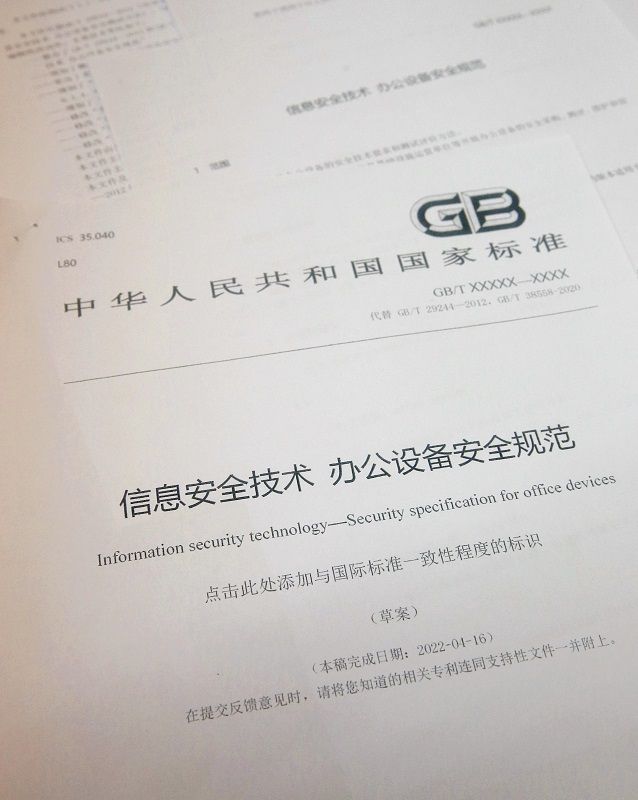
A copy of the draft paper of “Information security technology — Security specification for office devices” is seen.
15:47 JST, July 3, 2022
The Chinese government is set to require overseas manufacturers of multifunctional office equipment to design and manufacture such products in China, The Yomiuri Shimbun has learned. Devices such as printers, scanners and other products that fail to meet the requirements are likely to be excluded from submitting tenders to central and local governments and public companies.
There is strong concern within the Japanese government and corporate circles that the new regulation could be a “de facto forced transfer of technology” that could result in key technologies being leaked to the Chinese side.
The draft could become a new code to be followed when submitting tenders for government procurement and other projects. It is being compiled by China’s State Administration for Market Regulation agency under the name “Information security technology — Security specification for office devices.”
A draft of the regulation obtained by The Yomiuri Shimbun clearly states that office devices purchased by the government and others through the tendering process “should be designed, developed and manufactured in China.” It also stipulates that for safety purposes, devices “will be inspected to evaluate whether the design and production processes were conducted in China.”
The regulation also gives specific examples of targeted products, which include “devices that primarily perform one or more of the following functions: printing, scanning, faxing and copying.” It also applies to the procurement of entities that operate critical infrastructure such as telecommunications, transportation and finance.
In particular, it lists main control chips, laser-scanning parts, capacitors, electrical resistors and motors as “critical components” in office devices, and emphasizes that such items must be designed and manufactured in China. Multifunctional devices contain high concentrations of sensitive technologies, including some that could be adapted for military purposes.
Technically, the regulation would be a “recommendation,” equivalent in nature to Japanese Industrial Standards. In a white paper compiled last year, the Japanese Chamber of Commerce and Industry in China — comprising an association of Japanese companies that operate in China — recognized that “recommendations” issued by Beijing are cited in laws and regulations, leading to fears that such recommendations are gradually becoming mandatory.
Currently, many non-Chinese manufacturers design and develop products in their own countries and have them manufactured and assembled at factories in China. In many cases, such products are labelled as being “made in China.”
This prevents business secrets from leaking out of the country — many companies’ know-how is concentrated in design and development. Once the new regulation is introduced, companies will be forced to drastically review their operational methods.
“If we design and develop products in China, there is a high possibility that our technology will be swiped [by the Chinese side] in the process,” said a manufacturing official. “Chinese manufacturers will soon imitate us, and we’ll lose our competitiveness.”




Most Read
Popular articles in the past 24 hours
-

Japan PM Takaichi’s Cabinet Resigns en Masse
-

Japan's Govt to Submit Road Map for Growth Strategy in March, PM ...
-

Bus Carrying 40 Passengers Catches Fire on Chuo Expressway; All E...
-

Riku-Ryu Pair Wins Gold Medal: Their Strong Bond Leads to Major C...
-
Survey Shows False Election Info Perceived as True
-

Milano Cortina 2026: Japan’s Ami Nakai Leads Women’s ...
-

Japan’s Plan for Investment in U.S.: Aim for Mutual Development b...
-
Sanae Takaichi Elected Japan's 105th Prime Minister (UPDATE 1)
Popular articles in the past week
-
Japan PM Takaichi’s Cabinet Resigns en Masse
-

Man Infected with Measles Reportedly Dined at Restaurant in Tokyo...
-

Videos Plagiarized, Reposted with False Subtitles Claiming ‘Ryuky...
-

Milano Cortina 2026: Figure Skaters Riku Miura, Ryuichi Kihara Pa...
-

Tokyo’s New Record-Breaking Fountain Named ‘Tokyo Aqua Symphony’
-
CRA Leadership Election Will Center on Party Rebuilding; Lower Ho...
-

Milano Cortina 2026: Kokomo Murase Comes Out on Top After Overcom...
-
Japan's Govt to Submit Road Map for Growth Strategy in March, PM ...
Popular articles in the past month
-
Japan PM Takaichi’s Cabinet Resigns en Masse
-

Japan Institute to Use Domestic Commercial Optical Lattice Clock ...
-

Israeli Ambassador to Japan Speaks about Japan’s Role in the Reco...
-

Man Infected with Measles May Have Come in Contact with Many Peop...
-

China Eyes Rare Earth Foothold in Malaysia to Maintain Dominance,...
-

Prudential Life Insurance Plans to Fully Compensate for Damages C...
-

Woman with Measles Visited Hospital in Tokyo Multiple Times Befor...
-

Australian Woman Dies After Mishap on Ski Lift in Nagano Prefectu...
Top Articles in Politics
-
Japan PM Takaichi’s Cabinet Resigns en Masse
-

LDP Wins Historic Landslide Victory
-

LDP Wins Landslide Victory, Secures Single-party Majority; Ruling Coalition with JIP Poised to Secure Over 300 seats (UPDATE 1)
-
CRA Leadership Election Will Center on Party Rebuilding; Lower House Defeat Leaves Divisions among Former CDPJ, Komeito Members
-
Japan Tourism Agency Calls for Strengthening Measures Against Overtourism
JN ACCESS RANKING
-
Japan PM Takaichi’s Cabinet Resigns en Masse
-
Japan Institute to Use Domestic Commercial Optical Lattice Clock to Set Japan Standard Time
-
Israeli Ambassador to Japan Speaks about Japan’s Role in the Reconstruction of Gaza
-
Man Infected with Measles May Have Come in Contact with Many People in Tokyo, Went to Store, Restaurant Around When Symptoms Emerged
-
Prudential Life Insurance Plans to Fully Compensate for Damages Caused by Fraudulent Actions Without Waiting for Third-Party Committee Review