
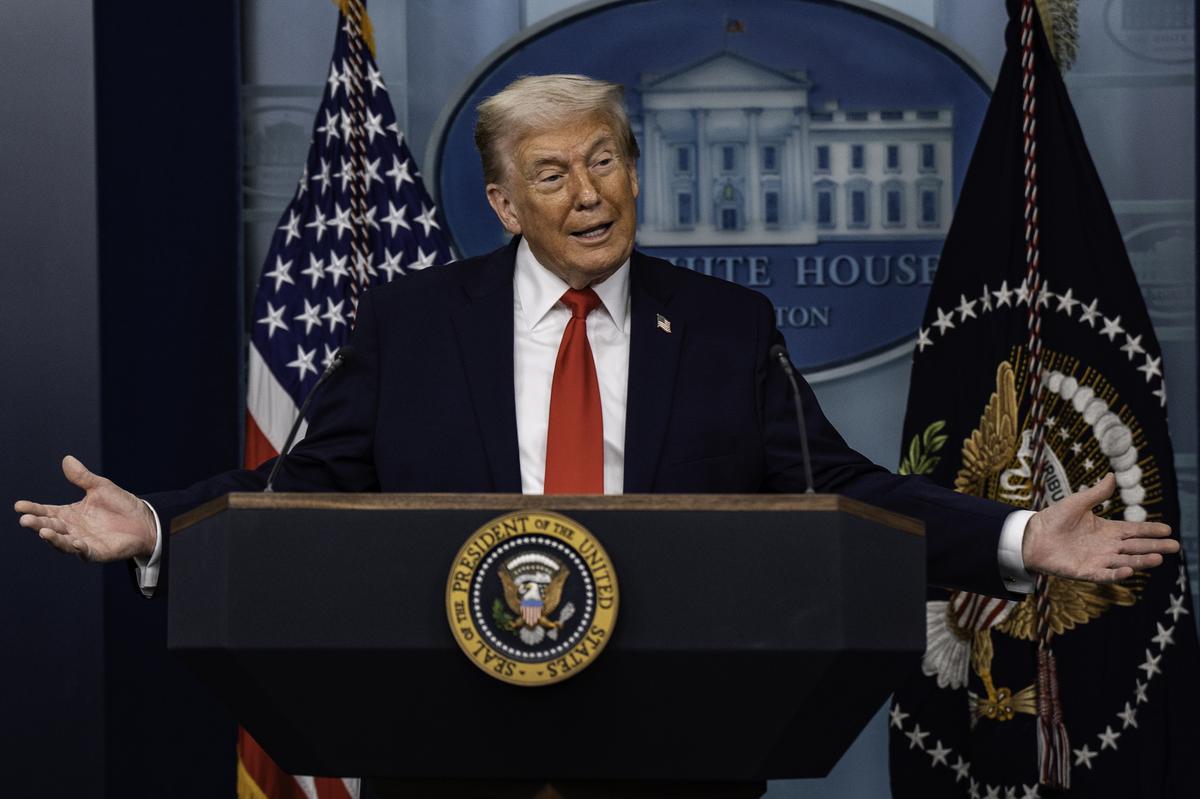
Political action committees affiliated with President Donald Trump raised astounding amounts of money in 2025, despite Trump not being up for any office.
13:19 JST, February 3, 2026
President Donald Trump, through an array of allied groups, has stockpiled nearly $400 million, according to the latest campaign finance report, money that he could deploy to boost the campaigns of Republicans in the midterm elections.
Meanwhile, the national Democratic Party lags well behind its counterpart in fundraising through the end of last year, according to the latest Federal Election Commission filings. The Democratic National Committee is emerging from a bruising and expensive 2024 election about $81 million behind the Republican National Committee, as it struggles to attract donors and move past debts.
The reports offer a snapshot of the financial standing of candidates and their affiliated groups at the start of a midterm election year, when Democrats are hoping to retake control of the House and Republicans are aiming to hold on to their control of Congress.
Here are some of the biggest takeaways:
Trump-aligned funds’ hefty haul
Trump-aligned committees have continued to fundraise, stockpiling hundreds of millions, even as the president has said he isn’t seeking to run for office again. While Trump hasn’t finalized all of his endorsements, and the committees have not yet said where the money will be used, Republicans hope to tap that money this year in House and Senate races so that they can hold on to power in the chambers. Trump’s aligned committees entered 2026 with $389 million to spend, a figure unmatched by any figure on the Democratic side.
MAGA Inc., a Trump-aligned super PAC, ended 2025 with $304 million cash on hand, bringing in $289 million throughout the year – the highest total reported by any political action committee at the end of 2025. It is a massive sum for any PAC, let alone one tied to a politician who isn’t in the running for office again.
The committee was formed after the 2024 election and has raked in seven- and eight-figure gifts from dozens of donors, including cryptocurrency company Foris DAX, OpenAI President Greg Brockman and trading firm founder Jeff Yass. It has already been active in House races, spending $1.7 million on a Tennessee special election in December.
Super PACs – third-party fundraising committees – are prohibited from coordinating with political candidates, but the Supreme Court is weighing a case that would decide whether laws limiting the amount of money political parties can spend in coordination with individual candidates violate the First Amendment.
Trump’s fundraising committees continue to raise tens of millions from smaller donors, many of whom only give $5 or $10 at a time online. The Trump National Committee – which raises money for Trump, the Republican National Committee and Vice President JD Vance’s leadership PAC – took in $76 million last year, bolstering Republicans across the board.
The president is spending some of his political funds on lawyers, using $13 million last year from two committees to pay his legal bills. The payments included $1.2 million to the law firm of Harmeet K. Dhillon, who now heads the civil rights division of the Justice Department, and $900,000 to the firm of Alina Habba, Trump’s personal lawyer.
Barometer for both parties ahead of midterms
The DNC owes more than $17 million, largely consisting of a $15 million loan it took out in October before the Virginia and New Jersey gubernatorial elections that resulted in victories for the party. The DNC has just $14 million in cash in the bank.
When merged with the Democratic House and Senate campaign committees, Democrats are entering 2026 with $85 million on hand – a total that amounts to about half of the total funds that they had going into the 2022 midterms.
The RNC, on the other hand, has stockpiled $95 million and owes no money. Together with the Republican House and Senate campaign committees, the GOP is entering 2026 with $165 million in the bank, nearly double the Democrats’ total.
With the House majority at stake in November, the Democratic Congressional Campaign Committee and the National Republican Congressional Committee – both of which raise money for House races – have about equal amounts at the ready. The DCCC reported $49 million in cash on hand at the end of 2025, while the NRCC reported $51 million. The two committees raised similar amounts in 2025, with the DCCC bringing in $115 million, and the NRCC $117 million.
The amounts are still behind both parties’ fundraising totals in 2021, before the 2022 midterms. At this point in that election cycle, when Democrats held the majority in the House, the DCCC reported having $83 million in cash on hand, according to its 2021 year-end filing to the FEC, while the NRCC had $78 million.
Democrats in key Senate races are doing well
While the national Democratic Party may be struggling to appeal to donors, Democrats running in key Senate races this year had fundraising boons.
Sen. Jon Ossoff (D-Georgia), who party strategists believe must hold on to his seat if Democrats are to overcome long odds and flip control of the Senate, ended the year with $26 million in the bank, vastly outraising his top three GOP opponents combined. His closest rival, Rep. Buddy Carter (R), entered 2026 with $4 million in cash in his campaign.
In North Carolina, where Democrats see one of their best chances of flipping a Republican-held seat in the race to succeed retiring GOP Sen. Thom Tillis, former Democratic governor Roy Cooper entered the election year with $12 million in cash. His likely opponent on the Republican side, former RNC chairman Michael Whatley, whom Trump has endorsed, reported having $4 million.
In Ohio, Democrat Sherrod Brown outraised Sen. Jon Husted (R-Ohio) in his effort to return to the Senate. While Husted entered 2026 with about $6 million, Brown – a former senator seeking a comeback in a state that Trump won – began 2026 with $10 million in his war chest.
A three-way Democratic primary in Michigan is currently stalling Democratic fundraising as the party seeks to hold on to the seat held by retiring Sen. Gary Peters. Former congressman Mike Rogers, widely seen as the likely GOP nominee in the race, entered 2026 with about $3 million in cash on hand, while the three Democrats vying for the party nomination entered with about $7 million combined cash.
Money is also pouring into the Democratic Senate primary in Texas. Rep. Jasmine Crockett (D) and state Rep. James Talarico (D) ended the year with $5.6 million and $7.1 million, respectively.
On Saturday, Democrats saw a glimmer of hope in Texas, where they have fallen short in recent midterm Senate contests after pre-election hype: The party flipped a state Senate seat in a conservative district in a special-election runoff where the Democrat was vastly outspent by a Trump-backed candidate.
In Texas, Attorney General Ken Paxton, incumbent Sen. John Cornyn and Rep. Wesley Hunt are in a bruising primary of their own to secure the Republican nomination for Senate. But Cornyn, a longtime senator, sits on a war chest of more than $15 million across all of his affiliated committees.
Paxton, who is challenging Cornyn from the right and has a national following from Trump’s Make America Great Again base, has $3.7 million in cash on hand, and filings show that his fundraising slowed throughout the year. Trump has not made an endorsement in the primary race.
Democrats targeted by Trump also bring in cash
Some Democrats who have been criticized by Trump did not need to be running for reelection to attract donor money.
Sen. Mark Kelly (D-Arizona), who is not up for reelection until 2028, ended 2025 with $15 million cash in hand, after raising about $13 million in the last three months of 2025. The Pentagon last year opened an investigation into the senator after he and five other Democratic colleagues reminded U.S. service members of their duty to disobey unlawful orders. Trump’s targeting of Kelly has made the senator from Arizona one of the prominent faces of the anti-Trump opposition.
Elon Musk’s continued influence
In 2024, Elon Musk cemented the title of America’s largest political donor, spending $277 million to elect Trump and other Republican candidates. After his months-long stint leading the U.S. DOGE Service – during which he oversaw the Trump administration’s major cuts to the federal government – Musk exited the Trump administration and found himself on the outs with the president, toying with the idea of creating his own political party.
But after a brief pause, Musk returned to Trump’s good graces and is again donating millions to Republican candidates and his own America PAC. In total, he gave at least $73 million to federal political committees in 2025.
Last year, Musk gave $10 million each to the Senate Leadership Fund and the Congressional Leadership Fund – two super PACs aimed at electing Republicans to Congress. He also gave $5 million to MAGA Inc. in June.
Musk also continued to build America PAC, funneling more than $45 million to his super PAC over the course of 2025. In 2024, Musk started a lottery initiative for registered swing-state voters who signed a petition as part of his super PAC’s voter recruitment drive. Individuals could receive $47 for each valid referral to a registered voter in a swing state. Musk attempted similar giveaways during the Wisconsin Supreme Court race. United States of America Inc. processed those payments.
Most recently, Musk gave $10 million to Senate candidate Nate Morris, a businessman who is running to succeed retiring Sen. Mitch McConnell (R-Kentucky). Trump has not made an endorsement in that primary race.
Crypto and AI sectors ready to deploy hundreds of millions
The pro-crypto Fairshake super PAC and its affiliates raised over $70 million in the last half of 2025, ending the year with $193 million on hand. Fairshake and its affiliated super PACs, Defend American Jobs and Protect Progress, spent hundreds of millions supporting dozens of candidates from both parties during the 2024 election. New groups are also popping up, including the Digital Freedom Fund, which received $21 million worth of bitcoin from Winklevoss Capital.
Pro-AI super PAC Leading the Future, which was founded in August, reported raising $50 million. That included a $25 million donation from Brockman and his wife, as well as an equal amount from prominent venture capital firm Andreessen Horowitz, whose co-founder Marc Andreessen is a Trump adviser.





Most Read
Popular articles in the past 24 hours
-

Chinese Satellites Pass Over Japan Every 10 Minutes, Monitoring U...
-

Japanese Modernist Artist Koiso’s ‘Long-Lost Masterpiece’ Returns...
-

Espresso Shots, Pricier Wine and an Unbeaten Italy Now Bound for ...
-

M4.4 Earthquake Hits Central Japan’s Gunma Pref.; No Tsunami Expe...
-

Japanese Expert on Arab Cuisine Presents Dish with Whole Fish, Cr...
-

Zelenskiy Says Ukraine Wants Money, Technology in Return for Midd...
-

World Baseball Classic: Venezuela Beats Japan in Nail-biting Back...
-

Rapid Services Resume on JR Chuo Line; Suspension Caused by Accid...
Popular articles in the past week
-

Japan Figure Skating Legend Yuzuru Hanyu Is Proud Disaster Surviv...
-

15 Measles Patients Confirmed in Tokyo in Past 6 Days; 1 May Have...
-

Massive Sewer Pipe Found Jutting Out of Highway in Osaka
-

Japan Govt to Tighten Requirements to Receive Permanent Residency...
-

Power Outage Forces About 980 Passengers in Yokohama to Walk to T...
-
JR Tokai Breaks Ground on Yamanashi Maglev Station; Will Be Part ...
-

Parents in Japan to Get Instagram Notifications When Teens Repeat...
-

Metal Pipe That Protruded 13 Meters Above Ground in Osaka Sinks B...
Popular articles in the past month
-

Producer Behind Pop Group XG Arrested for Cocaine Possession
-

Japan PM Takaichi’s Cabinet Resigns en Masse
-

Man Infected with Measles Reportedly Dined at Restaurant in Tokyo...
-
Japan Figure Skating Legend Yuzuru Hanyu Is Proud Disaster Surviv...
-

iPS Treatments Pass Key Milestone, but Broader Applications Far f...
-

Sanae Takaichi Elected Prime Minister of Japan; Keeps All Cabinet...
-

South Korea Tightens Rules on Foreigners Buying Homes in Seoul Me...
-

Nepal Bus Crash Kills 19 People, Injures 25 Including One Japanes...
Top Articles in News Services
-
Survey Shows False Election Info Perceived as True
-

Japan’s Nikkei Stock Average Falls as US-Iran Tensions Unsettle Investors (UPDATE 1)
-
Japan’s Nikkei Stock Average Rises on Tech Rally and Takaichi’s Spending Hopes (UPDATE 1)
-

Japan to Ban Use of Power Banks on Airplanes
-

North Korea Unveils Image of Kim Jong Un’s Teenage Daughter Firing Rifle
JN ACCESS RANKING
-
Producer Behind Pop Group XG Arrested for Cocaine Possession
-
Japan PM Takaichi’s Cabinet Resigns en Masse
-
Man Infected with Measles Reportedly Dined at Restaurant in Tokyo Station
-
Japan Figure Skating Legend Yuzuru Hanyu Is Proud Disaster Survivor and Gold Medalist, Vows to Continue Support Efforts
-
iPS Treatments Pass Key Milestone, but Broader Applications Far from Guaranteed