
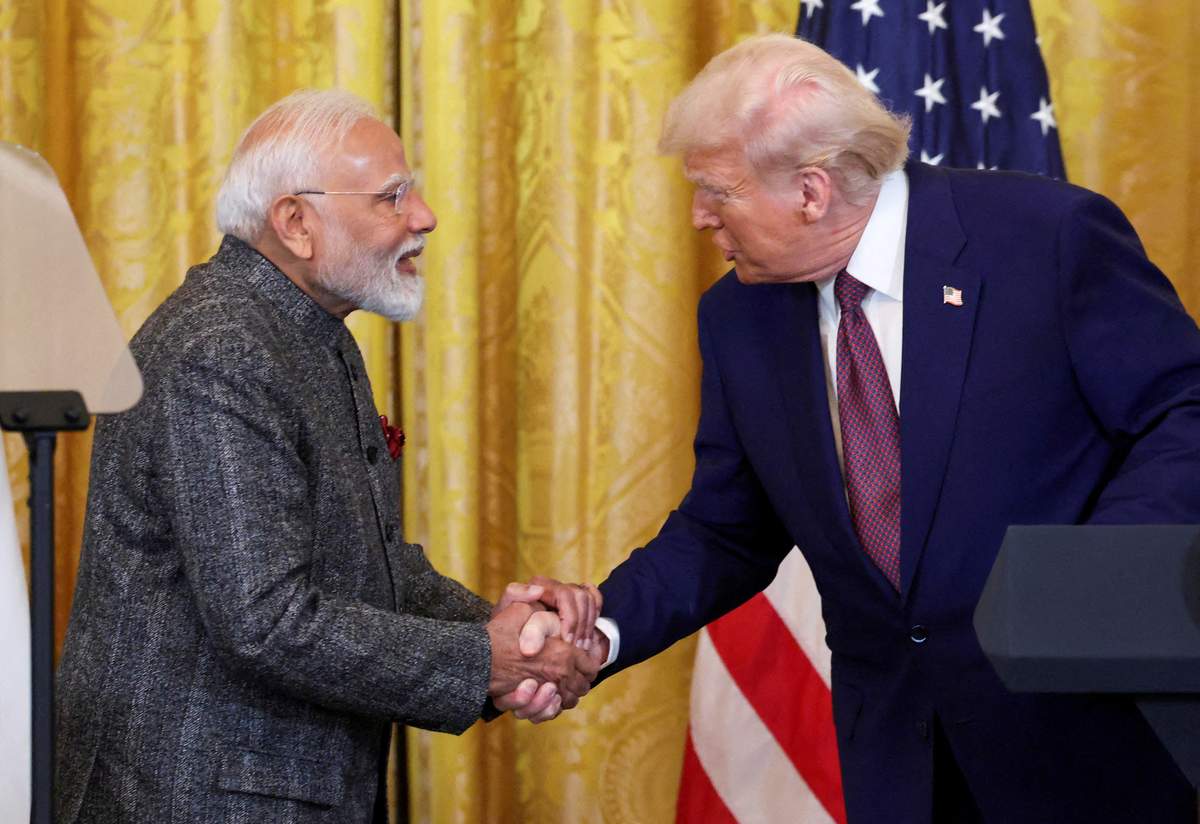
U.S. President Donald Trump and Indian Prime Minister Narendra Modi shake hands as they attend a joint press conference at the White House in Washington, D.C., U.S., February 13, 2025.
11:07 JST, February 7, 2026
WASHINGTON, Feb 6 (Reuters) – The United States and India moved closer to a trade pact on Friday, releasing an interim framework that would lower tariffs, reshape energy ties and deepen economic cooperation as both countries seek to realign global supply chains.
The framework reaffirms a commitment to negotiations toward a broader bilateral trade agreement, the two governments said in a joint statement, while noting that further negotiations were needed to complete the pact.
U.S. President Donald Trump announced a deal with India on Monday to cut U.S. tariffs on Indian goods to 18% from 50% in exchange for India halting purchases of Russian oil and lowering trade barriers.
Half of the 50% rate had been imposed separately by Trump as punishment for India’s purchases of Russian oil, which he said were fueling Moscow’s war effort in Ukraine. Trump signed an executive order on Friday rescinding that 25% portion after India agreed this week to shift its oil buying to the U.S. and Venezuela.
NEW DETAILS ON TARIFF REDUCTIONS
Friday’s joint statement provides additional details compared with initial outlines of the trade deal revealed by Trump on Monday.
It confirms that India will purchase $500 billion in U.S. goods over a five-year period, including oil, gas, coking coal, aircraft and aircraft parts, precious metals, and technology products. The last category includes graphics processing units, typically used for AI applications, and other goods used in data centers.
It said India would eliminate or reduce tariffs on all U.S. industrial goods and a wide range of U.S. food and agricultural products, including dried distillers’ grains and red sorghum for animal feed, tree nuts, fresh and processed fruit, soybean oil, wine and spirits.
U.S. TO KEEP 18% TARIFF
But the deal will apply an 18% tariff rate on most imports to the U.S. from India, including textiles and apparel, leather and footwear, plastic and rubber, organic chemicals, home decor, artisanal products and certain machinery.
India will get the same tariff relief granted to other allied countries that have signed trade deals with the United States on certain aircraft and aircraft parts, and will receive a quota for auto parts imports that will be subject to a lower tariff rate, according to the statement.
Depending on the results of the Trump administration’s tariff investigation into pharmaceuticals and their ingredients, “India will receive negotiated outcomes with respect to generic pharmaceuticals and ingredients,” the statement said.
Indian Trade Minister Piyush Goyal hailed the framework agreement in a social media post on X as opening a market worth $30 trillion – the U.S. annual GDP – to Indian exporters, especially farmers, fishermen, and micro and small-to-medium enterprises.
Goyal had said on Thursday that Washington and New Delhi aimed to sign a formal trade agreement in March, after which India’s tariff cuts on U.S. exports would go into effect.
ACCEPTING U.S. STANDARDS
India also agreed to address longstanding non-tariff barriers on imports of agriculture products, medical devices and communications gear, with negotiations to be completed within six months on an agreement to accept U.S. or international safety and licensing standards for product imports.
The U.S. affirmed that it intends to consider India’s requests for lower tariffs on Indian goods during further negotiations of the bilateral trade agreement. The two sides also agreed to cooperate on enforcement of export controls on sensitive technologies and take actions to address “non-market policies of third parties,” a reference to China.
The United States and India have struggled for years to conclude a full trade deal, with disputes spanning agriculture, digital trade, medical devices and market access. But strategic concerns — including competition with China, supply-chain diversification and energy security — have injected new urgency into talks, officials in both countries say.







Most Read
Popular articles in the past 24 hours
-
Seeking Nuclear Waste Site, Japan Eyes Remote Island of Minami-To...
-

Japan Ministry Asks to Conduct Nuclear Waste Disposal-related Sur...
-

Total Lunar Eclipse Visible for Some in Japan, While Clouds Block...
-

WBC to Begin: All the Pieces are in Place for Japan’s Second Stra...
-

Milano Cortina 2026: Ceremony for Winter Paralympic Torch Relay T...
-

Tokyo High Court Upholds Unification Church Dissolution Order; Li...
-
CARTOON OF THE DAY (March 4)
-

Japan to Set Up National Intelligence Bureau as Hub for Counterin...
Popular articles in the past week
-

Tokyo Spends Big on Children, Wins Over Parents
-
Japan’s Miura, Kihara Announce Withdrawal from Figure Skating Wor...
-

South Korea Tightens Rules on Foreigners Buying Homes in Seoul Me...
-
BOJ Keeping Eye on Economy and Takaichi's ‘Proactive Fiscal Polic...
-

Tokyo Measles Patient Traveled to Fukuoka Aboard JAL Planes; Susp...
-
Nidec Chairman Resigns Amid Accounting Scandal at Major Japanese ...
-

Strait of Hormuz Closure Shakes Markets; Prolonged Closure Could ...
-

Tourists Ignore Safety Barriers Near Famous Zao ‘Snow Monsters’ i...
Popular articles in the past month
-

Producer Behind Pop Group XG Arrested for Cocaine Possession
-

Japan PM Takaichi’s Cabinet Resigns en Masse
-

Man Infected with Measles Reportedly Dined at Restaurant in Tokyo...
-

Israeli Ambassador to Japan Speaks about Japan’s Role in the Reco...
-

Videos Plagiarized, Reposted with False Subtitles Claiming ‘Ryuky...
-

Prudential Life Insurance Plans to Fully Compensate for Damages C...
-

Woman with Measles Visited Hospital in Tokyo Multiple Times Befor...
-

iPS Treatments Pass Key Milestone, but Broader Applications Far f...
Top Articles in News Services
-
Survey Shows False Election Info Perceived as True
-
Hong Kong Ex-Publisher Jimmy Lai’s Sentence Raises International Outcry as China Defends It
-
Japan’s Nikkei Stock Average Falls as US-Iran Tensions Unsettle Investors (UPDATE 1)
-
Japan’s Nikkei Stock Average Touches 58,000 as Yen, Jgbs Rally on Election Fallout (UPDATE 1)
-
Japan’s Nikkei Stock Average Rises on Tech Rally and Takaichi’s Spending Hopes (UPDATE 1)
JN ACCESS RANKING
-
Producer Behind Pop Group XG Arrested for Cocaine Possession
-
Japan PM Takaichi’s Cabinet Resigns en Masse
-
Man Infected with Measles Reportedly Dined at Restaurant in Tokyo Station
-
Israeli Ambassador to Japan Speaks about Japan’s Role in the Reconstruction of Gaza
-
Videos Plagiarized, Reposted with False Subtitles Claiming ‘Ryukyu Belongs to China’; Anti-China False Information Also Posted in Japan