
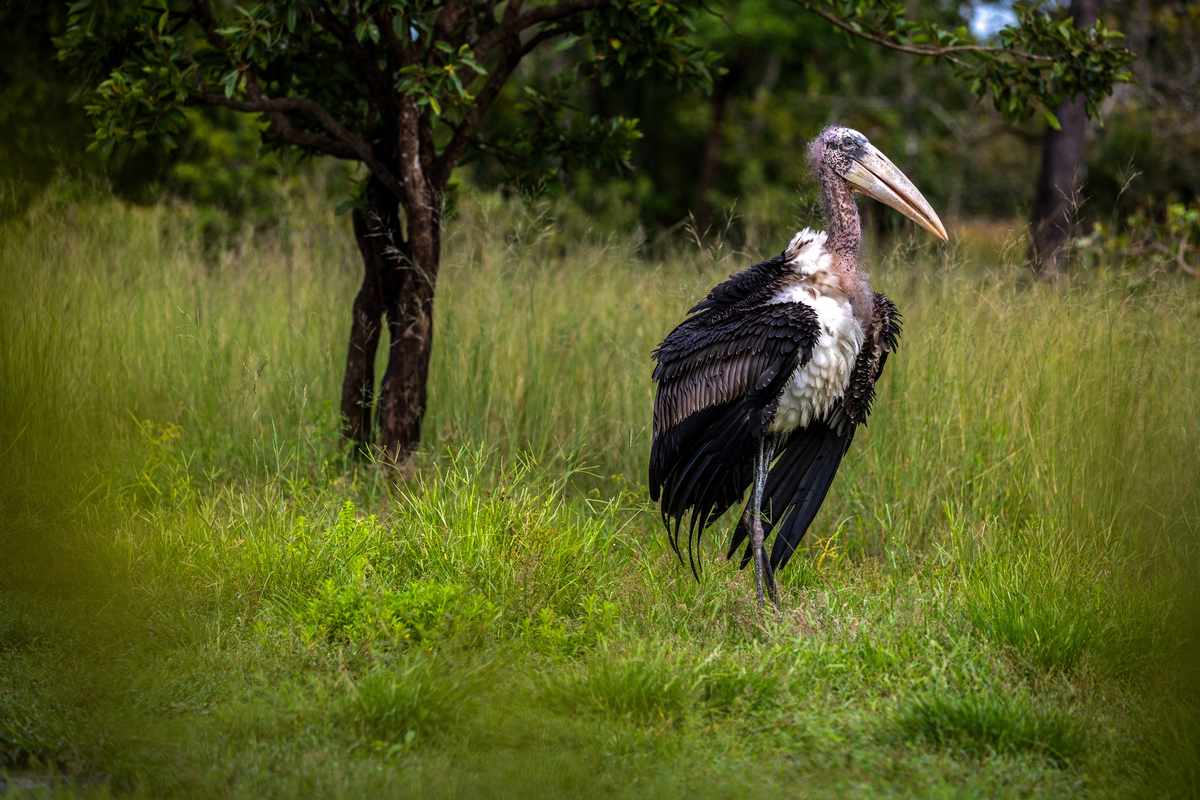
A greater adjutant, stands after being released at Siem Pang Wildlife Sanctuary in Stung Treng Province, Cambodia, October 15, 2025.
11:30 JST, November 20, 2025
HNOM PENH, Nov 20 (Reuters) – Conservationists in Cambodia have for the first time released two captive-bred Greater Adjutant Stork chicks into the wild as part of an ongoing programme to revive a species under threat from poaching and habitat loss.
The nine-month-old storks – a male and a female – were fitted with GPS trackers before their release into the Siem Pang Wildlife Sanctuary, a protected area overseen by Cambodia’s Rising Phoenix conservation group.
“This place is perfect because there are still wild Greater Adjutants in the area,” said Jack Willis, who leads research at the Angkor Centre for Conservation of Biodiversity (ACCB).
“We’re hoping by releasing them here that they could perhaps join a colony, but also this area is very well protected by Rising Phoenix and the Ministry of Environment.”
The Greater Adjutant Stork, with its distinctive large black wings and long neck, was once listed as endangered on the International Union for Conservation of Nature’s Red List. It is now classified as “Near Threatened” after decades of conservation efforts reversed a decline in population.
According to ACCB data, an estimated 1,500 mature Greater Adjutant Storks remain in the wild globally, including 200 to 250 in Cambodia, with the rest mostly in northeast India.
Willis said their future remained precarious.
“It could take one, one big event and we could lose an awful lot in Cambodia,” he said in an interview, adding that captive breeding was necessary to head off the threat of extinction.
ACCB currently has three rescued pairs of Greater Adjutant Storks at its conservation centre in Siem Reap province, but only one pair has successfully produced chicks.
Storks rescued from wildlife traffickers lack the parenting skills learned in the wild, making it harder for them to rear their young.
The centre does not expect the newly released storks to join the wild population immediately. The birds normally head to breeding sites in the Prek Toal sanctuary in late October, but this migratory behaviour is usually learned from the adult members of a colony.
Though meticulous efforts have been made to acclimatise the birds to their new surroundings, Willis said it would be considered a success if they survive their first three to four months in the wild.
“This allows us to ideally develop the protocol for the conservation of Greater Adjutants and potentially similar species of storks like Lesser Adjutants,” he said.








Most Read
Popular articles in the past 24 hours
-

Power Outage Forces About 980 Passengers in Yokohama to Walk to T...
-

Masako Ikeda, Voice of Maetel in ‘Galaxy Express 999,' Dies at 87
-

Japan Defense Agency to Develop AI Intelligence Analysis System f...
-

Japan's TEPCO Releases Footage from Fukushima N-Plant Reactor
-

Japan's Sanyo Shinkansen Suspended Again; Between Okayama, Aioi S...
-

Japan Considering Taking Part in U.S. ‘Golden Dome’ Defense Syste...
-

46 Evacuated from UAE, Oman on Japanese Govt-chartered Flight
-

Government to Establish ‘Command Center’ for Developing Nuclear P...
Popular articles in the past week
-

Japan Figure Skating Legend Yuzuru Hanyu Is Proud Disaster Surviv...
-

Nippon Life Insurance's U.S. Arm Sues OpenAI Over Legal Assistanc...
-

Govt to Utilize ODA for Ensuring Economic Security; Securing Ener...
-
15 Measles Patients Confirmed in Tokyo in Past 6 Days; 1 May Have...
-

Massive Sewer Pipe Found Jutting Out of Highway in Osaka
-

Japan Govt to Tighten Requirements to Receive Permanent Residency...
-

Beckoning Cats Get Makeover to Fit Modern Lifestyles with Sleek D...
-

JR Tokai Breaks Ground on Yamanashi Maglev Station; Will Be Part ...
Popular articles in the past month
-

Producer Behind Pop Group XG Arrested for Cocaine Possession
-

Japan PM Takaichi’s Cabinet Resigns en Masse
-

Man Infected with Measles Reportedly Dined at Restaurant in Tokyo...
-

Videos Plagiarized, Reposted with False Subtitles Claiming ‘Ryuky...
-
Japan Figure Skating Legend Yuzuru Hanyu Is Proud Disaster Surviv...
-

iPS Treatments Pass Key Milestone, but Broader Applications Far f...
-

Sanae Takaichi Elected Prime Minister of Japan; Keeps All Cabinet...
-

Nepal Bus Crash Kills 19 People, Injures 25 Including One Japanes...
Top Articles in News Services
-

Survey Shows False Election Info Perceived as True
-

Japan’s Nikkei Stock Average Falls as US-Iran Tensions Unsettle Investors (UPDATE 1)
-
Japan’s Nikkei Stock Average Rises on Tech Rally and Takaichi’s Spending Hopes (UPDATE 1)
-

Japan to Ban Use of Power Banks on Airplanes
-

North Korea Unveils Image of Kim Jong Un’s Teenage Daughter Firing Rifle
JN ACCESS RANKING
-
Producer Behind Pop Group XG Arrested for Cocaine Possession
-
Japan PM Takaichi’s Cabinet Resigns en Masse
-
Man Infected with Measles Reportedly Dined at Restaurant in Tokyo Station
-
Videos Plagiarized, Reposted with False Subtitles Claiming ‘Ryukyu Belongs to China’; Anti-China False Information Also Posted in Japan
-
Japan Figure Skating Legend Yuzuru Hanyu Is Proud Disaster Survivor and Gold Medalist, Vows to Continue Support Efforts