
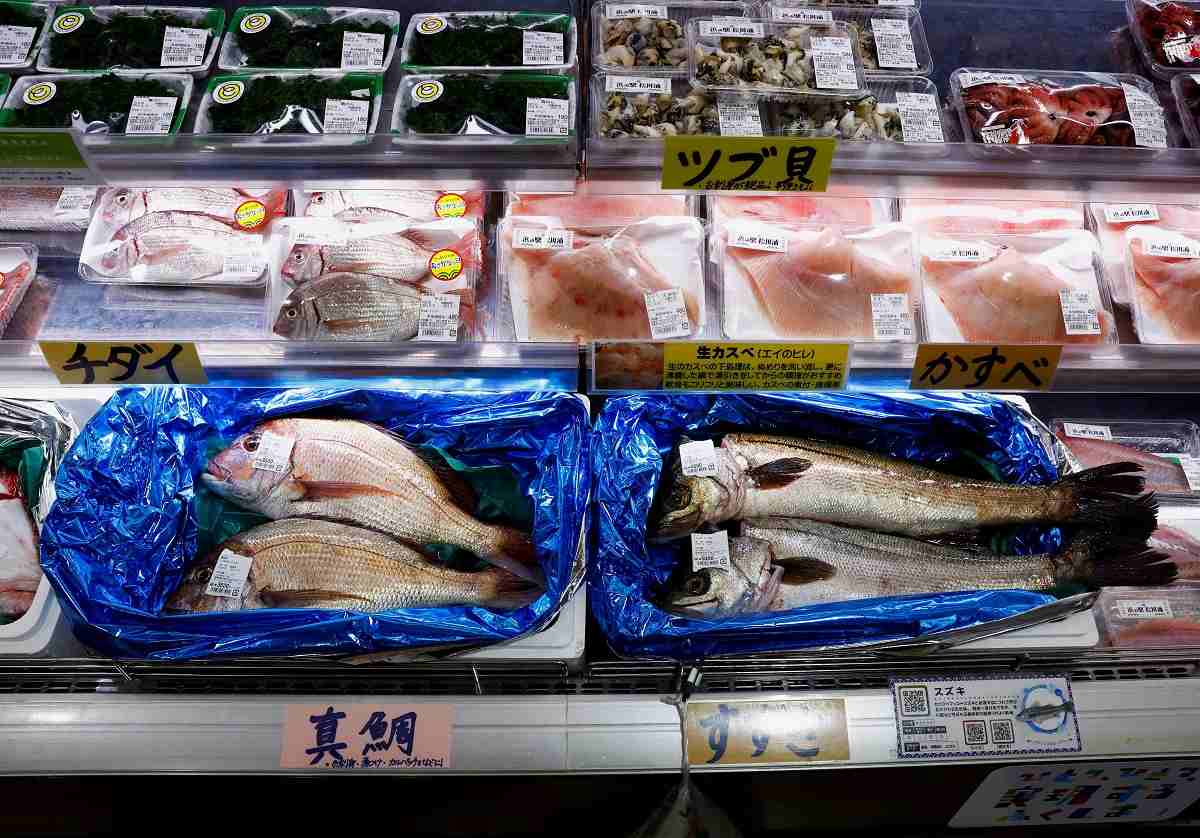
A view of locally caught seafood at the Hamanoeki Fish Market and Food Court in Soma, Fukushima Prefecture, Japan, August 31, 2023.
10:09 JST, September 27, 2023
Russia is considering joining China in banning Japanese seafood imports after Japan released treated radioactive water from the wrecked Fukushima nuclear power plant into the sea and is seeking talks with Japan over the matter, a Russian regulator said on Tuesday.
Japan started releasing the water from the plant into the ocean last month, drawing strong criticism from China. In retaliation, China imposed a blanket ban on all aquatic imports from Japan.
Russian food safety watchdog Rosselkhoznadzor on Tuesday said it had discussed Japanese food exports with its Chinese counterparts. Russia is one of the biggest marine product suppliers to China and is seeking to increase its market share.
“Taking into account the possible risks of radiation contamination of products, Rosselkhoznadzor is considering the possibility of joining with Chinese restrictions on supplies of fish products from Japan,” Rosselkhoznadzor said in a statement. “The final decision will be made after negotiations with the Japanese side.”
So far this year, Russia has imported 118 tonnes of Japanese seafood, the regulator said.
Rosselkhoznadzor said it had sent a letter to Japan on the need to hold talks and requesting information on Japan’s radiological testing of exported fish products by Oct. 16, including tritium.
Japan says the water is safe after being treated to remove most radioactive elements except tritium, a radionuclide difficult to separate from water. It is then diluted to internationally accepted levels before being released.
Japan has said criticism from Russia and China was unsupported by scientific evidence.
On Monday, in its latest report on water testing, Japan’s Ministry of Environment said analysis results of seawater, sampled on Sept. 19, showed the tritium concentrations were below the lower limit of detection at all 11 sampling points and would have no adverse impact on human health and the environment.
Russia has also detected no irregularities in marine samples used for tests in Russian regions that are relatively close to where the treated water was released, Rosselkhoznadzor’s far eastern branch said on Tuesday, Interfax reported.
Russia exported 2.3 million metric tons of marine products last year worth about $6.1 billion, around half its overall catch, with China, South Korea and Japan being the biggest importers, according to Russia’s fisheries agency.






Most Read
Popular articles in the past 24 hours
-

BOJ Keeping Eye on Economy and Takaichi's ‘Proactive Fiscal Polic...
-

University of Tsukuba Hospital to Introduce Working Dog Next Year...
-
Record 167 Elementary School Students Harmed Via Social Media in ...
-

Mizuho Bank May Have Lost Data on Thousands of Clients
-

Japan’s Hikonyan Cat Mascot to Celebrate 20th Birthday with Party...
-
Japan's Kairos Rocket Set to Launch on Sunday After Delays
-

Humbert Humbert: Husband-Wife Vocal Duo Brings Cheerful Singing t...
-

Mizuho to Cut Up to 5,000 Administrative Jobs with AI-Driven Oper...
Popular articles in the past week
-

Producer Behind Pop Group XG Arrested for Cocaine Possession
-

iPS Treatments Pass Key Milestone, but Broader Applications Far f...
-

Tokyo Skytree's Elevator Stops, Trapping 20 People; All Rescued (...
-

Nepal Bus Crash Kills 19 People, Injures 25 Including One Japanes...
-

Milano Cortina 2026: Japanese Gold Medalist Figure Skater Miura S...
-

Japan’s Major Real Estate Firms Expanding Overseas Businesses to ...
-

Milano Cortina 2026: Japanese Figure Skater Kaori Sakamoto’...
-

Reciprocal Tariffs Ruled Illegal: Judiciary Would Not Tolerate Pr...
Popular articles in the past month
-
Producer Behind Pop Group XG Arrested for Cocaine Possession
-

Japan PM Takaichi’s Cabinet Resigns en Masse
-

Japan Institute to Use Domestic Commercial Optical Lattice Clock ...
-

Man Infected with Measles Reportedly Dined at Restaurant in Tokyo...
-

Israeli Ambassador to Japan Speaks about Japan’s Role in the Reco...
-

Videos Plagiarized, Reposted with False Subtitles Claiming ‘Ryuky...
-

Man Infected with Measles May Have Come in Contact with Many Peop...
-

Prudential Life Insurance Plans to Fully Compensate for Damages C...
Top Articles in News Services
-
Survey Shows False Election Info Perceived as True
-
Hong Kong Ex-Publisher Jimmy Lai’s Sentence Raises International Outcry as China Defends It
-

Japan’s Nikkei Stock Average Touches 58,000 as Yen, Jgbs Rally on Election Fallout (UPDATE 1)
-
Japan’s Nikkei Stock Average Falls as US-Iran Tensions Unsettle Investors (UPDATE 1)
-
Trump Names Former Federal Reserve Governor Warsh as the Next Fed Chair, Replacing Powell
JN ACCESS RANKING
-
Producer Behind Pop Group XG Arrested for Cocaine Possession
-
Japan PM Takaichi’s Cabinet Resigns en Masse
-
Man Infected with Measles Reportedly Dined at Restaurant in Tokyo Station
-
Israeli Ambassador to Japan Speaks about Japan’s Role in the Reconstruction of Gaza
-
Videos Plagiarized, Reposted with False Subtitles Claiming ‘Ryukyu Belongs to China’; Anti-China False Information Also Posted in Japan