
Venezuela Releases Some Journalists and Activists from Prison as a Gesture to ‘Seek Peace’
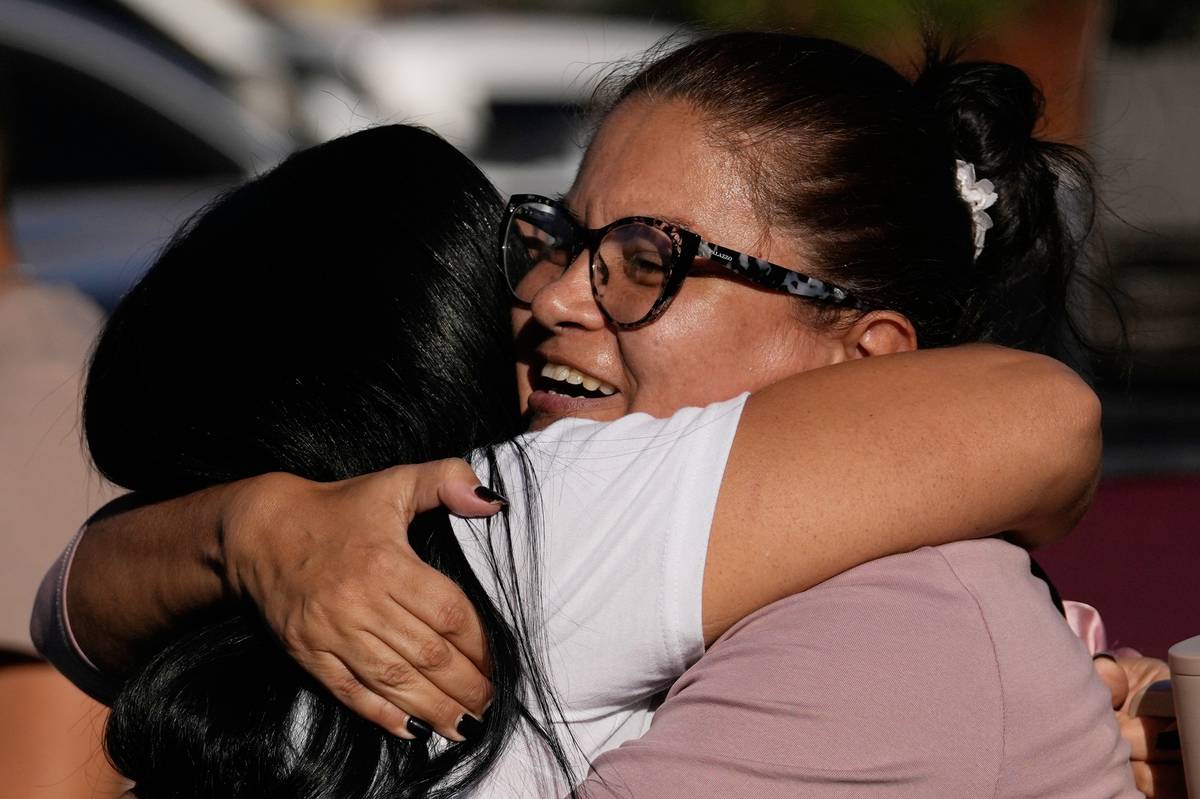
Relatives of detainee Yosnars Baduel embrace outside the Rodeo I prison in Guatire, Venezuela, Thursday, Jan. 8, 2026, after National Assembly President Jorge Rodriguez said the government would release Venezuelan and foreign prisoners.
11:50 JST, January 9, 2026
GUATIRE, Venezuela (AP) — Venezuela released a number of citizens and foreigners from its prisons on Thursday in what a top government official described as a gesture to “seek peace” less than a week after former President Nicolás Maduro was captured by U.S. forces to face drug-trafficking charges in New York.
Jorge Rodríguez, brother of acting President Delcy Rodríguez and head of the National Assembly, said a “significant number” of people would be freed, but he was not specific about how many or provide names. As night fell, The Associated Press identified only five released detainees — all Spanish citizens — but advocates said they expected more people to walk free in the coming hours.
Venezuela’s government has a history of releasing people imprisoned for political reasons — including real and perceived opponents — during moments of high tension to signal openness to dialogue. The releases on Thursday were the first since Maduro was deposed.
Human rights groups and members of the opposition were encouraged by the move, though it wasn’t clear yet what it represented — whether the growing pains of a government in transition or a symbolic overture to placate the Trump administration, which has allowed Maduro’s loyalists to stay in power as it exerts pressure through crippling sanctions.
Journalists, lawyers and human rights activists were among those freed on Thursday. At prisons across the country, families waited for hours in hopes their loved ones would be among those released.
“Consider this a gesture by the Bolivarian government, which is broadly intended to seek peace,” Rodríguez announced, using the term for the government in tribute to Simon Bolívar, Venezuela’s independence hero.
For Venezuelan opposition leader María Corina Machado, the gesture was more “an act of moral restitution.”
“Nothing brings back the stolen years,” she said in an audio message from exile addressed to families of released detainees, urging them to take comfort in the knowledge that “injustice will not be eternal and that the truth, though badly wounded, eventually prevails.”
Advocacy group says 863 detained for ‘political reasons’
The releases also signaled “good news” in the eyes of Alfredo Romero, president of Foro Penal, an advocacy group for prisoners based in Caracas.
He expressed cautious hope “that this is indeed the beginning of the dismantling of a repressive system in Venezuela … and not a mere gesture, a charade of releasing some prisoners and incarcerating others.”
Despite a widespread crackdown during the tumultuous 2024 election — in which the government said it detained 2,000 people — Venezuela’s government denies that there are prisoners unjustly detained, accusing them of plotting to destabilize Maduro’s government.
Romero’s organization said that as of Dec. 29, 2025, there were 863 people detained in Venezuela “for political reasons.”
The Spanish government said Thursday that five of its citizens had been released from custody in Venezuela and would soon return to Spain. Among them was prominent Venezuelan-Spanish lawyer and human rights activist Rocío San Miguel, according to the country’s top diplomat.
Speaking to Spanish broadcaster RNE, Spanish Foreign Minister José Manuel Albares identified the other Spanish nationals released as Andrés Martínez, José María Basoa, Ernesto Gorbe and Miguel Moreno.
Two of them, Martínez and Basoa, were arrested in Venezuela in September 2024 and accused of plotting to destabilize Maduro’s government as Spanish spies — allegations vehemently denied by Spain.
Spain’s El País newspaper reported Thursday that another freed detainee, Gorbe, was arrested in 2024 on allegations of overstaying his visa.
Families wait outside prisons
As the news of the release broke Thursday, families of detainees rushed to prisons across the country, seeking information on their loved ones.
Pedro Durán, 60, was among those hoping to reunite with his brother Franklin Durán as he waited outside a prison in the town of Guatire, around 25 miles (43 kilometers) outside of Caracas. Durán said his brother was detained in 2021 on charges of trying to overthrow Maduro’s government — an accusation his family denies.
Durán, who has been living in Spain, heard rumors on Wednesday that the government could release a number of detainees and immediately bought a plane ticket from Madrid to Caracas to find his brother.
“I don’t have words to express the emotion I’m feeling,” Durán said. “We’re feeling a lot of hope … We’re just waiting now.”
Despite the anticipation, fear persists.
“Of course everyone here is very scared, but what more could (the government) do to us that they haven’t done already,” he added.
‘A bargaining chip’
Ronal Rodríguez, a researcher at the Venezuelan Observatory at the University of Rosario in Bogotá, Colombia, said the government releases prisoners at politically strategic moments.
In July last year, Venezuela released 10 jailed U.S. citizens and permanent residents in exchange for the repatriation of over 200 Venezuelans deported by the Trump administration to El Salvador, where they had been held in a prison built to house criminal gangs.
“The regime uses them like a bargaining chip,” he said of prisoners in Venezuela. It will be telling to see not only how many people the government releases, he said, but also under what conditions and whether the releases include anyone high-profile.
On Wednesday, the Trump administration sought to assert its control over Venezuelan oil, seizing a pair of sanctioned tankers transporting petroleum and announcing plans to relax some sanctions so the U.S. can oversee the sale of Venezuela’s petroleum worldwide.
Both moves reflect the administration’s determination to make good on its effort to control the next steps in Venezuela through its vast oil resources after U.S. President Donald Trump pledged after the capture of Maduro that the U.S. will “run” the country.





Most Read
Popular articles in the past 24 hours
-

Japan PM Takaichi’s Cabinet Resigns en Masse
-
U.S. Firm to Build Training Hub in Fukushima N-plant for Debris R...
-

Bus Carrying 40 Passengers Catches Fire on Chuo Expressway; All E...
-

Milano Cortina 2026: Japan Gains Bronze in Speed Skating Women's ...
-
TEPCO's Niigata Pref. Nuclear Power Plant Begins Transmitting Pow...
-

Milano Cortina 2026: Japan’s Ami Nakai Leads Women’s ...
-

Japan's Govt to Submit Road Map for Growth Strategy in March, PM ...
-

Riku-Ryu Pair Wins Gold Medal: Their Strong Bond Leads to Major C...
Popular articles in the past week
-

Videos Plagiarized, Reposted with False Subtitles Claiming ‘Ryuky...
-

Man Infected with Measles Reportedly Dined at Restaurant in Tokyo...
-
Japan PM Takaichi’s Cabinet Resigns en Masse
-

Tokyo’s New Record-Breaking Fountain Named ‘Tokyo Aqua Symphony’
-

Milano Cortina 2026: Figure Skaters Riku Miura, Ryuichi Kihara Pa...
-

Milano Cortina 2026: Kokomo Murase Comes Out on Top After Overcom...
-
CRA Leadership Election Will Center on Party Rebuilding; Lower Ho...
-
Crime in Japan Ticks Up for 4th Straight Year
Popular articles in the past month
-

Japan Institute to Use Domestic Commercial Optical Lattice Clock ...
-

Israeli Ambassador to Japan Speaks about Japan’s Role in the Reco...
-

Man Infected with Measles May Have Come in Contact with Many Peop...
-
China Eyes Rare Earth Foothold in Malaysia to Maintain Dominance,...
-

Prudential Life Insurance Plans to Fully Compensate for Damages C...
-

Woman with Measles Visited Hospital in Tokyo Multiple Times Befor...
-

Australian Woman Dies After Mishap on Ski Lift in Nagano Prefectu...
-
Foreign Snowboarder in Serious Condition After Hanging in Midair ...
Top Articles in News Services
-

Prudential Life Expected to Face Inspection over Fraud
-
Hong Kong Ex-Publisher Jimmy Lai’s Sentence Raises International Outcry as China Defends It
-

Japan’s Nikkei Stock Average Touches 58,000 as Yen, Jgbs Rally on Election Fallout (UPDATE 1)
-
Trump Names Former Federal Reserve Governor Warsh as the Next Fed Chair, Replacing Powell
-

Suzuki Overtakes Nissan as Japan’s Third‑Largest Automaker in 2025
JN ACCESS RANKING
-
Japan Institute to Use Domestic Commercial Optical Lattice Clock to Set Japan Standard Time
-
Israeli Ambassador to Japan Speaks about Japan’s Role in the Reconstruction of Gaza
-
Man Infected with Measles May Have Come in Contact with Many People in Tokyo, Went to Store, Restaurant Around When Symptoms Emerged
-
Prudential Life Insurance Plans to Fully Compensate for Damages Caused by Fraudulent Actions Without Waiting for Third-Party Committee Review
-
Woman with Measles Visited Hospital in Tokyo Multiple Times Before Being Diagnosed with Disease