
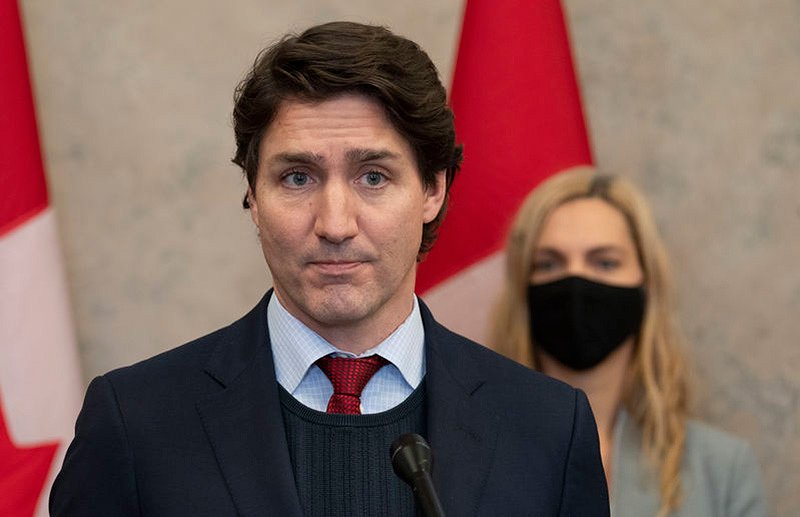
Canadian Prime Minister Justin Trudeau announces Canada will join a diplomatic boycott of the Beijing Winter Olympics over human rights concerns in Ottawa on Wednesday. Looking on at rear is Sport Minister Pascale St-Onge.
December 9, 2021
TORONTO (AP) — Canada will join the United States, the United Kingdom and Australia in a diplomatic boycott of the Beijing Winter Olympics over human rights concerns, Prime Minister Justin Trudeau said Wednesday.
The announcement came after the White House, the Australian government and the UK government confirmed diplomatic boycotts of the Winter Games in February to protest Chinese human rights abuses. China has vowed to react with “firm countermeasures.”
Trudeau said his government has been talks with allies about it in recent months.
“We are extremely concerned by the repeated human rights violations by the Chinese government,” Trudeau said.
“They should not be surprised we will not be sending any diplomatic representation.”
The diplomatic moves by Canada, the U.S., Britain and Australia do not affect their athletes’ ability to compete in the games.
Rights groups have called for a full-blown boycott of the Beijing Winter Games, citing Chinese human rights abuses against its Uyghur minority in the northwest Xinjiang province, which some have called genocide. They also point to Beijing’s suppression of democratic protests in Hong Kong and a sweeping crackdown on dissent in the semi-autonomous territory.
The White House confirmed Monday that it was staging a diplomatic boycott of the upcoming games and Australia followed suit Wednesday, with Prime Minister Scott Morrison saying it was “in Australia’s national interest.”
Relations between Canada and China have been poor since China arrested two Canadians in China in Dec. 2018, shortly after Canada arrested Meng Wanzhou, Huawei Technologies’ chief financial officer and the daughter of the company’s founder, on a U.S. extradition request. Many countries labeled China’s action “hostage politics,” while China has described the charges against Huawei and Meng as a politically motivated attempt to hold back China’s economic and technological development.
China, the U.S. and Canada essentially completed a high-stakes prisoner swap earlier this year but the reputation of the Chinese government has been severely tarnished in Canada.
“Concerns around arbitrary detention are real and shared by many countries around the world,” Trudeau said.
Canadian Foreign Minister Mélanie Joly said more countries need to take similar action.
“It is important to send a strong signal to China,” Joly said. “Human rights violations are not acceptable.”






Most Read
Popular articles in the past 24 hours
-

10 Foreign Tourists Sustain Injuries After Fire at Capsule Hotel ...
-

World Baseball Classic: Venezuela Beats Japan in Nail-biting Back...
-

Zelenskiy Says Ukraine Wants Money, Technology in Return for Midd...
-

Rapid Services Resume on JR Chuo Line; Suspension Caused by Accid...
-

Rapid Services on JR Chuo Line Suspended; Accident at Kokubunji S...
-

World Baseball Classic: Venezuela Beats Japan in Back-and-Forth Q...
-

World Baseball Classic: Red Sox’s Abreu Hits 3-run Homer, Giving ...
-

Rich Local Ingredients Make Nagato Oden Popular Dish
Popular articles in the past week
-

Japan Figure Skating Legend Yuzuru Hanyu Is Proud Disaster Surviv...
-

15 Measles Patients Confirmed in Tokyo in Past 6 Days; 1 May Have...
-

Massive Sewer Pipe Found Jutting Out of Highway in Osaka
-
Japan Govt to Tighten Requirements to Receive Permanent Residency...
-

Power Outage Forces About 980 Passengers in Yokohama to Walk to T...
-
JR Tokai Breaks Ground on Yamanashi Maglev Station; Will Be Part ...
-

Parents in Japan to Get Instagram Notifications When Teens Repeat...
-

'World's Oldest Bio-Business' Is Japan's Seed Koji Retailing, Mol...
Popular articles in the past month
-

Producer Behind Pop Group XG Arrested for Cocaine Possession
-

Japan PM Takaichi’s Cabinet Resigns en Masse
-

Man Infected with Measles Reportedly Dined at Restaurant in Tokyo...
-
Japan Figure Skating Legend Yuzuru Hanyu Is Proud Disaster Surviv...
-

iPS Treatments Pass Key Milestone, but Broader Applications Far f...
-

Sanae Takaichi Elected Prime Minister of Japan; Keeps All Cabinet...
-

South Korea Tightens Rules on Foreigners Buying Homes in Seoul Me...
-

Nepal Bus Crash Kills 19 People, Injures 25 Including One Japanes...
Top Articles in News Services
-
Survey Shows False Election Info Perceived as True
-

Japan’s Nikkei Stock Average Falls as US-Iran Tensions Unsettle Investors (UPDATE 1)
-
Japan’s Nikkei Stock Average Rises on Tech Rally and Takaichi’s Spending Hopes (UPDATE 1)
-

Japan to Ban Use of Power Banks on Airplanes
-

North Korea Unveils Image of Kim Jong Un’s Teenage Daughter Firing Rifle
JN ACCESS RANKING
-
Producer Behind Pop Group XG Arrested for Cocaine Possession
-
Japan PM Takaichi’s Cabinet Resigns en Masse
-
Man Infected with Measles Reportedly Dined at Restaurant in Tokyo Station
-
Japan Figure Skating Legend Yuzuru Hanyu Is Proud Disaster Survivor and Gold Medalist, Vows to Continue Support Efforts
-
iPS Treatments Pass Key Milestone, but Broader Applications Far from Guaranteed