
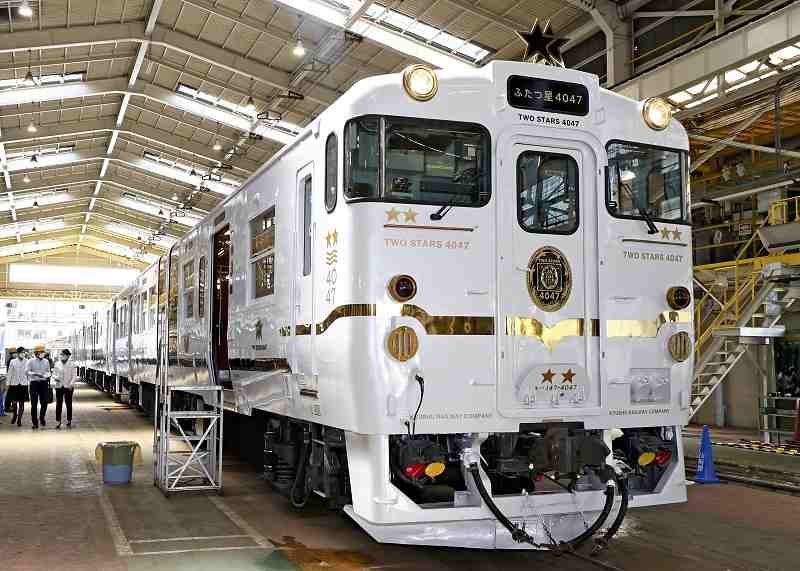
The sightseeing train Two Stars 4047 is seen in Kitakyushu on Thursday.
1:00 JST, September 17, 2022
Kyushu Railway Co., or JR Kyushu, unveiled the sightseeing train Two Stars 4047 to media at a train depot in Kitakyushu on Thursday.
The train will begin operating in the western Kyushu region from Sept. 23, when services start on the Nishi-Kyushu Shinkansen line that runs between Takeo Onsen Station and Nagasaki Station.
The Two Stars train was designed by industrial designer Eiji Mitooka. The exterior is white, inspired by clouds in the sky and yachts on the sea, and a golden belt wraps around the train cars. The seats have the same pattern as the ones in the Kamome Shinkansen to give a sense of harmony.
The Two Stars train will operate twice a day and connects Takeo Onsen Station and Nagasaki Station via a different route from the Shinkansen line. The morning train will leave Takeo Onsen Station and run along the shore of the Ariake Sea to Nagasaki Station. The afternoon train’s return journey allows passengers to view Omura Bay. Specialties found along the route will be sold on board.
“I hope to create a train that has a lasting popularity and that it will lead to the revitalization of western Kyushu,” said JR Kyushu President Yoji Furumiya.
※※※





Most Read
Popular articles in the past 24 hours
-

Director Naomi Kawase's New Film Explores Heart Transplants in Ja...
-

Japan’s Nikkei Stock Average Rises on Tech Rally and Takaichi's S...
-

Takaichi Expected to Express Desire for Constitutional Revision P...
-

Security Services Law Unconstitutional: Do Not Restrict Career Ch...
-
Japanese Man Living in Iraq Suspected of Illegally Entering U.S. ...
-
New Leader of Japan's CRA Opposition Party Faces Challenge of For...
-

Milano Cortina 2026: Snowboarding Star Fukada Wins Gold in Hard-F...
-

Tokyo Exhibition Featuring VR Walk Through 2025 Osaka-Kansai Expo...
Popular articles in the past week
-

Japan PM Takaichi’s Cabinet Resigns en Masse
-

Man Infected with Measles Reportedly Dined at Restaurant in Tokyo...
-

Videos Plagiarized, Reposted with False Subtitles Claiming ‘Ryuky...
-

Sanae Takaichi Elected 105th Prime Minister of Japan; Keeps All C...
-

Japan's Govt to Submit Road Map for Growth Strategy in March, PM ...
-

Milano Cortina 2026: Figure Skaters Riku Miura, Ryuichi Kihara Pa...
-
Tokyo’s New Record-Breaking Fountain Named ‘Tokyo Aqua Symphony’
-

Bus Carrying 40 Passengers Catches Fire on Chuo Expressway; All E...
Popular articles in the past month
-
Japan PM Takaichi’s Cabinet Resigns en Masse
-

Japan Institute to Use Domestic Commercial Optical Lattice Clock ...
-

Israeli Ambassador to Japan Speaks about Japan’s Role in the Reco...
-
Man Infected with Measles Reportedly Dined at Restaurant in Tokyo...
-

Man Infected with Measles May Have Come in Contact with Many Peop...
-

Prudential Life Insurance Plans to Fully Compensate for Damages C...
-
Videos Plagiarized, Reposted with False Subtitles Claiming ‘Ryuky...
-

Woman with Measles Visited Hospital in Tokyo Multiple Times Befor...
Top Articles in Features
-
Sapporo Snow Festival Opens with 210 Snow and Ice Sculptures at 3 Venues in Hokkaido, Features Huge Dogu
-
Tokyo’s New Record-Breaking Fountain Named ‘Tokyo Aqua Symphony’
-

Tourists Flock to Ice Dome Lodge at Resort in Hokkaido, Japan; Facility Invites Visitors to Sleep on Beds Made of Ice
-

High-Hydration Bread on the Rise, Seeing Increase in Specialty Shops, Recipe Searches
-
Heirs to Kyoto Talent: Craftsman Works to Keep Tradition of ‘Kinran’ Brocade Alive Through Initiatives, New Creations
JN ACCESS RANKING
-
Japan PM Takaichi’s Cabinet Resigns en Masse
-
Japan Institute to Use Domestic Commercial Optical Lattice Clock to Set Japan Standard Time
-
Israeli Ambassador to Japan Speaks about Japan’s Role in the Reconstruction of Gaza
-
Man Infected with Measles Reportedly Dined at Restaurant in Tokyo Station
-
Man Infected with Measles May Have Come in Contact with Many People in Tokyo, Went to Store, Restaurant Around When Symptoms Emerged