
Heirs to Kyoto Talent: Craftsman Works to Keep Tradition of ‘Kinran’ Brocade Alive Through Initiatives, New Creations
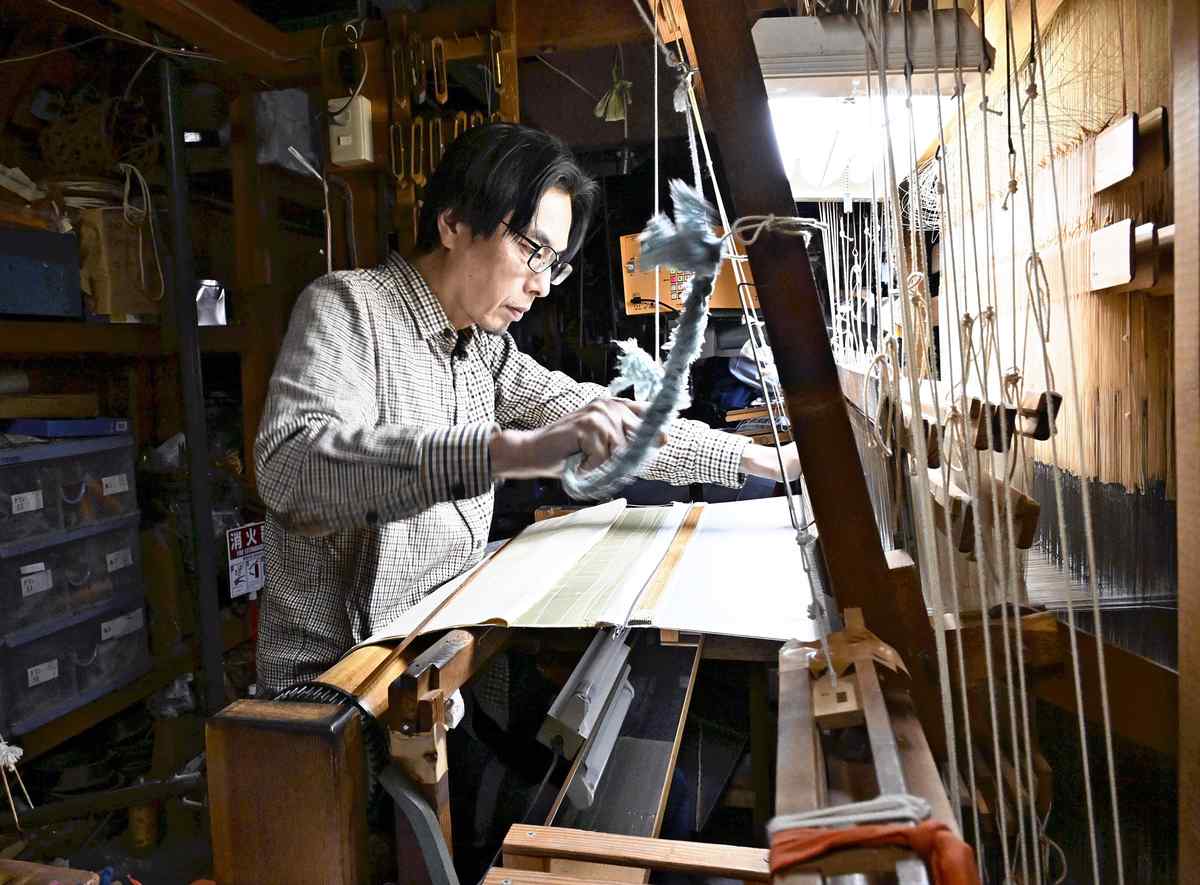
Keiji Okamoto works at a loom in the Okamoto Orimono Co. workshop in Kamigyo Ward, Kyoto.
11:55 JST, February 14, 2026
KYOTO — Clack, thud. Clack, thud. The lonely sound of the hand-operated loom echoes through the chilly workshop. Under the soft light, lustrous silk and gold threads are carefully woven together, emanating a powerful sense of presence.

The workshop, which is part of Okamoto Orimono Co., is located in the Nishijin district, in a residential area of Kamigyo Ward, Kyoto. The area is known for producing Nishijin-ori brocade. Keiji Okamoto, 53, the fourth-generation operator of the family-run company, operates the loom with composure and precision.
You may also like to read
Heirs to Kyoto Talent: Craftsman Strives for ‘Blacker than Black’ Dye, Mastering Prestigious Technique Heirs to Kyoto Talent: Successor Preserves Traditional Japanese Sweets with New IngredientsThe company is famous for its “kinran” brocade, which uses gold and silver threads and foil to create beautiful and impressive patterns. The rich, gorgeous brocade is ideal for priests’ robes and ceremonial tools and is therefore treasured in shrines and temples. The company has preserved the kinran craft for more than 100 years and over four generations.
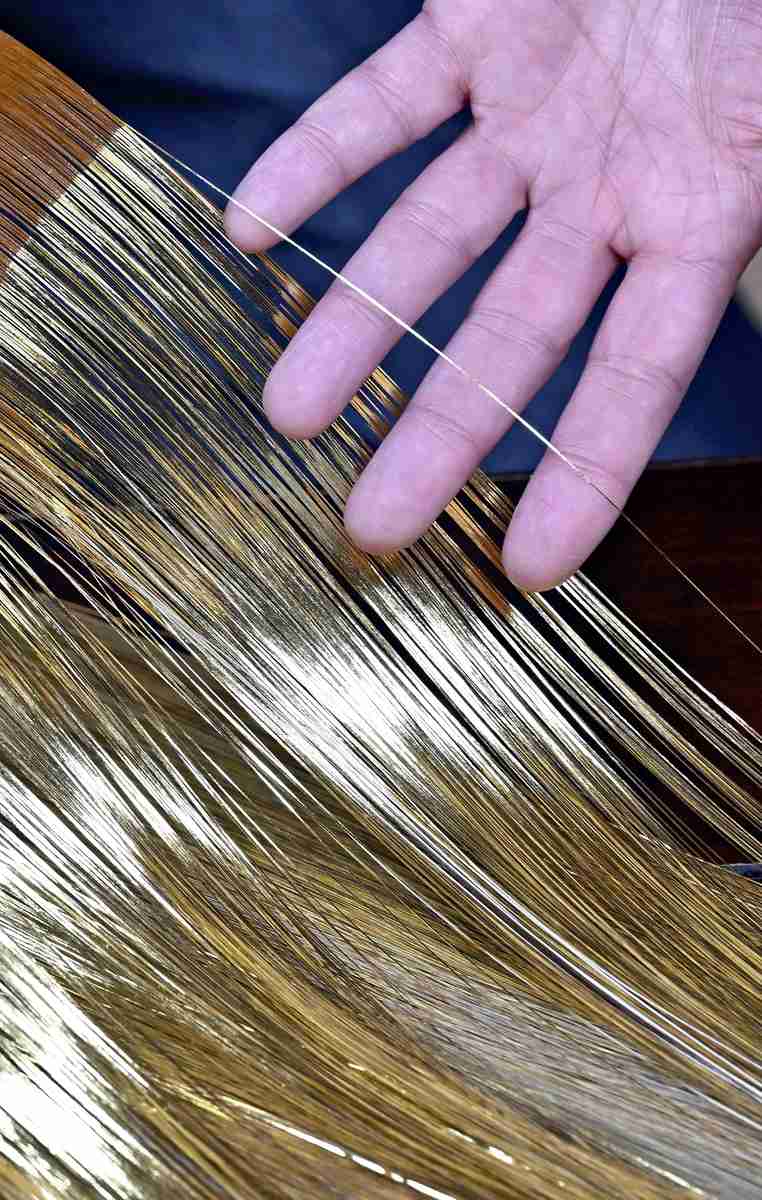
Hikibaku threads are made with gold foil adhered to washi paper and cut thinly. High purity gold is used.
Okamoto’s father and uncle were also skilled craftsmen, so he grew up hearing the sound of looms in the family home and workshop where relatives would gather. After high school, he moved to Tokyo so he could be independent, and studied oil painting at art college. It wasn’t until he was away from Kyoto that he truly grasped the depth of the city.
He initially thought of Nishijin-ori textiles as “gaudy, with flashy patterns made with excessive gold threads.” However, his opinion changed when he came across an essay by 20th century Japanese author Junichiro Tanizaki. He was impressed by the author’s description of gold radiating brilliance in a dimly lit temple hall. Okamoto finally understood the profound depth of kinran, which is intended to express the Pure Land of Amida Buddha, and his interest naturally turned toward the family business.
Exhibited at 2025 expo
After returning to Kyoto, Okamoto started to work closely with his wife, Ema, 52, to expand the company’s customer base. Ema was originally from Hokkaido and met him in Tokyo, where she was studying textile design.
They exhibited kinran items at trade shows and developed neckties using fabrics that were suitable for everyday wear. However, they soon realized that within the apparel industry, Nishijin weaving is considered a luxury item, so they needed to shift their focus.
“I thought it’s OK if it doesn’t sell. I decided to be as unique as possible and create products that would shock people with their high quality and expensive price,” he said.
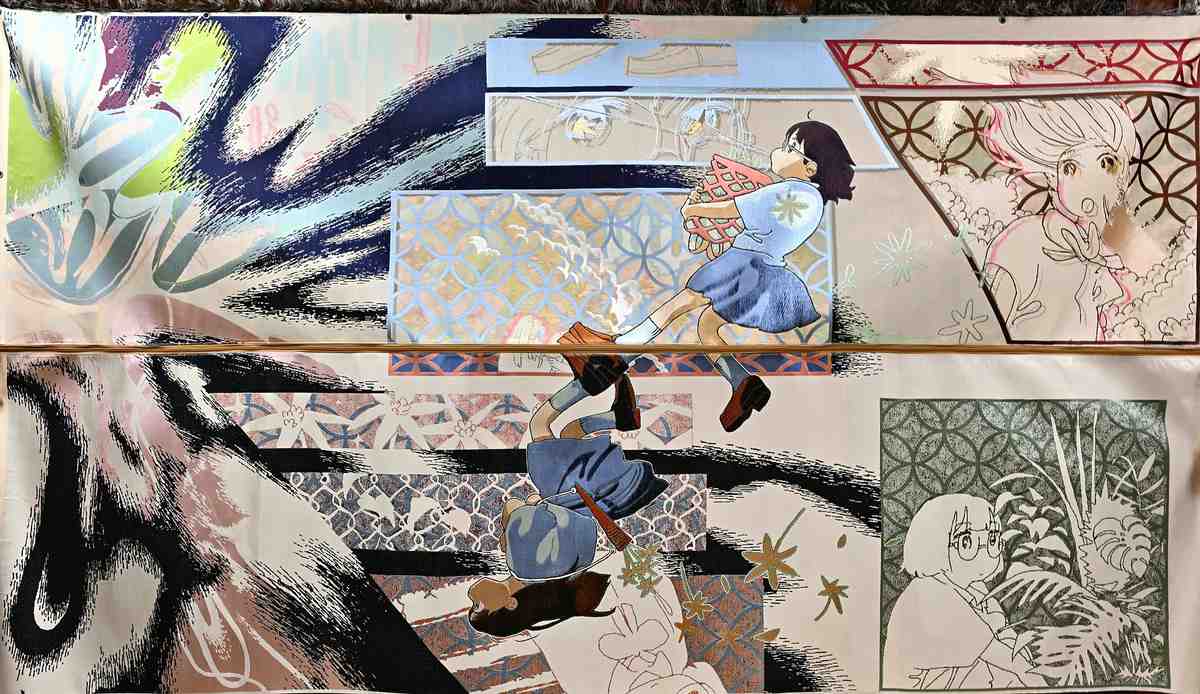
The tapestry titled “Hyuran,” created with the theme “a story of two people chasing light in a dream,” was exhibited at the 2025 Osaka-Kansai Expo.
Okamoto resolved to focus on “hikibaku,” a technique in which gold and silver foil are applied to lacquered washi paper, then cut into thin, long strips to be threads and woven as wefts. The technique requires a high level of skill that only a few people master. Fabrics woven using this technique are rare and precious. His hikibaku wallets and drawstring pouches attracted attention when they were presented at made-to-order trade shows.
“Some people want to give unique gifts, and our products struck a chord with them,” said Okamoto.
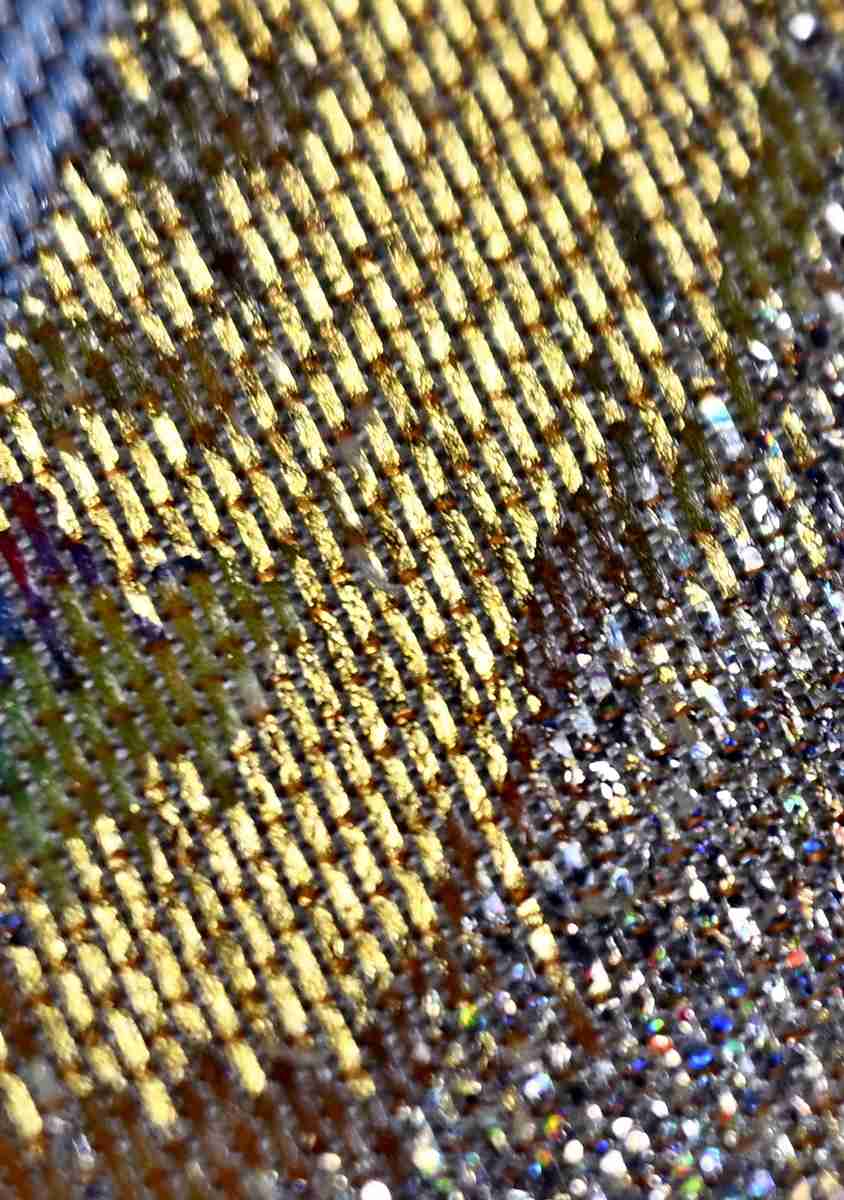
A section of Hyuran woven with hikibaku weft threads to give it a three-dimensional, brilliant appearance.
Last year, Okamoto collaborated with Granuto, a duo of creators from Kyoto, to produce a multicolored tapestry titled “Hyuran,” measuring about 1.4 meters by 2.5 meters, for which the hikibaku technique was extensively used. Its design was entirely different from the items the company usually delivers to shrines and temples. In addition, no mistakes were allowed once weaving began.
Despite these challenges, Okamoto completed the tapestry over a period of six months by using a power loom. It was unveiled at the 2025 Osaka-Kansai Expo.
Okamoto worked on the project after thinking hard about how to make people know about hikibaku. After completing and exhibiting it, he gained confidence.
“We showed people what was possible with hikibaku,” he said.
Efforts to increase radiance
The Nishijin weaving industry traditionally uses a highly specialized division of labor, which includes painting, pattern designing, lacquer application to washi paper and cutting foil, among other jobs. The industry’s workforce is aging, and the techniques required to make the tools and parts needed for weaving are also being lost. There is also a severe shortage of people willing to take over the jobs.
“I can’t tell my son to take over our family business,” said Okamoto. But when he was with his wife, he optimistically said, “Things will work out.”
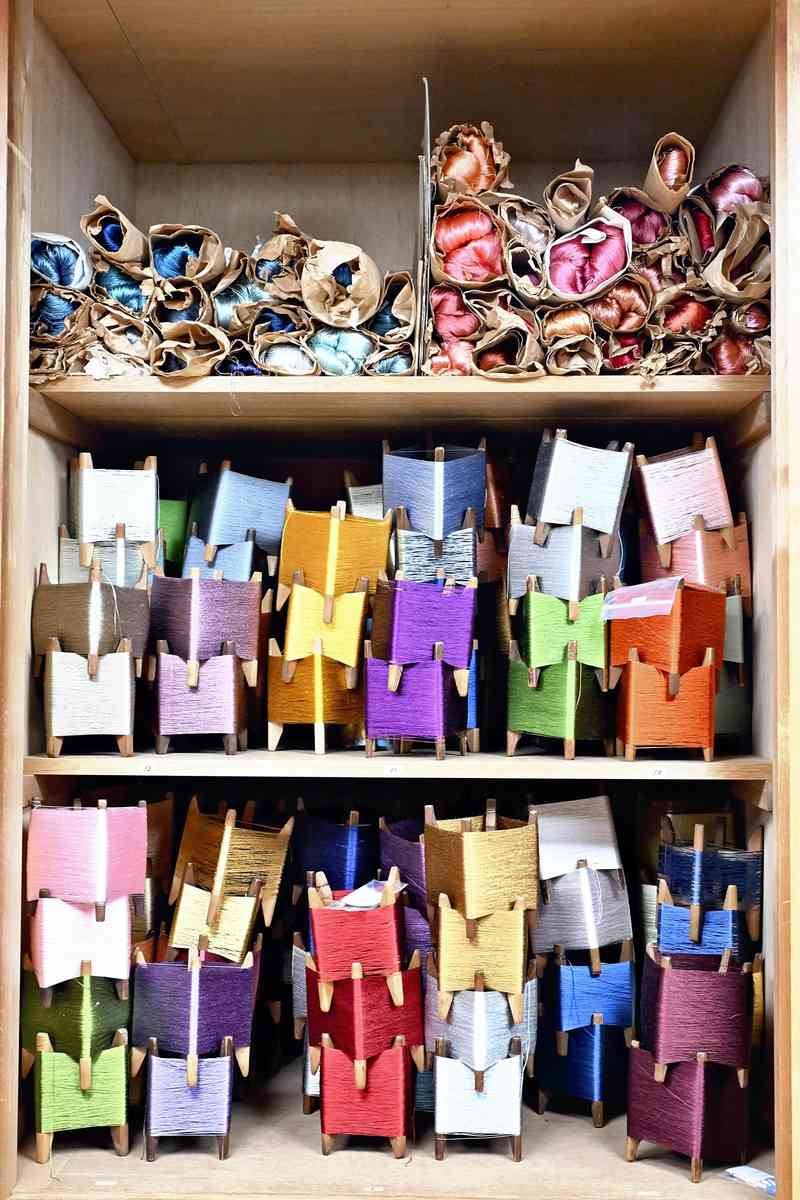
Spools of silk thread in various colors are kept on the shelves.
Ema, who married Okamoto about 30 years ago, works with him and is also in charge of publicity. She is positive about her work and the changes in their business. “Although I knew nothing at first, I created our company’s official website and started posting on social media sites,” she said. “Now, [the content] occasionally goes viral, and the number of visitors to our trade shows and customers has gradually increased.”
Okamoto is also involved in a new initiative. Since March last year, he has been active as a member of the Nishijin Otasuke-tai (Nishijin support squad), which aims to work on the industry’s challenges by working with other weaving companies.
“I’m always feeling the pressure to pass the tradition on to the next generation, but one weaving company alone can’t solve everything,” said Okamoto.
“The most important thing is to have fun. I begin by getting more people to know about my work and do my part to stop the industry from shrinking, even if by only a little. I’m actually a bit excited to see what happens next.”
***
If you are interested in the original Japanese version of this story, click here.


Related Tags





Most Read
Popular articles in the past 24 hours
-

Amid Strait of Hormuz Blockade, Shipping Companies Scramble to Ge...
-

Japan Drafts New Measures against Tech Leakage on Government Fund...
-

Defense Against Cyberattacks Vital for Nations and Companies, Esp...
-

Signboard Collapses on Visitors from Taiwan at Farm in Japan’s To...
-

Honda to Reimport 2 U.S.-Made Models to Sell in Japan; Both Model...
-

Ibaraki Pref.'s 1st Foreign Bus Driver Hired in Tsukuba
-

Milano Cortina 2026: China Beats Japan for Upset Victory in Wheel...
-

China Sets a Lower Economic Growth Target of 4.5% to 5% for 2026 ...
Popular articles in the past week
-

South Korea Tightens Rules on Foreigners Buying Homes in Seoul Me...
-
Tokyo Spends Big on Children, Wins Over Parents
-

Japan’s Miura, Kihara Announce Withdrawal from Figure Skating Wor...
-
2 Unpublished Early Novellas by Japan's Kenzaburo Oe Discovered, ...
-

Strait of Hormuz Closure Shakes Markets; Prolonged Closure Could ...
-

Tourists Ignore Safety Barriers Near Famous Zao ‘Snow Monsters’ i...
-

Iran Situation: Japan Must Exert Diplomatic Efforts without Merel...
-

Measles Patient Visited Hospital in Bunkyo Ward, Tokyo, Metropoli...
Popular articles in the past month
-

Producer Behind Pop Group XG Arrested for Cocaine Possession
-

Japan PM Takaichi’s Cabinet Resigns en Masse
-

Man Infected with Measles Reportedly Dined at Restaurant in Tokyo...
-

Videos Plagiarized, Reposted with False Subtitles Claiming ‘Ryuky...
-

Prudential Life Insurance Plans to Fully Compensate for Damages C...
-

Woman with Measles Visited Hospital in Tokyo Multiple Times Befor...
-

iPS Treatments Pass Key Milestone, but Broader Applications Far f...
-

Sanae Takaichi Elected Prime Minister of Japan; Keeps All Cabinet...
Top Articles in Features
-

Tokyo’s New Record-Breaking Fountain Named ‘Tokyo Aqua Symphony’
-

High-Hydration Bread on the Rise, Seeing Increase in Specialty Shops, Recipe Searches
-

Maltese Pavilion’s Famous Ftira Bread Now Available in Osaka; Loaves Became Popular during 2025 Osaka-Kansai Expo
-

My Spendthrift Mother Constantly Asks Me for Money
-
Japanese Students Use Traditional Pickle to Create Novel Wagashi Confectionery
JN ACCESS RANKING
-
Producer Behind Pop Group XG Arrested for Cocaine Possession
-
Japan PM Takaichi’s Cabinet Resigns en Masse
-
Man Infected with Measles Reportedly Dined at Restaurant in Tokyo Station
-
Videos Plagiarized, Reposted with False Subtitles Claiming ‘Ryukyu Belongs to China’; Anti-China False Information Also Posted in Japan
-
Prudential Life Insurance Plans to Fully Compensate for Damages Caused by Fraudulent Actions Without Waiting for Third-Party Committee Review