
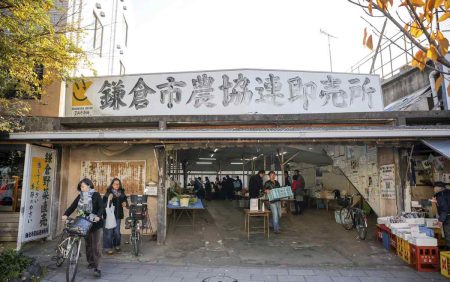
Facing a main street in Kamakura, Kanagawa Prefecture, the weathered, single-story Kamakura City Agricultural Cooperative Union Sales Stand and faded sign lettering evoke a deep sense of history.
16:25 JST, February 2, 2026
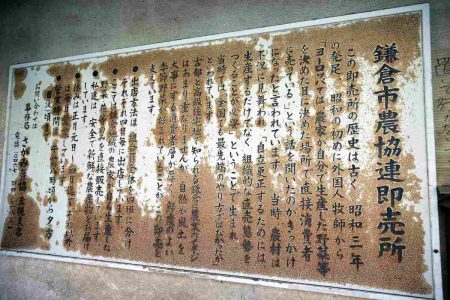
A weathered sign explaining the history of renbai
KAMAKURA, Kanagawa — In the heart of Kanagawa Prefecture’s Kamakura, a city bustling with domestic and international tourists alike, stands the modest, weathered structure of the Kamakura City Agricultural Cooperative Union Sales Stand, which evokes pure nostalgia for the Showa-era (1926-89).
Inside the market, beneath its aging corrugated metal roof and hand-painted signs with faded lettering, a colorful array of fresh local vegetables such as daikon radish, cabbage and fennel is on display.
The farmers market is considered a pioneer of the European-style market in Japan, where producers sell directly to consumers, and affectionately nicknamed “renbai” by locals.
About 20 farming households from Kamakura and the Nagaodaicho district of Yokohama’s Sakae Ward are split into four groups, rotating daily to staff the market.
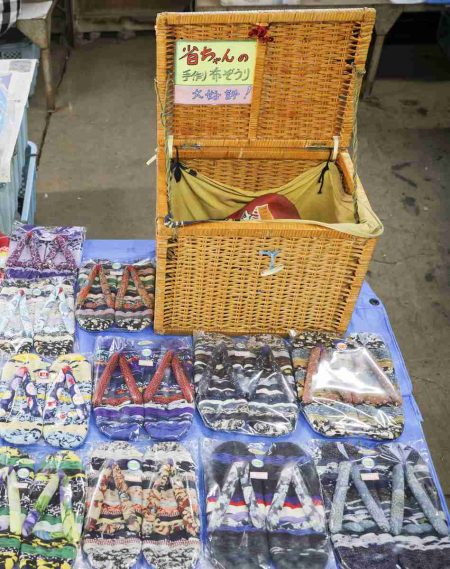
Handmade straw sandals crafted during breaks from farm work are sold at the market.
Its history dates back to the early Showa era, in 1928. According to a vendor, it was inspired by a foreign missionary remarking to farmers — then selling from oxcarts and handcarts — that European farmers sold their produce at permanent market sites. The current site is its third location.
The inclusion of farmers from Nagaodaicho stems from the area originally belonging to the Kamakura district before being annexed by Yokohama City.
Participating farmers focus on the local Kamakura Yasai vegetable brand, producing a wide variety of crops in small batches.
In winter, the daikon selection alone is a splash of colors, featuring varieties such as koushin (red-core), aonaga (green) and purple radishes.
When a female customer asked how to prepare raw “oomasari” peanuts, Hiromi Suzuki, 69, advised that they are best boiled in heavily salted water for 30 minutes. “They can also be frozen for later,” she added, “and taste better if you go a bit heavy on the salt.”
This opportunity to chat with growers while picking out produce is part of what makes renbai so charming.
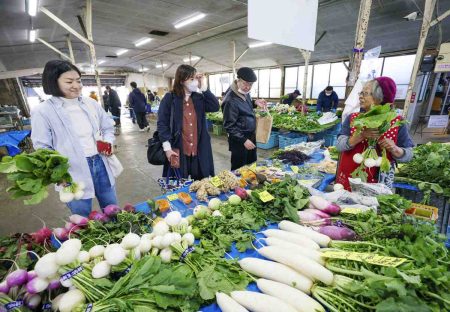
Hiromi Suzuki, right, explains how to prepare various vegetables.
Alongside regular customers, professionals from the restaurant industry flock to the market early in the morning, selecting fresh produce before the price tags have even been set out.
Joji Somura, who runs a French restaurant in Kiba, Tokyo, was seen stocking up on leeks and lettuce. “The selection of fresh, seasonal produce here is outstanding,” he said. “There’s a vibrant seasonal energy here that you just don’t find in Tokyo’s wholesale markets.”
Kaneo Yamamori, 70, who cultivates about 120 vegetable varieties, was busy tending to customers as he reflected: “Since this is a tourist area, people look for vibrant, eye-catching produce, which eventually became our hallmark. It was really the conversations with our customers that nurtured the growth of the Kamakura Yasai brand.”
***
The Kamakura City Agricultural Cooperative Union Sales Stand
Address: 1-13-10 Komachi, Kamakura, Kanagawa Prefecture
Access: A 3-minute walk from the east exit of JR Kamakura Station
Hours: Sales start at about 8 a.m. Closed from Jan. 1 to 4.


Related Tags


Most Read
Popular articles in the past 24 hours
-
Seeking Nuclear Waste Site, Japan Eyes Remote Island of Minami-To...
-

Total Lunar Eclipse Visible for Some in Japan, While Clouds Block...
-

Japan Ministry Asks to Conduct Nuclear Waste Disposal-related Sur...
-

WBC to Begin: All the Pieces are in Place for Japan’s Second Stra...
-

Milano Cortina 2026: Ceremony for Winter Paralympic Torch Relay T...
-
Tokyo High Court Upholds Unification Church Dissolution Order; Li...
-

How Trump Assassination Attempts Played into His Decision to Atta...
-

CARTOON OF THE DAY (March 4)
Popular articles in the past week
-
Tokyo Spends Big on Children, Wins Over Parents
-

Japan’s Miura, Kihara Announce Withdrawal from Figure Skating Wor...
-
South Korea Tightens Rules on Foreigners Buying Homes in Seoul Me...
-
BOJ Keeping Eye on Economy and Takaichi's ‘Proactive Fiscal Polic...
-
Tokyo Measles Patient Traveled to Fukuoka Aboard JAL Planes; Susp...
-
Nidec Chairman Resigns Amid Accounting Scandal at Major Japanese ...
-
Strait of Hormuz Closure Shakes Markets; Prolonged Closure Could ...
-
Tourists Ignore Safety Barriers Near Famous Zao ‘Snow Monsters’ i...
Popular articles in the past month
-

Producer Behind Pop Group XG Arrested for Cocaine Possession
-

Japan PM Takaichi’s Cabinet Resigns en Masse
-

Man Infected with Measles Reportedly Dined at Restaurant in Tokyo...
-

Israeli Ambassador to Japan Speaks about Japan’s Role in the Reco...
-

Videos Plagiarized, Reposted with False Subtitles Claiming ‘Ryuky...
-

Prudential Life Insurance Plans to Fully Compensate for Damages C...
-

Woman with Measles Visited Hospital in Tokyo Multiple Times Befor...
-

iPS Treatments Pass Key Milestone, but Broader Applications Far f...
Top Articles in Features
-
Tokyo’s New Record-Breaking Fountain Named ‘Tokyo Aqua Symphony’
-
High-Hydration Bread on the Rise, Seeing Increase in Specialty Shops, Recipe Searches
-
Heirs to Kyoto Talent: Craftsman Works to Keep Tradition of ‘Kinran’ Brocade Alive Through Initiatives, New Creations
-
Maltese Pavilion’s Famous Ftira Bread Now Available in Osaka; Loaves Became Popular during 2025 Osaka-Kansai Expo
-
Visitors Enjoy Early Blooming Flowers Set Against Mt. Fuji
JN ACCESS RANKING
-
Producer Behind Pop Group XG Arrested for Cocaine Possession
-
Japan PM Takaichi’s Cabinet Resigns en Masse
-
Man Infected with Measles Reportedly Dined at Restaurant in Tokyo Station
-
Israeli Ambassador to Japan Speaks about Japan’s Role in the Reconstruction of Gaza
-
Videos Plagiarized, Reposted with False Subtitles Claiming ‘Ryukyu Belongs to China’; Anti-China False Information Also Posted in Japan