
Hyogo: Kobe Muslim Mosque in Japan Symbolizes Coexistence with People with Different Religious, Cultural Backgrounds
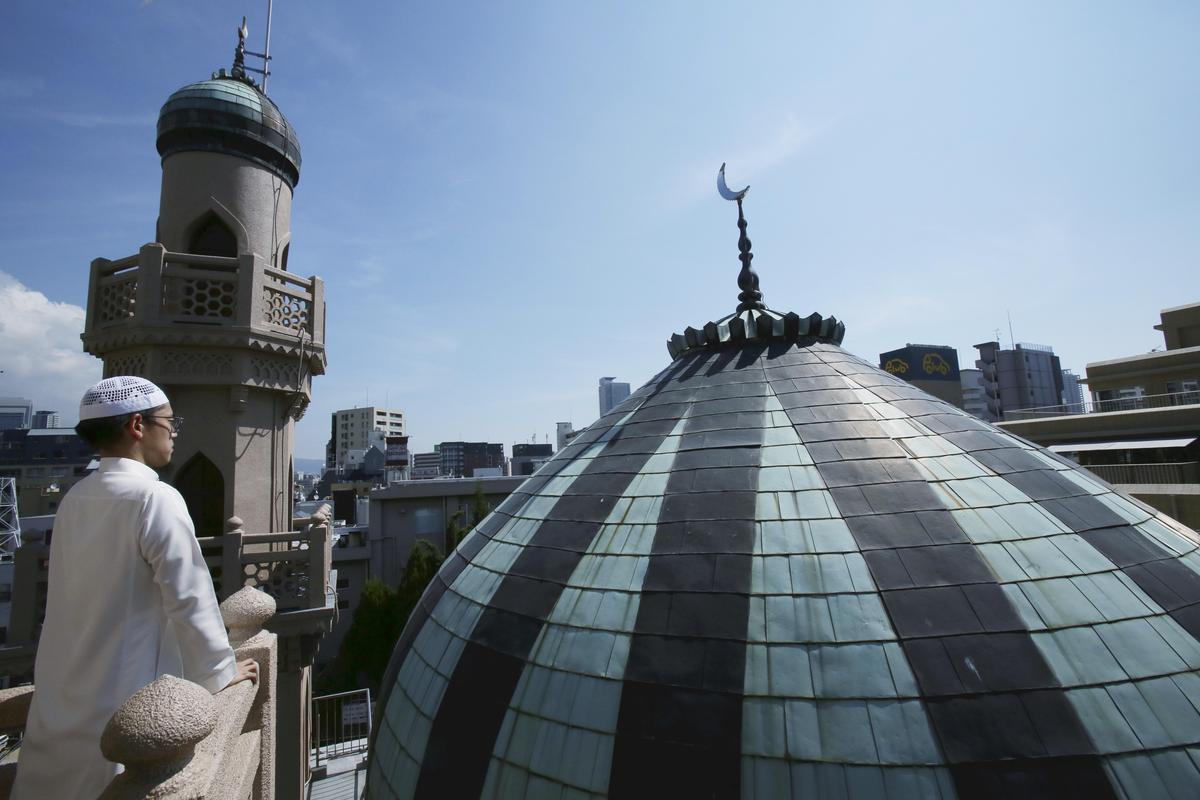
Imam Yusuke Fujitani explains about the onion-shaped dome while standing on the minaret of Kobe Muslim Mosque with Kobe’s city landscape seen in the background.
12:54 JST, November 1, 2025
KOBE — As the first Islamic religious facility in Japan, Kobe Muslim Mosque stands in an exotic location in Kobe.
Having survived intact through war and disaster, the mosque, dubbed “the Miracle Mosque,” marked its 90th anniversary this year since opening. This solemn building has continued to watch over the port city over the years.
With an onion-shaped dome and a minaret tower, the mosque stands in the city’s Kitano area, where historic Western-style houses and restaurants are concentrated. The surfaces of its walls are decorated with beautiful geometric patterns that give the structure an exotic feeling.
The ferro-concrete building of the mosque is three stories tall with a basement. The first and second floors form a prayer room with a two-story ceiling.
At the center of the prayer room, there is a niche on a wall called “mihrab” that indicates the direction of Mecca, the most holy place in Islam. Next to the mihrab, there is a minbar at which an imam, a prayer leader, stands and delivers sermons.
Chandeliers hung from the ceiling illuminate the inside of the prayer space.
A balcony on the second floor is used as a space where women offer their prayers. On Fridays, when collective worships are held, the third floor is opened to worshippers. The building can accommodate about 400 people.
A guide took me through the mosque, and I climbed up a spiral staircase to the balcony of the minaret tower.
From the balcony, the dome with a crescent moon-shaped roof cresting atop it is seen just below and the city landscape of Kobe can be seen in full view.
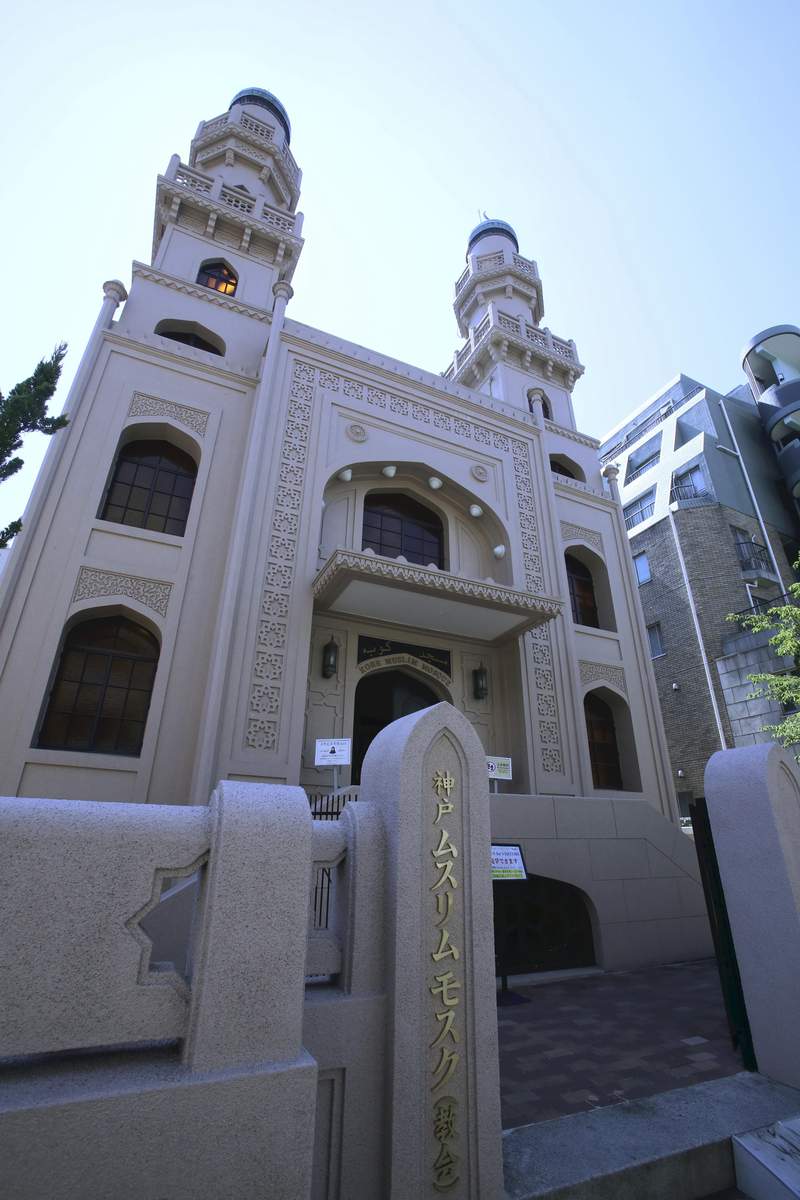
The mosque’s exterior beige walls are impressive. The building is robust and is still standing after past disasters.
Yusuke Fujitani, 32, the first Japanese imam of the mosque, said, “I heard that when this mosque was just built, azans, which are calls for Muslims to begin prayers, were made.”
The mosque was built in 1935 with donations from Muslims. After World War I, people from all over the world gathered in Kobe, where international trade flourished.
Muslim Indians, Turks and Tatars immigrated to Kobe. They engaged in the project to build the mosque seeking a place of prayer. In October that year, a large opening ceremony was held.
During the bombing of Kobe during World War II in 1945, the building was not burned. However, many other buildings around it burned down, and the mosque kept its function as a place of prayer.
The structure did not collapse in the Great Hanshin Earthquake in 1995, and accommodated about 30 families as an evacuation shelter for about three months.
“I heard that the people helped each other regardless of faith and shared supplies,” Fujitani said.
As the building survived the two huge disasters, it became a hot topic overseas as the Miracle Mosque, and it has been visited by Muslims and other visitors frequently.
Yoshitaka Somada, a 66-year-old local Muslim, said, “The mosque symbolizes Kobe’s history of coexistence between Japanese and foreigners. I hope it will become a place familiar to more and more people.”

Built to be more robust, suitable to the city
The mosque was designed by Jan Josef Svagr (1885-1969), a Czech architect. He worked as a building engineer in Russia and China, and then came to Japan. He designed many other religious buildings in Japan, including Catholic Toyonaka Church in Toyonaka, Osaka Prefecture.
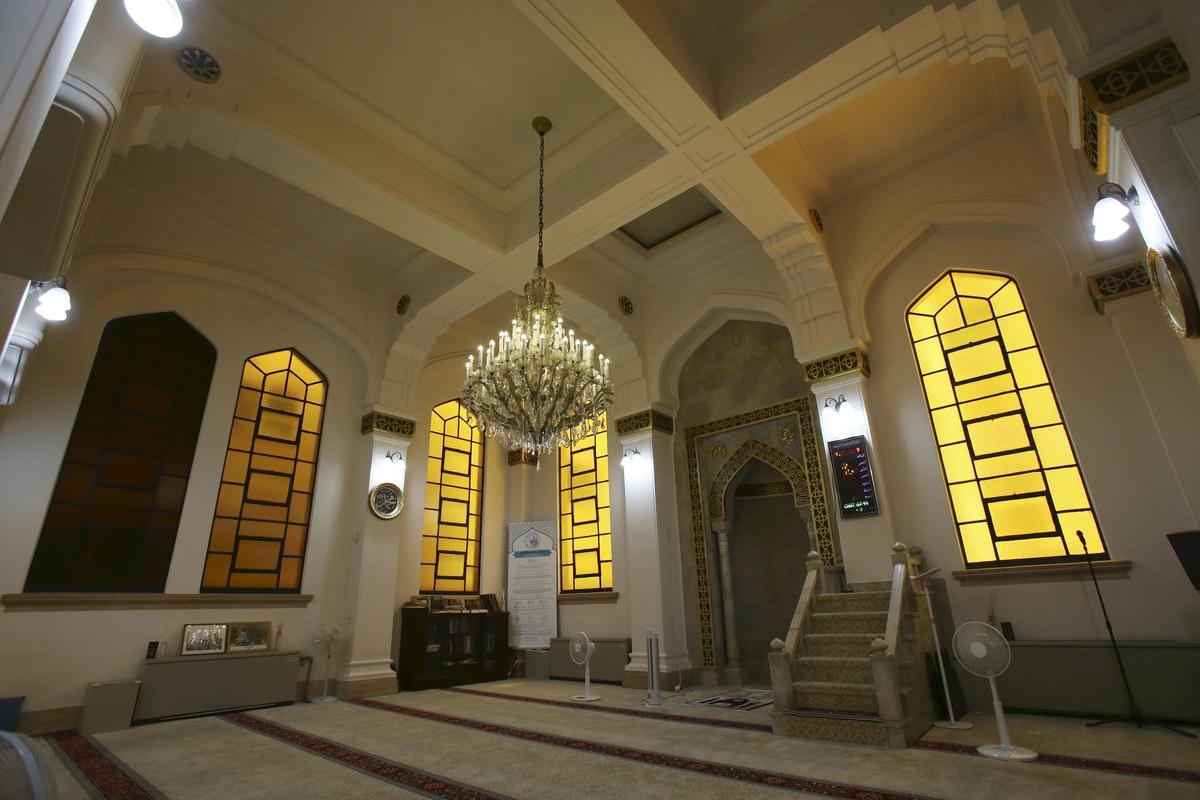
A prayer room on the first floor where arch-shaped designs of the mihrab and windows at the center are eye-catching.
The mosque was constructed by Takenaka Corp., but Svagr appears to have modified the blueprint created by the contractor.
After the modification, the number of pillars increased, beams became thicker and Oriental styles of tortoise shell-shaped patterns were added on the minaret tower’s railing. The original blueprint did not show the onion-shaped dome.
These features suggest that Svagr’s intention was to create a robust building, which was suitable for Kobe.
Yushi Utaka, a professor at the University of Hyogo’s School of Human Science and Environment, said, “It’s a precious structure not only because it was the first mosque built in Japan but also because it survived damage from the war and earthquakes.”

Halal fast food
Around the mosque, there are many restaurants and foodstuff stores that are “halal,” meaning that the food is in line with Islamic law.
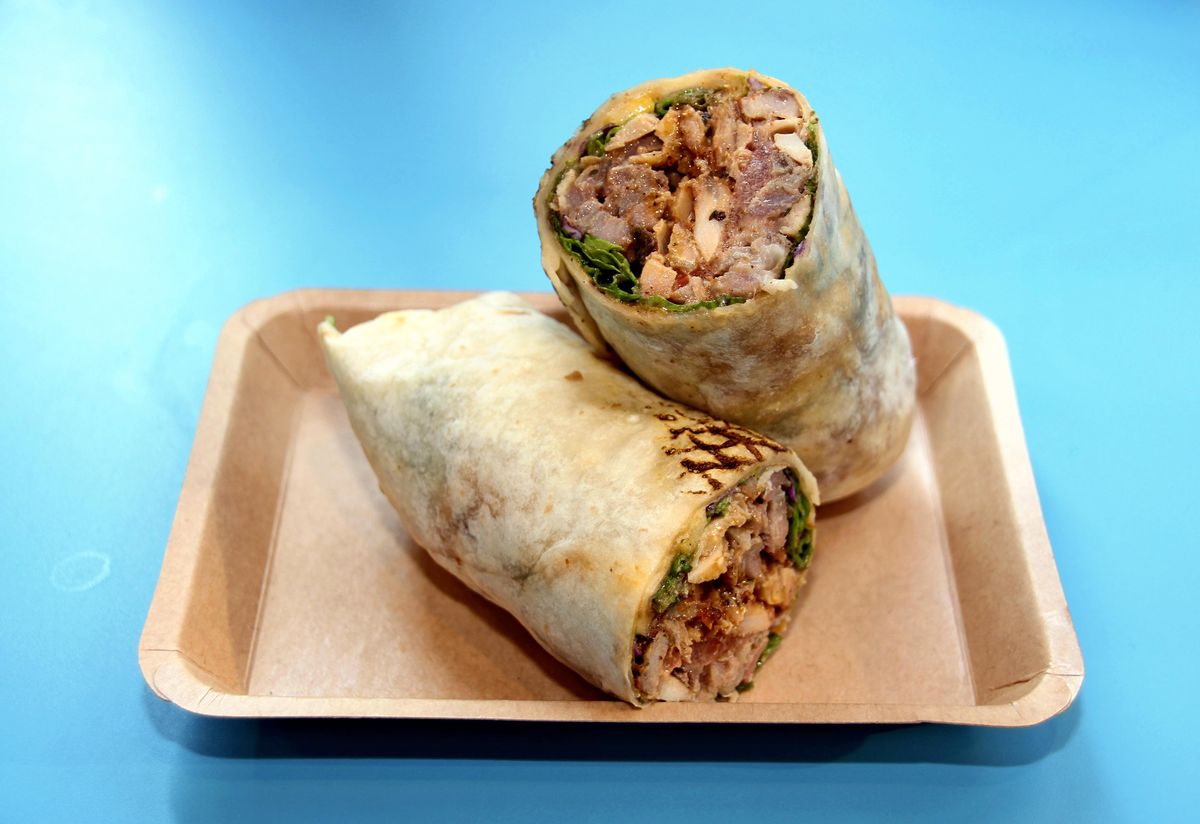
The Beef & Chicken Roll Sandwich
One of them, Kobe Shawarma, is a fast-food shop that is popular for Middle-Eastern-style sandwiches and desserts.
One of its most popular cuisines is the Beef & Chicken Roll Sandwich, priced at ¥990 including tax. It is a kind of pita wrap sandwich that has meats grilled on a skewer while being rotated and seven kinds of vegetables.
“The meats are grilled after having been soaked in yogurt or vinegar for a long time, and so they become tasty,” said a 27-year-old employee of the store.
The store is open from 11 a.m. to 9 p.m.
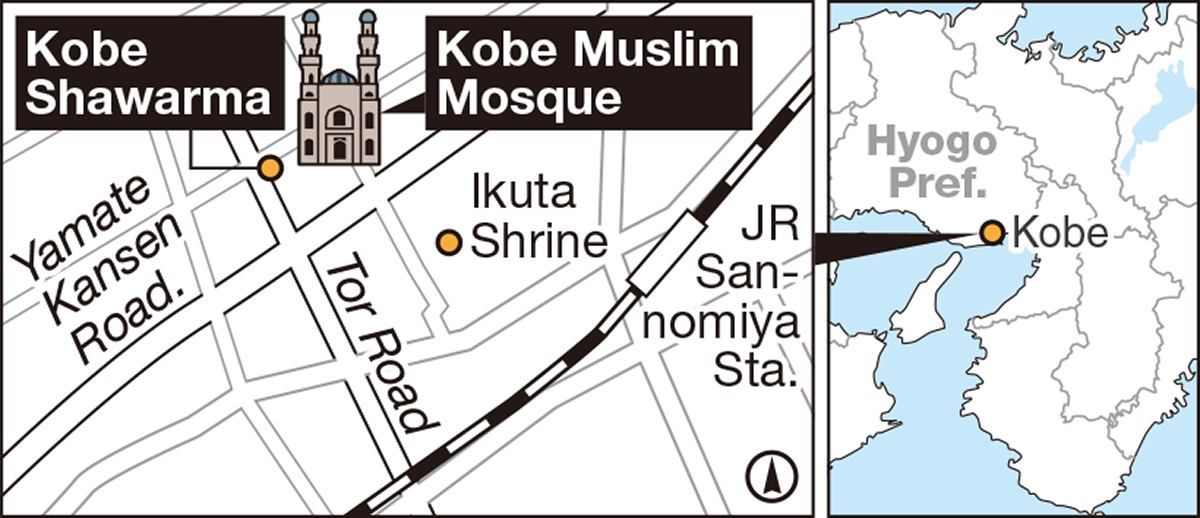
Kobe Muslim Mosque
About 15-minute walk from JR Sannomiya Station. Visitors are allowed to enter the mosque from 10 a.m. to 6 p.m. except on Fridays. If the number of the visitors is small, prior reservations are not necessary. Modest or non-revealing clothing is required for entry.





Most Read
Popular articles in the past 24 hours
-
Moai Statue Shows Lasting Bond Between Miyagi Pref. Town, Easter ...
-

Milano Cortina 2026: Japan’s Oguri Wins Para Snowboard Silver at ...
-
Japan's Defense Ministry: North Korea Appears to Have Fired Balli...
-

Aichi Fisheries Cooperatives Use Smart Tech to Farm Triploid Oyst...
-

National Intelligence Council: Proposed Body Must Be Utilized To ...
-

Teachers Support Students’ Inquiry Learning behind the Scenes
-

Japan's Lower House Passes Budget Proposal; Could Be Delayed in U...
-

CARTOON OF THE DAY (March 14)
Popular articles in the past week
-

Japan Figure Skating Legend Yuzuru Hanyu Is Proud Disaster Surviv...
-
Govt to Utilize ODA for Ensuring Economic Security; Securing Ener...
-
15 Measles Patients Confirmed in Tokyo in Past 6 Days; 1 May Have...
-
Massive Sewer Pipe Found Jutting Out of Highway in Osaka
-

Japan Govt to Tighten Requirements to Receive Permanent Residency...
-
JR Tokai Breaks Ground on Yamanashi Maglev Station; Will Be Part ...
-
Power Outage Forces About 980 Passengers in Yokohama to Walk to T...
-
Beckoning Cats Get Makeover to Fit Modern Lifestyles with Sleek D...
Popular articles in the past month
-

Producer Behind Pop Group XG Arrested for Cocaine Possession
-

Japan PM Takaichi’s Cabinet Resigns en Masse
-

Man Infected with Measles Reportedly Dined at Restaurant in Tokyo...
-

Videos Plagiarized, Reposted with False Subtitles Claiming ‘Ryuky...
-
Japan Figure Skating Legend Yuzuru Hanyu Is Proud Disaster Surviv...
-

iPS Treatments Pass Key Milestone, but Broader Applications Far f...
-

Sanae Takaichi Elected Prime Minister of Japan; Keeps All Cabinet...
-

Nepal Bus Crash Kills 19 People, Injures 25 Including One Japanes...
Top Articles in Features
-
Tokyo’s New Record-Breaking Fountain Named ‘Tokyo Aqua Symphony’
-

High-Hydration Bread on the Rise, Seeing Increase in Specialty Shops, Recipe Searches
-
Japanese Students Use Traditional Pickle to Create Novel Wagashi Confectionery
-

My Spendthrift Mother Constantly Asks Me for Money
-
Tourists Ignore Safety Barriers Near Famous Zao ‘Snow Monsters’ in Japan
JN ACCESS RANKING
-
Producer Behind Pop Group XG Arrested for Cocaine Possession
-
Japan PM Takaichi’s Cabinet Resigns en Masse
-
Man Infected with Measles Reportedly Dined at Restaurant in Tokyo Station
-
Videos Plagiarized, Reposted with False Subtitles Claiming ‘Ryukyu Belongs to China’; Anti-China False Information Also Posted in Japan
-
Japan Figure Skating Legend Yuzuru Hanyu Is Proud Disaster Survivor and Gold Medalist, Vows to Continue Support Efforts