
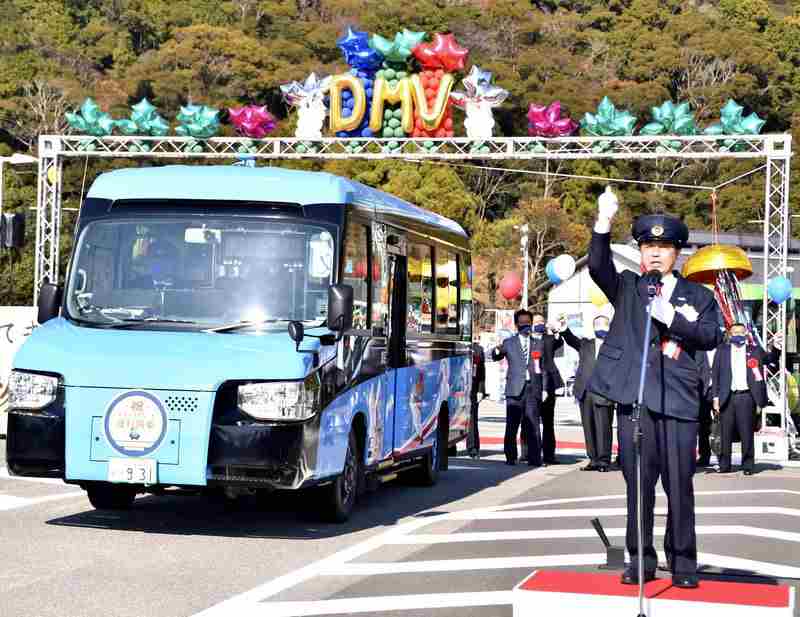
Asa Coast Railway’s dual-mode vehicle is seen in Kaiyo, Tokushima Prefecture, on Saturday.
14:54 JST, December 27, 2021
TOKUSHIMA — A dual-mode vehicle capable of running on both railway tracks and roads has started services on the Asa Coast Railway Line, a railroad linking Tokushima and Kochi prefectures, marking the world’s first full-scale operation of such a vehicle.
The DMV is an adapted minibus with a capacity of about 20 passengers. It runs along the coast of the two prefectures. After a ceremony to celebrate the start of the service on Saturday, the first DMV carrying railroad fans and others departed at about 12:30 p.m.
Mode change
In a test-drive on Dec. 10, a DMV carrying local residents departed from the Awa Kainan Bunkamura cultural facility and ran on the road. At Awa-Kainan Station in Kaiyo, Tokushima Prefecture, the metal wheels stored on the vehicle’s underside were lowered to switch from bus mode to train mode. When the driver pressed the accelerator, the vehicle started to glide along the railroad tracks.
“It’s more comfortable than a train because it shakes less,” said a 59-year-old civil servant from Anan, Tokushima Prefecture, who was riding the DMV.
The vehicle is 8 meters long and 2 meters wide, and was adapted from a Toyota Motor Corp. minibus. In addition to railroad wheels, the vehicle is equipped with a location notification system and brakes equivalent to an automatic train stop system.
The main route is about 15 kilometers long — of which about 10 kilometers are railway tracks — and mainly runs along the border of the two prefectures. On weekdays, the DMV makes 26 inbound and outbound runs, and 30 on weekends and holidays. On weekends and holidays, the vehicle also makes one round trip from the Awa Kainan cultural facility to Cape Muroto — a distance of about 50 kilometers each way.
The Asa Coast Railway Line stopped operating a year ago. Two stations were renovated, with platforms lowered to accommodate the DMVs. The DMV system cost ¥1.6 billion, including three vehicles.
“We’re finally at the starting line,” said Toyoki Ihara, an executive director of Asa Coast Railway Co.
Decade of planning
Asa Coast Railway began considering the DMV project around 2009. In the days of the now-defunct Japanese National Railways, consideration was given to extending the line from Tokushima to Muroto. However, passenger numbers continued to decrease due to depopulation, and the expansion was deemed unrealistic. The idea of the DMV system emerged, which JR Hokkaido had been considering since 2002, but suspended.
Because the extended section runs on public roads, there was no need to build new tracks, crossings and other essential railroad infrastructure. Maintenance costs can be kept low.
However, a technical problem existed. There were concerns within JR Hokkaido that since the DMV is lighter than an ordinary train car, the vehicle could derail if it were to run on snowy tracks.
The government’s technical evaluation committee noted that the long-term durability of the parts supporting the wheels of the DMV “needs to be continued to be verified.”
For the time being, inspections will be conducted every year, instead of once every four years as originally planned.


Related Tags


Most Read
Popular articles in the past 24 hours
-
Japan's Defense Ministry: North Korea Appears to Have Fired Balli...
-

Milano Cortina 2026: Japan’s Oguri Wins Para Snowboard Silver at ...
-

National Intelligence Council: Proposed Body Must Be Utilized To ...
-
Aichi Fisheries Cooperatives Use Smart Tech to Farm Triploid Oyst...
-

Teachers Support Students’ Inquiry Learning behind the Scenes
-

CARTOON OF THE DAY (March 14)
-

Japan's Lower House Passes Budget Proposal; Could Be Delayed in U...
-

Fukuoka: American Beavers at Japan's Zoo Create Sculptures; Visit...
Popular articles in the past week
-

Japan Figure Skating Legend Yuzuru Hanyu Is Proud Disaster Surviv...
-
Govt to Utilize ODA for Ensuring Economic Security; Securing Ener...
-
15 Measles Patients Confirmed in Tokyo in Past 6 Days; 1 May Have...
-
Massive Sewer Pipe Found Jutting Out of Highway in Osaka
-

Japan Govt to Tighten Requirements to Receive Permanent Residency...
-
JR Tokai Breaks Ground on Yamanashi Maglev Station; Will Be Part ...
-
Power Outage Forces About 980 Passengers in Yokohama to Walk to T...
-

Beckoning Cats Get Makeover to Fit Modern Lifestyles with Sleek D...
Popular articles in the past month
-

Producer Behind Pop Group XG Arrested for Cocaine Possession
-

Japan PM Takaichi’s Cabinet Resigns en Masse
-

Man Infected with Measles Reportedly Dined at Restaurant in Tokyo...
-
Japan Figure Skating Legend Yuzuru Hanyu Is Proud Disaster Surviv...
-

iPS Treatments Pass Key Milestone, but Broader Applications Far f...
-

Sanae Takaichi Elected Prime Minister of Japan; Keeps All Cabinet...
-

Nepal Bus Crash Kills 19 People, Injures 25 Including One Japanes...
-

South Korea Tightens Rules on Foreigners Buying Homes in Seoul Me...
Top Articles in Features
-

Tokyo’s New Record-Breaking Fountain Named ‘Tokyo Aqua Symphony’
-

High-Hydration Bread on the Rise, Seeing Increase in Specialty Shops, Recipe Searches
-

Japanese Students Use Traditional Pickle to Create Novel Wagashi Confectionery
-

My Spendthrift Mother Constantly Asks Me for Money
-
Tourists Ignore Safety Barriers Near Famous Zao ‘Snow Monsters’ in Japan
JN ACCESS RANKING
-
Producer Behind Pop Group XG Arrested for Cocaine Possession
-
Japan PM Takaichi’s Cabinet Resigns en Masse
-
Man Infected with Measles Reportedly Dined at Restaurant in Tokyo Station
-
Japan Figure Skating Legend Yuzuru Hanyu Is Proud Disaster Survivor and Gold Medalist, Vows to Continue Support Efforts
-
iPS Treatments Pass Key Milestone, but Broader Applications Far from Guaranteed