
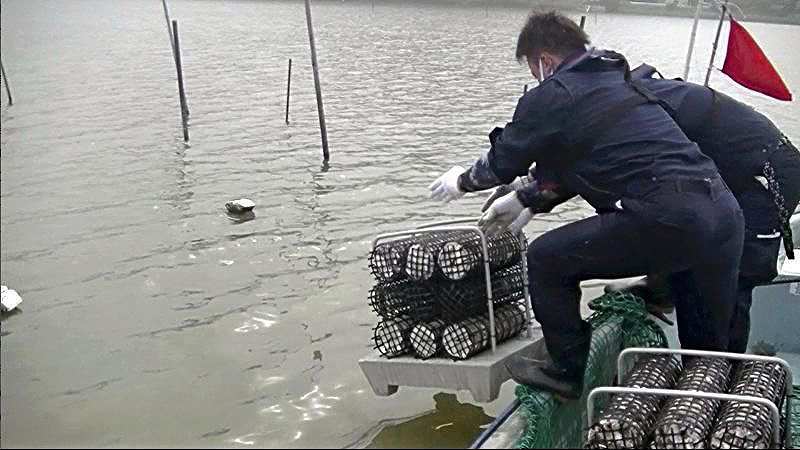
Staff set up artificial reefs for prawns at Lake Kojima.
9:30 JST, December 19, 2021
OKAYAMA — More prawns are being found in an artificial lake in Okayama, which is sparking hope the water will be cleaned because they eat excess plankton that fouls the water.
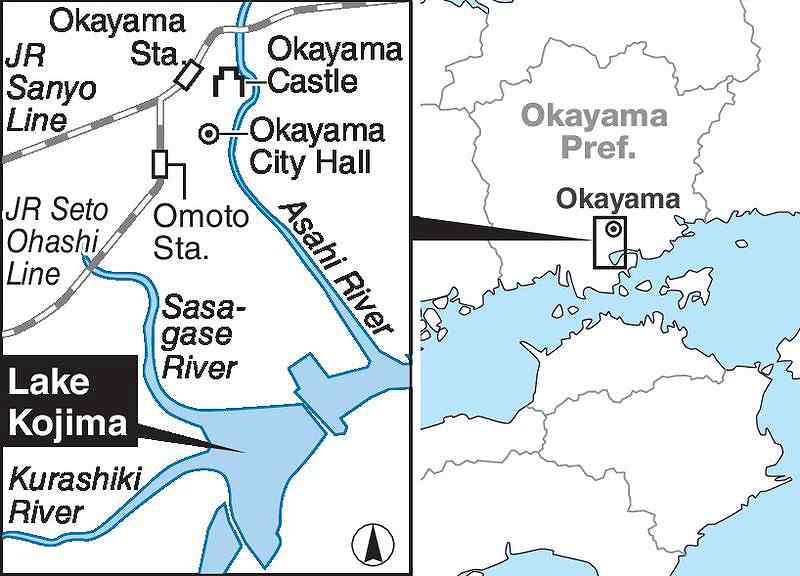
Lake Kojima, which straddles Okayama and Tamano cities, has an area of 10.88 square kilometers and was created to secure water for agriculture in 1959 by damming Kojima Bay and desalinating it.
As its watershed population reaches about 680,000 people, or about one-third of the whole prefecture, the lake has been plagued with water pollution due to the large inflow of wastewater from households and industries. The situation has worsened due to its shallow depth of about 2 meters, which stagnates the water.
In terms of the chemical oxygen demand, which indicates the level of pollution, the lake recorded 12 milligrams per liter in fiscal 1998, the third worst in the country. It has been improving, but the environmental standard of 5 milligrams per liter has not been achieved; it stood at 7.7 milligrams per liter in fiscal 2019.
Given this, the Okayama prefectural government has focused on a type of prawn that inhabits the lake — oriental river prawns. The species feed on plankton and take nitrogen and phosphorus into their bodies.
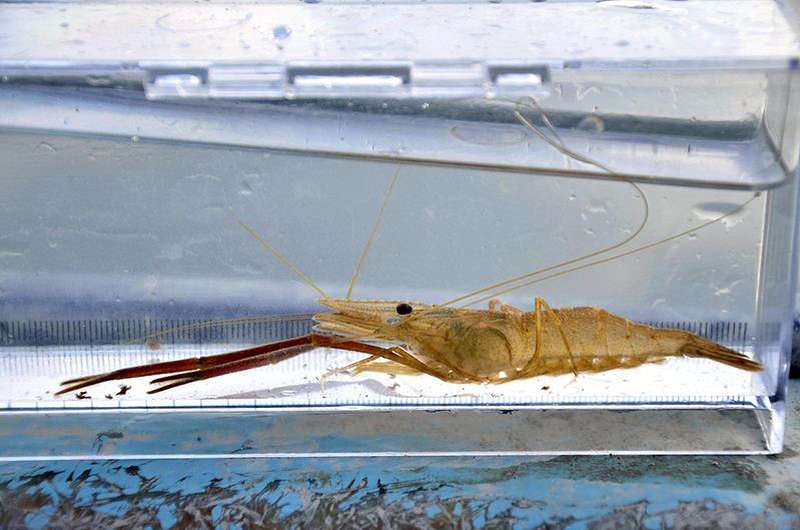
An oriental river prawn
There have been fewer prawns in the lake, however. At their peak in 1981, there was a catch of about 13 tons of prawns, but in recent years, the catch has fallen to about 3 tons. The development of seawalls and other facilities are affecting and reducing their habitat.
Thus, the prefectural government started in 2018 to set up artificial reefs — tubes stuffed with oyster and scallop shells — in the lake on an experimental basis. It is hoped that oriental river prawns will increase their numbers as the reefs are expected to help them avoid predation and secure spawning grounds.
The prefectural government learned from the experiment that more prawns are caught in areas where the reefs were installed compared to areas with no reefs. In fiscal 2020, the same comparison showed a difference of 1.3 to 3 times the prawns.
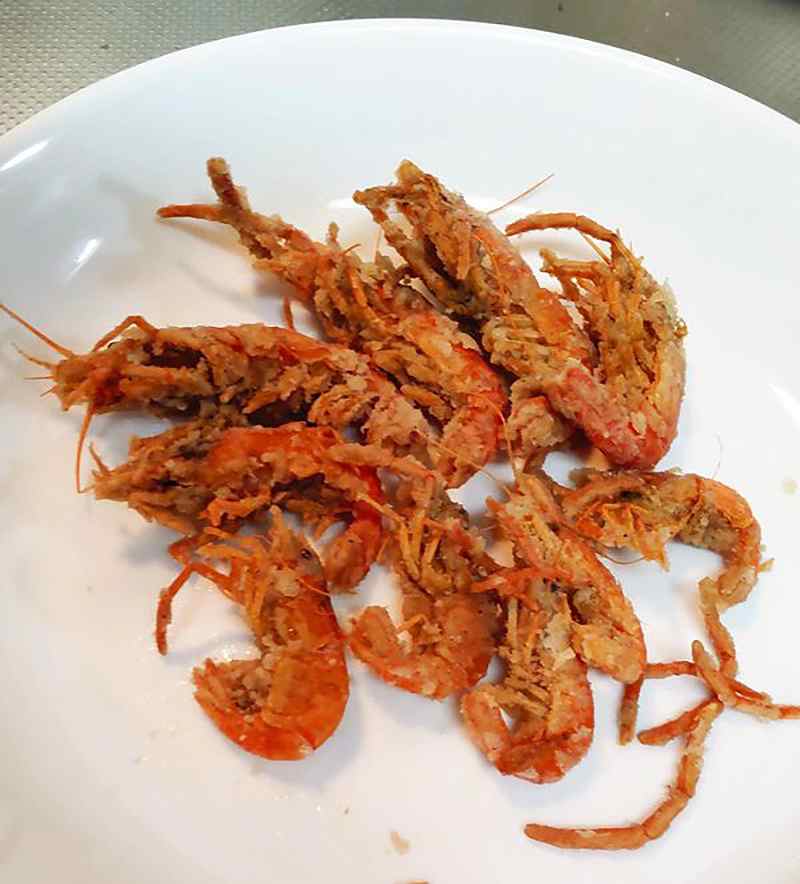
Fried prawns
“I feel like the amount of prawns we can catch is increasing,” said a 71-year-old fisherman, who has been working at Lake Kojima for about 40 years. He sells some of the prawns he catches to wholesalers.
Having more prawns not only contributes to water purification, but also benefits local fishermen because the oriental river prawns are sometimes treated as a luxury ingredient at high-end restaurants thanks to their unusual appearance.
The challenge is discerning how to elevate the prawn’s name recognition to better sell them. The low profile is also acknowledged by Yuji Mitsuyoshi, a dealer in river fish and shellfish, including eels and prawns, in Okayama City.
“Since the price is unstable, it is difficult for the species to compete with other species,” Mitsuyoshi said. “The solution is to raise the profile of the product and have more fishermen catch them.”
An official of the prefectural government said: “We would like to consider effective promotional methods to help make our prawns better known, and at the same time, make more people aware of the water pollution problems of Lake Kojima.”


Related Tags







Most Read
Popular articles in the past 24 hours
-
Rising Kabuki Star Works to Ensure Deaf Audience's Enjoyment of P...
-

Lady Bess: Iroha Okuda, Mayuko Kominami Discuss Performing Elizab...
-

Japan Considering Taking Part in U.S. ‘Golden Dome’ Defense Syste...
-

Japan's TEPCO Releases Footage from Fukushima N-Plant Reactor
-

46 Evacuated from UAE, Oman on Japanese Govt-chartered Flight
-

Driver Dies in Collision with Express Train at Crossing in Mito; ...
-

Japan's Sanyo Shinkansen Suspended Again; Between Okayama, Aioi S...
-

Raise Interest Rate, Stop Yen’s Fall to Stabilize Prices
Popular articles in the past week
-

Japan Figure Skating Legend Yuzuru Hanyu Is Proud Disaster Surviv...
-

Nippon Life Insurance's U.S. Arm Sues OpenAI Over Legal Assistanc...
-

Govt to Utilize ODA for Ensuring Economic Security; Securing Ener...
-
15 Measles Patients Confirmed in Tokyo in Past 6 Days; 1 May Have...
-

Massive Sewer Pipe Found Jutting Out of Highway in Osaka
-

Japan Govt to Tighten Requirements to Receive Permanent Residency...
-

Beckoning Cats Get Makeover to Fit Modern Lifestyles with Sleek D...
-
Japan Govt Survey Finds Just 10% of Workers Want Working Hours to...
Popular articles in the past month
-

Producer Behind Pop Group XG Arrested for Cocaine Possession
-

Japan PM Takaichi’s Cabinet Resigns en Masse
-

Man Infected with Measles Reportedly Dined at Restaurant in Tokyo...
-

Videos Plagiarized, Reposted with False Subtitles Claiming ‘Ryuky...
-
Japan Figure Skating Legend Yuzuru Hanyu Is Proud Disaster Surviv...
-

iPS Treatments Pass Key Milestone, but Broader Applications Far f...
-

Sanae Takaichi Elected Prime Minister of Japan; Keeps All Cabinet...
-

Nepal Bus Crash Kills 19 People, Injures 25 Including One Japanes...
Top Articles in Features
-

Tokyo’s New Record-Breaking Fountain Named ‘Tokyo Aqua Symphony’
-

High-Hydration Bread on the Rise, Seeing Increase in Specialty Shops, Recipe Searches
-

Japanese Students Use Traditional Pickle to Create Novel Wagashi Confectionery
-

My Spendthrift Mother Constantly Asks Me for Money
-

Heirs to Kyoto Talent: Craftsman Works to Keep Tradition of ‘Kinran’ Brocade Alive Through Initiatives, New Creations
JN ACCESS RANKING
-
Producer Behind Pop Group XG Arrested for Cocaine Possession
-
Japan PM Takaichi’s Cabinet Resigns en Masse
-
Man Infected with Measles Reportedly Dined at Restaurant in Tokyo Station
-
Videos Plagiarized, Reposted with False Subtitles Claiming ‘Ryukyu Belongs to China’; Anti-China False Information Also Posted in Japan
-
Japan Figure Skating Legend Yuzuru Hanyu Is Proud Disaster Survivor and Gold Medalist, Vows to Continue Support Efforts