
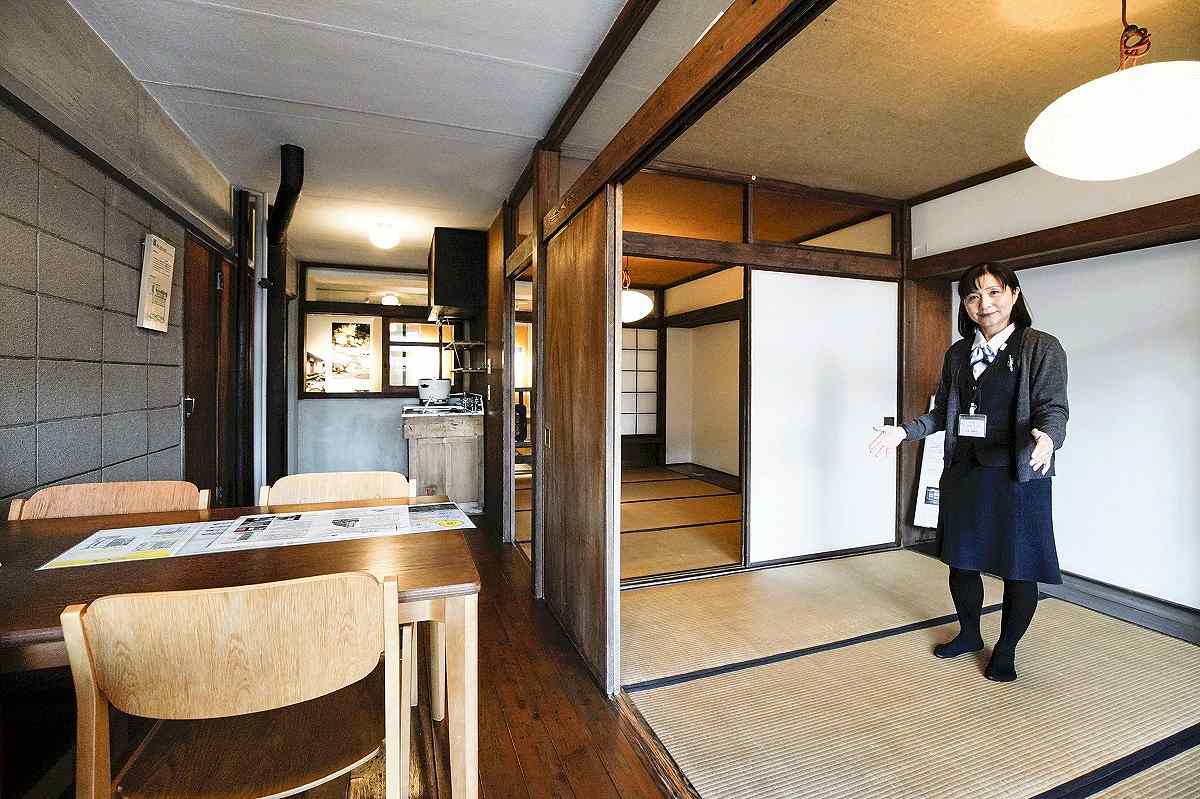
A unit from Harumi High-rise Apartments equipped with tatami mats that were custom-made to fit the width of the fusuma sliding doors is seen.
12:58 JST, January 26, 2021
Living in a danchi, or a large collective housing complex, was the dream of many during Japan’s period of high economic growth from the mid-1950s to the early 1970s. Residents of these complexes provided by the Japan Housing Corporation, or Urban Renaissance Agency as it’s known today, were enviously dubbed “danchi-zoku,” which loosely translates to “tribes” living in danchi.
Many such complexes were built from the period before World War II to the period of high economic growth, but recent redevelopment projects have caused them to disappear one after another.
The interiors of some of these facilities have been preserved and are on display at the Housing Apartment History Hall, a museum operated by the Urban Renaissance Agency dedicated to displaying mementos from the housing units of yesteryear. Those who visit the museum in Hachioji, Tokyo, can get a glimpse at the way lifestyles have changed over several decades.
One of the museum’s exhibits comes from the Dojunkai Daikanyama Apartments that once stood in Shibuya Ward, Tokyo. These apartments were built in 1927 by the now defunct Dojunkai, which was established to facilitate reconstruction following the Great Kanto Earthquake of 1923.
The Daikanyama apartments were at the forefront of a wave of modern reinforced concrete housing complexes. Each family unit was designed with two rooms, a kitchen and a flush toilet. It was surprising that there was also a rubbish chute in the kitchen.
Each unit was relatively small, having only 28 square meters of floor space. However, their popularity lay in the fact that they came bundled with basic utilities — electricity, gas and water.
When the Japan Housing Corporation built the Hasune Danchi housing complex in Itabashi Ward, Tokyo, in 1957, it introduced the “dining kitchen,” a Japanese-English phrase commonly abbreviated as DK that denotes a dining room combined with a kitchen. A 2DK layout — two bedrooms with a dining kitchen — became a mainstay of the corporation’s complexes.
Around this time, eating and sleeping in separate rooms had become commonplace. The monthly rent for one of these units was ¥4,500. This was during a period when the average annual income for a 33-year-old company employee was said to be around ¥335,000. To live in such a unit equipped with modern home appliances such as a refrigerator was a dream held by many at the time.
Built in 1958, the 10-story Harumi High-rise Apartments in Chuo Ward, Tokyo, were designed by renowned architect Kunio Maekawa, designer of the Tokyo Bunka Kaikan hall.
This complex, which boasted an open atmosphere, was the first Japan Housing Corporation complex to be equipped with elevators. These elevators only stopped on certain floors. The other floors didn’t have corridors for common use. While this made the units on the elevator-less floors more spacious, it also made their monthly rent more expensive. The museum also has exhibits featuring two-story terraced homes, each equipped with a garden, and the evolution of bathrooms and kitchens over time can also be seen.
“I hope that visitors will enjoy picturing how life was during those times,” said Yuji Masushige, an Urban Renaissance Agency official. “Depending on their age, some visitors may feel nostalgic, while others will see a world like they’ve never seen before.”
Housing Apartment History Hall: 2683-3, Ishikawamachi, Hachioji, Tokyo

Related Tags





Most Read
Popular articles in the past 24 hours
-

Lady Bess: Iroha Okuda, Mayuko Kominami Discuss Performing Elizab...
-

Japan Considering Taking Part in U.S. ‘Golden Dome’ Defense Syste...
-

Japan's TEPCO Releases Footage from Fukushima N-Plant Reactor
-

Oil Reserve Releases: G7 Members Unite against Growing Threat
-

46 Evacuated from UAE, Oman on Japanese Govt-chartered Flight
-

Japan's Sanyo Shinkansen Suspended Again; Between Okayama, Aioi S...
-

Driver Dies in Collision with Express Train at Crossing in Mito; ...
-

Raise Interest Rate, Stop Yen’s Fall to Stabilize Prices
Popular articles in the past week
-

Japan Figure Skating Legend Yuzuru Hanyu Is Proud Disaster Surviv...
-

Nippon Life Insurance's U.S. Arm Sues OpenAI Over Legal Assistanc...
-
Govt to Utilize ODA for Ensuring Economic Security; Securing Ener...
-
15 Measles Patients Confirmed in Tokyo in Past 6 Days; 1 May Have...
-
Massive Sewer Pipe Found Jutting Out of Highway in Osaka
-

Japan Govt to Tighten Requirements to Receive Permanent Residency...
-
Beckoning Cats Get Makeover to Fit Modern Lifestyles with Sleek D...
-

Japan's 2nd Round of U.S. Investments May Be Worth Over $100 Bill...
Popular articles in the past month
-

Producer Behind Pop Group XG Arrested for Cocaine Possession
-

Japan PM Takaichi’s Cabinet Resigns en Masse
-

Man Infected with Measles Reportedly Dined at Restaurant in Tokyo...
-

Videos Plagiarized, Reposted with False Subtitles Claiming ‘Ryuky...
-
Japan Figure Skating Legend Yuzuru Hanyu Is Proud Disaster Surviv...
-

iPS Treatments Pass Key Milestone, but Broader Applications Far f...
-

Sanae Takaichi Elected Prime Minister of Japan; Keeps All Cabinet...
-

Nepal Bus Crash Kills 19 People, Injures 25 Including One Japanes...
Top Articles in Features
-

Tokyo’s New Record-Breaking Fountain Named ‘Tokyo Aqua Symphony’
-

High-Hydration Bread on the Rise, Seeing Increase in Specialty Shops, Recipe Searches
-
Japanese Students Use Traditional Pickle to Create Novel Wagashi Confectionery
-

My Spendthrift Mother Constantly Asks Me for Money
-
Heirs to Kyoto Talent: Craftsman Works to Keep Tradition of ‘Kinran’ Brocade Alive Through Initiatives, New Creations
JN ACCESS RANKING
-
Producer Behind Pop Group XG Arrested for Cocaine Possession
-
Japan PM Takaichi’s Cabinet Resigns en Masse
-
Man Infected with Measles Reportedly Dined at Restaurant in Tokyo Station
-
Videos Plagiarized, Reposted with False Subtitles Claiming ‘Ryukyu Belongs to China’; Anti-China False Information Also Posted in Japan
-
Japan Figure Skating Legend Yuzuru Hanyu Is Proud Disaster Survivor and Gold Medalist, Vows to Continue Support Efforts