
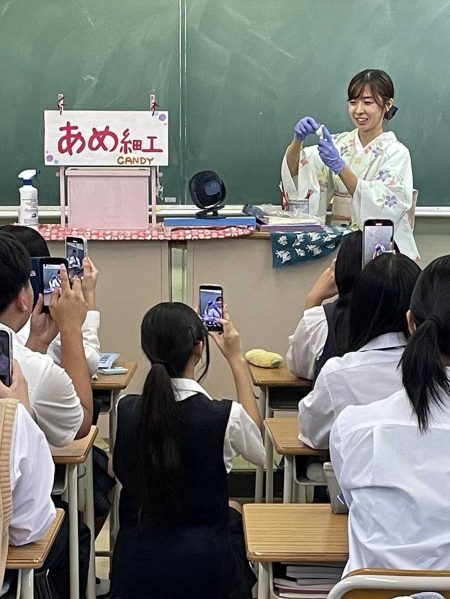
Candy craft artist Bau Mitsusaki demonstrates her skills as students film it with their phones at Nippa High School in Kanagawa Prefecture (Sept. 2025)
8:00 JST, March 14, 2026
“Inquiry-based learning,” where students identify questions, gather information, analyze it and then use their findings to identify and tackle new questions in increasingly sophisticated ways, has now become a core element of school education. In elementary, junior high and high schools, it is not only conducted during the “Period for Integrated Studies (Inquiry)” but is also spreading into all subject classes, including art and physical education. The key question now is how to realize high-quality learning that allows each student to become deeply engaged. To achieve this, it is important for teachers to create environments and provide appropriate guidance so that themes and approaches can emerge that are based on students’ own interests and curiosity.
Yokohama Municipal Ooka Elementary School is known nationally for its inquiry-based learning, where the know-how cultivated through years of research is shared among teachers, and students in every class learn proactively. In late January 2026, I attended a lesson study meeting and observed a Period for Integrated Studies class taught by Masako Masui, the school’s lead teacher for research and a fifth-grade homeroom teacher.
I’ve observed dozens of lessons at this school before, and that day as well, students were actively engaged in discussion. A student serving as the daily leader announced the activity, and after the teacher designated the first speaker, the discussion proceeded with students themselves selecting the next speaker. This is the school’s style. The teacher concentrates on organizing the students’ comments on the board and only minimally intervenes in the discussion. At the end, students rapidly write down their thoughts on reflection sheets.
One reason the students hold such serious discussions is the careful preparation done by the teachers. In many schools, the Period for Integrated Studies is conducted at the grade level with the same theme each year. At this school, however, it is conducted at the class level, and the theme changes every year. Therefore, the homeroom teachers first consider the theme and conduct a trial inquiry on their own. They also seek advice from experts and confirm whether the topic can function as meaningful learning.
Masui selected “local nature” as a candidate theme because many students are inherently interested in nature and because it could be connected with forests, a topic studied in fifth-grade social studies. She investigated the schoolyard, a nearby river and parks, and also spoke with members of civic groups and local government officials. She designed the overall structure of the learning while imagining how students’ learning might expand.
However, it is the students, not the teachers, who ultimately decide the theme — the teachers prepare an environment that helps the students find the themes themselves. In this case, during a lesson on composing spring haiku, students were encouraged to pay attention to the nature in the schoolyard and nearby river. As a result, students began proposing ideas such as “We want to investigate local living creatures” and “We want to do activities to enjoy nature.” The class then discussed thoroughly what they could do until everyone was satisfied.
Even when the theme is agreed upon by everyone, there are differences in what each student specifically wants to do. Some students investigate, others play and sometimes they even cook and taste things related to their topic. Each student decides their own activity beforehand, carries it out and then shares the results with the class. These accumulated activities gradually develop into broader topics for the class, such as cleaning the river or preserving nature.
“We do something different every time, so it never gets boring,” said Shoichi Hirota, 11. Riko Honma, 11, said, “Nature changes depending on the season and the weather, so the same situation never happens twice.”
Principal Teruyo Mawatari, 65, explained: “Even without being told, students can investigate, discuss and find issues on their own. This ability becomes especially noticeable in the upper grades, to the point where there is hardly any room for teachers to step in.”
Associate Prof. Akihiro Aizawa of Kamakura Women’s University said: “When activities are valued and students are encouraged to express what they notice and feel, they become genuinely engaged. For that to happen, teachers must carefully plan the activities, conduct thorough research on teaching materials, and support the process from behind the scenes.”
Excellent forms of inquiry-based learning are increasingly being used, but challenges remain. In particular, understanding of what kind of inquiry-based learning is required is still insufficient, and the quality varies among schools. The Central Council for Education, which is discussing the next national Course of Study, has defined inquiry-based learning as learning in which students set questions based on their own interests and curiosity, engage in trial and error, and aim to create new value.
Among these elements, “setting questions based on students’ own interests and curiosity” is somewhat surprisingly not considered an essential component in the current Course of Study. Instead, it is merely listed as one example alongside “contemporary issues” such as international understanding, the environment and welfare, as well as “local issues.” In the Council’s working group, however, there is a shared understanding that this element is indispensable for improving the quality of inquiry, and the next revision is expected to clearly position it as a prerequisite. It will also clarify that this does not mean leaving everything to the students. Rather, as students deepen their questions through trial and error, teachers’ “instructional leadership” in designing and supporting learning will be indispensable.
Learning in which teachers set the questions and students’ freedom is somewhat limited is also conducted in some subject classes that give attention to the inquiry process, and the working group includes such learning within inquiry-based learning in a broad sense. At Kanagawa Prefectural Nippa High School, a lesson on Logical Japanese was conducted in an inquiry-oriented way using the production of social media videos as its theme.
Logical Japanese is an elective subject introduced in the 2022 academic year under the current Course of Study. Through essays, commentaries and explanatory texts, it aims to cultivate logical reading ability, critical thinking skills and the ability to express opinions with evidence. Takuya Mori, a 33-year-old teacher at the school, wanted to develop these abilities through real-world challenges. He therefore planned a class in which students would create social media videos based on requests from outside clients, using a medium familiar to students.
The client was Bau Mitsusaki, a candy craft artist. The request was to produce short social media videos introducing amezaiku, a traditional Japanese craft in which heated and softened syrup candy is shaped into animals or flowers within minutes using scissors and bare hands. After observing Mitsusaki’s demonstration and trying candy craft themselves, the students considered what message they should convey and to whom, and developed plans in groups of four or five.
The completed videos varied widely. Some showed the process of a lump of candy transforming into an animal in a quiz format, others emphasized the delicate movements of the artisan’s hands, and some included English narration for foreign audiences. Mitsusaki commented: “Thanks to everyone, the charm of candy craft has been amplified. I’d like to upload the videos in stages.”
Second-year student Rio Mizuguchi, 17, said, “I was able to truly feel the importance of presentation skills needed to enter society.” Sena Kobayashi, 17, said, “I realized that in order to communicate something to someone, you have to understand that person’s position and feelings.”
Mori said: “By dealing with real-world challenges, students engaged proactively while keeping the client’s intentions in mind. Through evaluation by external instructors and by fellow students, they were also able to develop the ability to see issues from multiple perspectives and to critically examine both their own ideas and those of others.”
Inquiry-based learning often takes place over a long period of time, and the choice of theme and the way it is carried out greatly affect the quality of students’ school life. Therefore, teachers must create the environment and design the pathway of learning. Through these often unseen efforts of teachers, students’ interests and curiosity are drawn out and clarified, supporting the learning in which students become deeply engaged.
Political Pulse appears every Saturday.
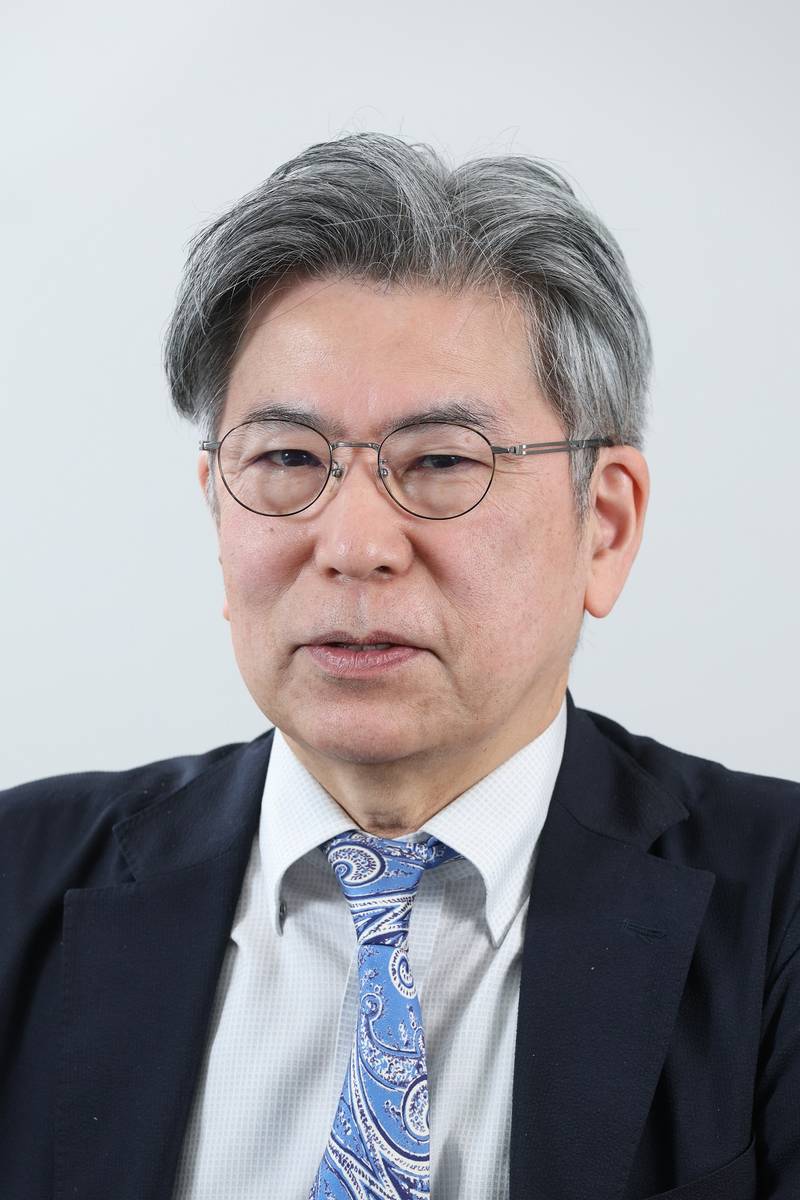
Makoto Hattori
Makoto Hattori is a staff writer at the Yomiuri Research Institute.





Most Read
Popular articles in the past 24 hours
-
Lady Bess: Iroha Okuda, Mayuko Kominami Discuss Performing Elizab...
-

Japan's TEPCO Releases Footage from Fukushima N-Plant Reactor
-

Japan Considering Taking Part in U.S. ‘Golden Dome’ Defense Syste...
-

Oil Reserve Releases: G7 Members Unite against Growing Threat
-

Japan's Sanyo Shinkansen Suspended Again; Between Okayama, Aioi S...
-

46 Evacuated from UAE, Oman on Japanese Govt-chartered Flight
-

Driver Dies in Collision with Express Train at Crossing in Mito; ...
-

Paw Patrol: Larry Marks 15 Years at 10 Downing Street
Popular articles in the past week
-

Japan Figure Skating Legend Yuzuru Hanyu Is Proud Disaster Surviv...
-

Nippon Life Insurance's U.S. Arm Sues OpenAI Over Legal Assistanc...
-
Govt to Utilize ODA for Ensuring Economic Security; Securing Ener...
-

15 Measles Patients Confirmed in Tokyo in Past 6 Days; 1 May Have...
-

Massive Sewer Pipe Found Jutting Out of Highway in Osaka
-

Japan Govt to Tighten Requirements to Receive Permanent Residency...
-

Beckoning Cats Get Makeover to Fit Modern Lifestyles with Sleek D...
-

Japan's 2nd Round of U.S. Investments May Be Worth Over $100 Bill...
Popular articles in the past month
-

Producer Behind Pop Group XG Arrested for Cocaine Possession
-

Japan PM Takaichi’s Cabinet Resigns en Masse
-

Man Infected with Measles Reportedly Dined at Restaurant in Tokyo...
-

Videos Plagiarized, Reposted with False Subtitles Claiming ‘Ryuky...
-
Japan Figure Skating Legend Yuzuru Hanyu Is Proud Disaster Surviv...
-

iPS Treatments Pass Key Milestone, but Broader Applications Far f...
-

Sanae Takaichi Elected Prime Minister of Japan; Keeps All Cabinet...
-

Nepal Bus Crash Kills 19 People, Injures 25 Including One Japanes...
Top Articles in Editorial & Columns
-

Riku-Ryu Pair Wins Gold Medal: Their Strong Bond Leads to Major Comeback Victory
-
Reciprocal Tariffs Ruled Illegal: Judiciary Would Not Tolerate President’s High-Handed Approach
-
Japan’s Plan for Investment in U.S.: Aim for Mutual Development by Ensuring Profitability
-

Chronic Issues Erode Thailand’s Economy as Political Confusion Persists, Threatening Terminal Decline in Its Economy
-
Iran Situation: Japan Must Exert Diplomatic Efforts without Merely Standing by
JN ACCESS RANKING
-
Producer Behind Pop Group XG Arrested for Cocaine Possession
-
Japan PM Takaichi’s Cabinet Resigns en Masse
-
Man Infected with Measles Reportedly Dined at Restaurant in Tokyo Station
-
Videos Plagiarized, Reposted with False Subtitles Claiming ‘Ryukyu Belongs to China’; Anti-China False Information Also Posted in Japan
-
Japan Figure Skating Legend Yuzuru Hanyu Is Proud Disaster Survivor and Gold Medalist, Vows to Continue Support Efforts