
China Criticizes Sanae Takaichi, but China Itself Is to Blame for Worsening Relations with Japan
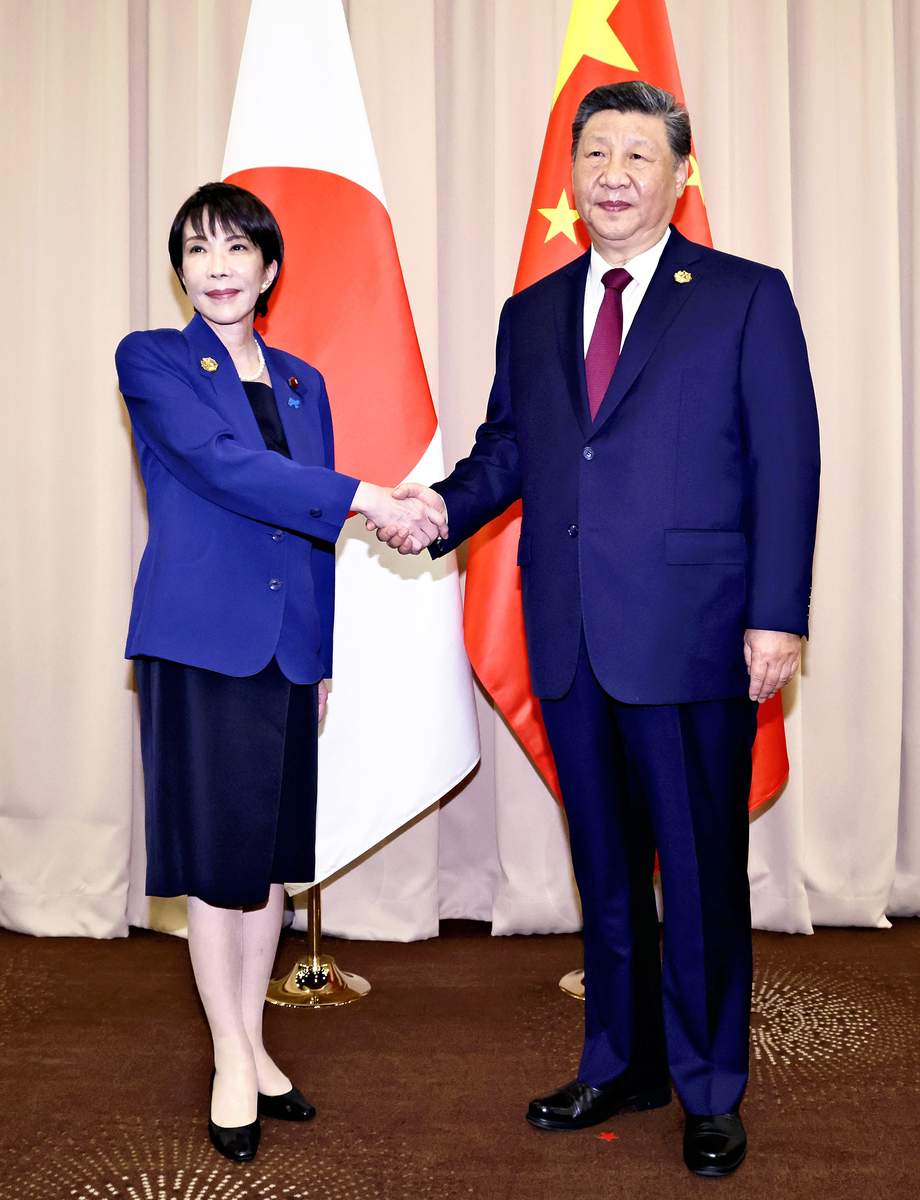
Prime Minister Sanae Takaichi, left, shakes hands with Chinese President Xi Jinping before their first bilateral meeting on Oct. 31, 2025.
8:00 JST, January 10, 2026
Although Japan-China relations seemed to worsen after Prime Minister Sanae Takaichi’s remark that a Taiwan contingency could constitute a “survival-threatening situation,” the fact is that the relationship has been deteriorating for over a decade because Chinese President Xi Jinping’s hegemonic ambitions and assertive military activities have awakened the Japanese people to the military threat posed by China.
China conducted military exercises around Taiwan and in the Western Pacific at the end of 2025. The exercises were believed to be aimed at showing its military capabilities, including those needed for a maritime blockade and so-called anti-access/area-denial (A2/AD), in which Chinese forces could intercept U.S. aircraft carriers. China also conducted another practical exercise last June in which two Chinese Navy carriers simulated fighting each other, with one playing the role of a U.S. carrier in the Western Pacific. The Japanese government concluded that it was a rehearsal for A2/AD against U.S. carriers. If the potential of such A2/AD operations could be proven, China might think it could annex Taiwan without U.S. forces intervening.
In early December, two H-6K Chinese bombers flew between Okinawa Island and Miyakojima Island, then headed northeast. They flew as far as the waters off Shikoku before turning back, accompanied by Russian bombers. The H-6K is a modernized version of the H-6, capable of launching a CJ-20 air-to-ground cruise missile, which can deliver a nuclear warhead and has a maximum range of more than 1,500 kilometers. This exercise was seen as a demonstration that Chinese bombers could bomb Tokyo or the U.S. naval base in Yokosuka, Kanagawa Prefecture.
China has been increasing its military activities in the Western Pacific since 2013. That autumn, an H-6 Chinese bomber flew across the “first island chain,” a series of island groups spanning the southern part of Kyushu, the Nansei Islands, Taiwan and the Philippines, for the first time. Soon after that, China conducted a large military exercise called “Mobile-5” in the Western Pacific and unilaterally declared a Chinese air defense identification zone (ADIZ), in the East China Sea.
That year, 2013, was a turning point not only because military activities far away from the Chinese coast started in earnest but also because Xi, who first assumed the presidency that spring, declared his hegemonic ambition. He underscored his intention to realize a “Chinese Dream.” That meant China would take back its sphere of influence or “territory,” which it one-sidedly claimed to have obtained during the Qing dynasty (1644-1912) then lost during and after the First Sino-Japanese War (1894-95), including Taiwan, the Senkaku Islands and even Okinawa Prefecture.
Getting back to the point, China has been pursuing its territorial ambition and for that reason expanding assertive military activities ceaselessly near Japan regardless of who the Japanese prime minister is or what he or she says. Furthermore, Xi seems to have confirmed his ultimate goals. In his New Year’s Eve remarks, he said, “The reunification of our motherland, a trend of the times, is unstoppable.”
What has changed is Japanese people’s minds. In the early 2000s, Japan-China relations were called “cold political relations but hot economic relations.” It meant Japanese people, especially in the business sector, wanted to have good relations with China. But today, anxieties about China have grown and grown, so even those in the business sector tend to resign themselves to cold relations. They are becoming more and more anxious about the risk of doing business in and with China after they have seen China put its own narrative before economic rationality and even weaponize economic relations.
Even conceding that Takaichi was thoughtless when she publicly referred to a survival-threatening situation – not because that was incorrect but because she gave China an opportunity to take advantage of it – it is China that should be blamed for the worsening of bad relations between Japan and China.
In addition to direct Japan-China relations, we should pay attention to another vital bilateral relationship, the U.S.-China one. Comparing 2025 with 2013, not only were Chinese military activities in the Western Pacific similar in those two years, but U.S.-China relations had similarities, too.
In 2013, then U.S. President Barack Obama took only half measures with China. His administration expected not only a win-win economic relationship but also China’s help in addressing global matters such as climate change and world economic issues, and it underestimated China’s hegemonic ambition. Then National Security Advisor Susan Rice gave a policy speech on Asia on Nov. 21 before then Vice President Joe Biden’s Asia visit. She said: “When it comes to China, we seek to operationalize a new model of major power relations. That means managing inevitable competition while forging deeper cooperation on issues where our interests converge — in Asia and beyond.”
China of course took advantage of this U.S. weakness. It announced the Chinese ADIZ over the East China Sea on Nov. 23, only two days after Rice’s speech. The situation went as China planned. In China, Biden didn’t spoil his visit by criticizing China publicly or asking Xi to rescind the ADIZ, despite Japan having requested him to do so.
Today’s U.S. president, Donald Trump, also wants a big trade deal with China, and has blinded himself to China’s assertive military activities motivated by its hegemonic ambition. Regarding the Chinese naval exercise near Taiwan at the end of 2025, Trump said at a press conference: “I have a great relationship with President Xi … nothing worries me.”
We must expect Trump to keep up his “trade deal first” tendency at least until his planned China visit in April because he needs an accomplishment on trade to help Republicans win in the upcoming midterm congressional election in November. China will surely take advantage of this golden opportunity. It may take another provocative action which could serve its hegemonic ambition.
So, what should Japan do or not do at this juncture? The most important thing is not to rush to compromise with China, understanding that China will never give up its narratives and territorial ambitions no matter what Japan may do. We must not forget what happened when then Prime Minister Naoto Kan compromised with China when a Chinese fishing boat rammed a Japanese Coast Guard patrol vessel in 2010. China simply began to increase its own Coast Guard vessels’ presence near Senkakus. We must also recall that it took about five years for the second administration of Prime Minister Shinzo Abe to normalize Japan-China relations after the 2013 diplomatic conflict with China.
Japan-China relations are, as I mentioned, apt to be influenced by U.S.-China relations, so the Takaichi administration needs to lobby and influence Trump not to have any illusions about a “G2” U.S.-China partnership or a big Chinese compromise on trade. Japan should wait patiently for an opportunity when Chinese leaders feel anxiety about relations with the United States. In the meantime, Japan will also have to strengthen its defense capabilities and diplomatic ties with the United States and other friends so that they can deter China from putting its territorial ambitions into action by force.
Political Pulse appears every Saturday.

Satoshi Ogawa
Ogawa is the deputy chief of the President’s Office of The Yomiuri Shimbun..





Most Read
Popular articles in the past 24 hours
-

Strait of Hormuz Closure Shakes Markets; Prolonged Closure Could ...
-

Iran Situation: Japan Must Exert Diplomatic Efforts without Merel...
-
Measles Patient Visited Hospital in Bunkyo Ward, Tokyo, Metropoli...
-

Milano Cortina 2026: Japanese Figure Skater Miura Returns to Home...
-

Takayama Among World's Top 10 Most Welcoming Cities for 2026; 2nd...
-
2 of Japan's Opposition Parties Submit Bill to Revise Political F...
-
Chiba Police to Arrest Japanese National in Midair; Man Accused o...
-
Former Nomura Securities Employee Given 18-year Prison Sentence f...
Popular articles in the past week
-
Milano Cortina 2026: Japanese Gold Medalist Figure Skater Miura S...
-
Tokyo Spends Big on Children, Wins Over Parents
-

Japan’s Miura, Kihara Announce Withdrawal from Figure Skating Wor...
-

Yokohama to Test Out Renewable-Powered Offshore Floating Data Cen...
-
BOJ Keeping Eye on Economy and Takaichi's ‘Proactive Fiscal Polic...
-
Tokyo Measles Patient Traveled to Fukuoka Aboard JAL Planes; Susp...
-
Japan’s Takaichi Speaks on New U.S. Tariff in Upper House, Says P...
-
Nidec Chairman Resigns Amid Accounting Scandal at Major Japanese ...
Popular articles in the past month
-

Producer Behind Pop Group XG Arrested for Cocaine Possession
-

Japan PM Takaichi’s Cabinet Resigns en Masse
-

Man Infected with Measles Reportedly Dined at Restaurant in Tokyo...
-

Israeli Ambassador to Japan Speaks about Japan’s Role in the Reco...
-

Videos Plagiarized, Reposted with False Subtitles Claiming ‘Ryuky...
-

Prudential Life Insurance Plans to Fully Compensate for Damages C...
-

Woman with Measles Visited Hospital in Tokyo Multiple Times Befor...
-

iPS Treatments Pass Key Milestone, but Broader Applications Far f...
Top Articles in Editorial & Columns
-

Riku-Ryu Pair Wins Gold Medal: Their Strong Bond Leads to Major Comeback Victory
-
Reciprocal Tariffs Ruled Illegal: Judiciary Would Not Tolerate President’s High-Handed Approach
-
China Provoked Takaichi into Risky Move of Dissolving House of Representatives, But It’s a Gamble She Just Might Win
-
Japan’s Plan for Investment in U.S.: Aim for Mutual Development by Ensuring Profitability
-
Flu Cases Surging Again: Infection Can Also Be Prevented by Humidifying Indoor Spaces
JN ACCESS RANKING
-
Producer Behind Pop Group XG Arrested for Cocaine Possession
-
Japan PM Takaichi’s Cabinet Resigns en Masse
-
Man Infected with Measles Reportedly Dined at Restaurant in Tokyo Station
-
Israeli Ambassador to Japan Speaks about Japan’s Role in the Reconstruction of Gaza
-
Videos Plagiarized, Reposted with False Subtitles Claiming ‘Ryukyu Belongs to China’; Anti-China False Information Also Posted in Japan