
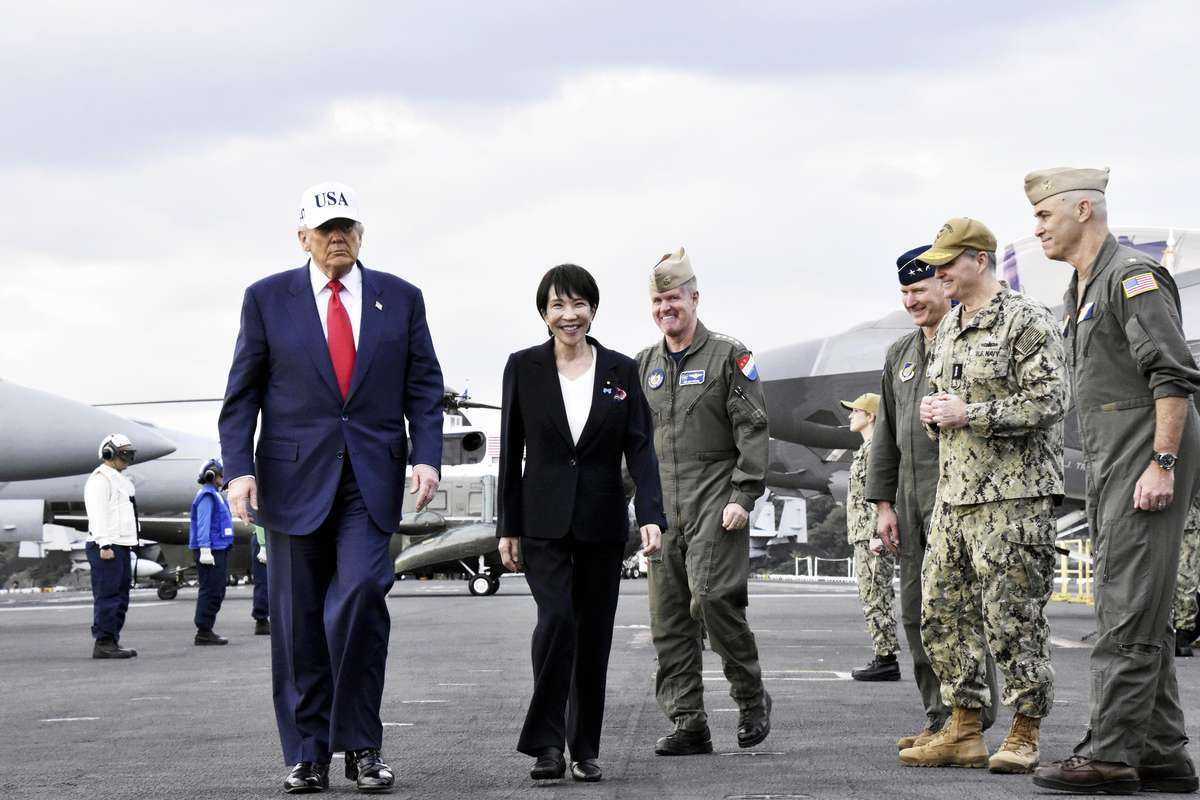
Prime Minister Sanae Takaichi and U.S. President Donald Trump arrive aboard the aircraft carrier USS George Washington on Oct. 28, 2025, in Yokosuka, Kanagawa Prefecture.
8:00 JST, January 3, 2026
The world entered 2026 amid intense upheaval and uncertainty.
The year that just ended, 2025, saw the international economic order that had sustained 80 years of postwar prosperity undergo a significant shift. There is no new international economic roadmap. The year now beginning will likely be an essential step as nations search for a starting point for creating new rules. The power of two major countries, the United States and China, has grown even stronger. Japan is in a unique position between that pair. Japan must leverage its distinct characteristics to build its own strategy.
Let us consider our current position from a 100-year perspective.
John Maynard Keynes’ essay “Economic Possibilities for Our Grandchildren,” written in 1930 during the Great Depression, remains a favorite among economists and others to this day.
Keynes made these two predictions:
One hundred years later, technological innovation and capital accumulation would raise living standards by up to eightfold.
Moreover, three hours of work per day would be sufficient to obtain the necessities of life.
That 100-year mark, 2030, is now approaching.
In a 2024 column, International Monetary Fund Managing Director Kristalina Georgieva marveled, “His forecast proved to be remarkably accurate: even as the global population has quadrupled over the past century, per capita global income has risen eightfold.”
Georgieva praised global economic progress, noting: “In addition to the massive leap in living standards, the world saw unprecedented poverty reduction. Over the past three decades alone, 1.5 billion people lifted themselves out of poverty, and hundreds of millions entered the middle class. Consider also the dramatic improvements in life expectancy, infant mortality rates, literacy rates, and education levels — especially for girls — that have taken place.”
But every advance also casts a shadow.
After Keynes’ essay, World War II broke out, beginning a chain of events that ultimately led the world to develop under an interlinked order of the rule of law, democracy and free trade.
How would Keynes view the world today?
Today, history is shifting its direction again.
Democracy and the rule of law are faltering, and the free trade system faces a crisis. The world is reverting to an era of imperialistic rivalry between great powers.
Today, the United States and China together account for 43% of global GDP. The two powers, the United States and China, drive the world.
Neither of them is an ideal global model.
China’s hegemonic behavior remains unchanged, but the United States has also lost its ideal of leading the world through mutually beneficial development with other countries. The second administration of U.S. President Donald Trump has indiscriminately imposed high tariffs and turned its back on the free trade system.
In his book “The Great Trade Hack,” international economist Richard Baldwin points out that the United States and China, with their different capitalist systems, are facing off against each other, but neither will emerge as the winner.
Both the United States and China have political and economic systems with intense shades of light and shadow.
The United States accounts for about a quarter of global GDP, benefits from the dollar system and leads in innovations such as artificial intelligence. U.S. tech companies, such as Nvidia, now account for roughly 20% of the world’s market capitalization. Dollar settlements account for about 60% of international financial transactions and 80% of trade transactions.
Meanwhile, inequality is growing at an alarming rate. In what is termed a K-shaped economy, people in the top 20% of income brackets command 50% of total income, a proportion that rises annually. Domestic political divisions are deep, and crime is said to be rampant. The health insurance system is harsh to low-income earners, and despite the country’s high gross domestic product, the average life expectancy is only 78 years, which is low by developed-country standards.
China, with a state-led capitalist system, different from what exists in the United States, has become overwhelmingly strong in manufacturing. It has risen to become a manufacturing superpower through unfair subsidies, state-owned enterprises and state-led industrial policies. Baldwin notes that China’s share of total global manufacturing output is 35%, three times that of the United States, six times that of Japan and nine times that of Germany, a level that is historically unprecedented.
However, its domestic politics are marked by a sense of stagnation, no less than those of the United States. Its per capita GDP still lags far behind that of developed countries. A prolonged real estate slump has only increased public discontent, and the unemployment rate among young people is high. The birth rate is declining, and the population is aging rapidly. Turning their backs on the fierce competition known as “involution,” a young generation of people who “lie flat” has emerged.
Must we choose between American-style fierce, unequal competition and Chinese-style state capitalism ruled by one party?
That choice betrays Keynes’ hope for the future.
In a world dominated by the United States and China, how will Japan survive?
While it may not compete as fiercely as the United States or China, Japan’s diligent national character and strong manufacturing sector still give it high international competitiveness. In semiconductor manufacturing, companies like Tokyo Electron Ltd. hold significant global market shares. Even in traditional steel, Nippon Steel’s acquisition of U.S. Steel signals a renewed bid for the world’s top position. Toyota Motor Corp. continues to hold its position as the world’s largest automaker.
Japan’s soft power and competitiveness in content industries like animation are also rising. Health care infrastructure is well-developed, with an average life expectancy of 84 years. Cities are safe, with low rates of violent crime.
It is crucial for Japan to solidify its political stability, accelerate economic structural reform and actively engage with other nations through a transparent, multitrack approach that promotes its interests and global cooperation.
Japan must face the reality that the United States is stepping back from its role as the global leader of the international order.
Japan now has fewer economic sectors in direct competition with the United States, and the relationship is increasingly complementary.
First, Japan should build relationships with the United States that ensure mutually beneficial outcomes.
One example is the plan for $550 billion in Japanese investment in the United States.
Japan proposed this framework during the U.S.-Japan tariff negotiations.
From an economic security perspective, it envisions building supply chains in energy, semiconductors, shipbuilding, rare earths and other sectors.
The Trump administration has openly displayed hostility toward Europe and deepened conflicts with India. Compared to the past, U.S. national power has declined, and it needs partners to engage in the medium- to long-term competition with China. As the world’s fourth largest economy, Japan should be the United States’ best partner in confronting China.
Second, Japan’s autonomy is essential. Japan needs to deepen cooperation with European and Asian nations that share its commitment to free trade, the rule of law and democracy, thereby supporting Japan’s long-term strategy for global engagement.
Third, Japan should review its strategy toward China. Japan-China relations have deteriorated following Prime Minister Sanae Takaichi’s remark regarding a survival-threatening situation in connection with a Taiwan contingency.
Strengthening ties with the United States, alongside deepening cooperation with European and Asian nations, will also enhance Japan’s ability to manage its relationship with China.
In his essay, Keynes also pointed out, “To those who sweat for their daily bread leisure is a longed-for sweet — until they get it.”
Keynes expressed curiosity about how people might thrive in a future with abundant leisure.
Now, a world of three-hour workdays has not arrived, but if it does, people will find ways to enrich their leisure from the perspective of modern society. In this highly capitalistic society, desires are endlessly generated.
Keynes’ forecasts proved inspiring, but predicting the future is challenging.
Looking back at over 2,000 years of history, Japan is an emerging country. Looking forward over a 100-year time frame, the future holds boundless possibilities.
In this era of uncertainty, reaffirming Japan’s strengths and unique contributions is vital for navigating the future.
Political Pulse appears every Saturday.
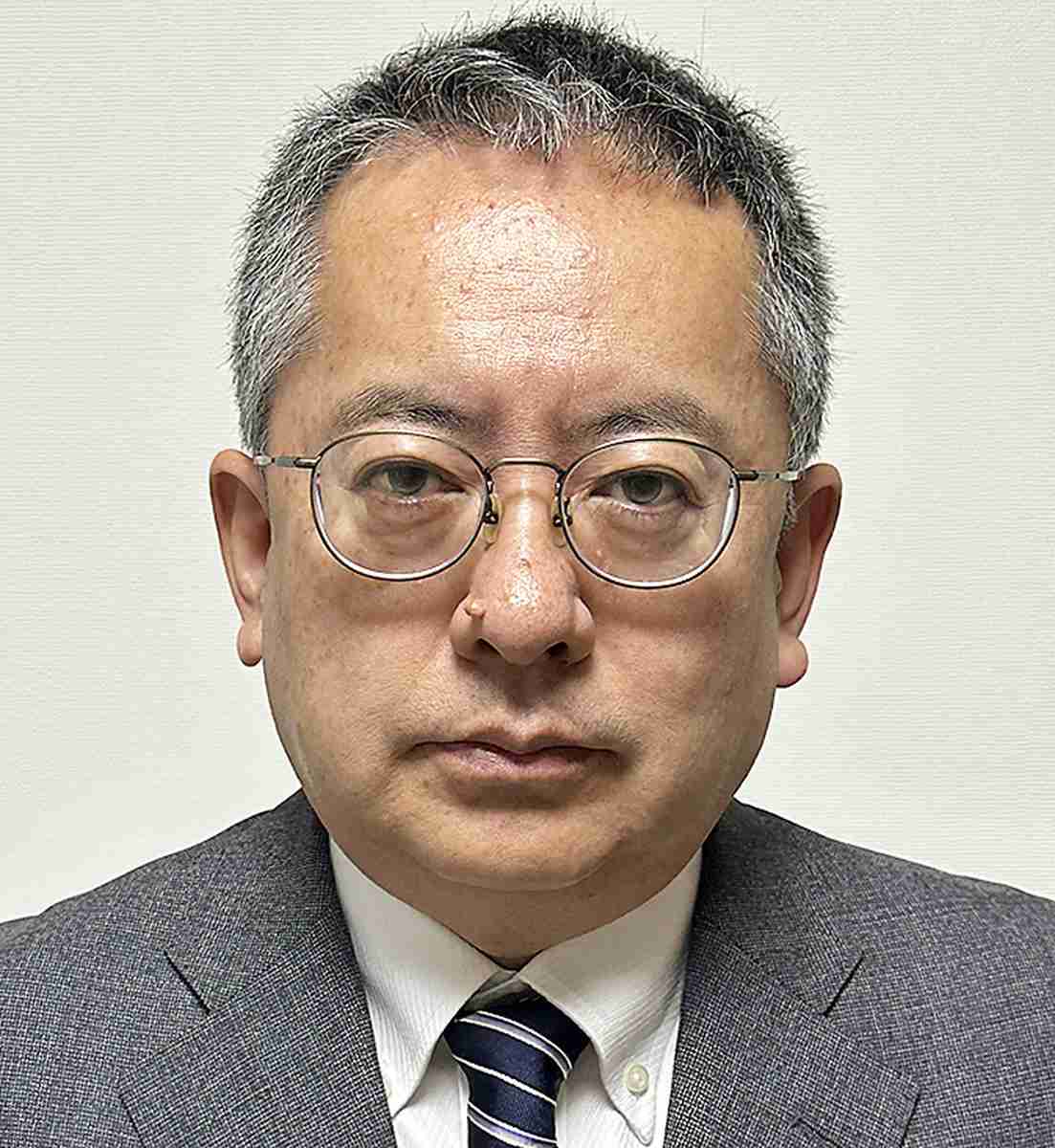
Akihiro Okada
Akihiro Okada is a vice chairman of the editorial board for The Yomiuri Shimbun.





Most Read
Popular articles in the past 24 hours
-

Strait of Hormuz Closure Shakes Markets; Prolonged Closure Could ...
-

Iran Situation: Japan Must Exert Diplomatic Efforts without Merel...
-

Measles Patient Visited Hospital in Bunkyo Ward, Tokyo, Metropoli...
-

Milano Cortina 2026: Japanese Figure Skater Miura Returns to Home...
-

Takayama Among World's Top 10 Most Welcoming Cities for 2026; 2nd...
-
2 of Japan's Opposition Parties Submit Bill to Revise Political F...
-
Chiba Police to Arrest Japanese National in Midair; Man Accused o...
-

Former Nomura Securities Employee Given 18-year Prison Sentence f...
Popular articles in the past week
-
Milano Cortina 2026: Japanese Gold Medalist Figure Skater Miura S...
-

Tokyo Spends Big on Children, Wins Over Parents
-

Japan’s Miura, Kihara Announce Withdrawal from Figure Skating Wor...
-

Yokohama to Test Out Renewable-Powered Offshore Floating Data Cen...
-
BOJ Keeping Eye on Economy and Takaichi's ‘Proactive Fiscal Polic...
-

Tokyo Measles Patient Traveled to Fukuoka Aboard JAL Planes; Susp...
-
Japan’s Takaichi Speaks on New U.S. Tariff in Upper House, Says P...
-
Nidec Chairman Resigns Amid Accounting Scandal at Major Japanese ...
Popular articles in the past month
-

Producer Behind Pop Group XG Arrested for Cocaine Possession
-

Japan PM Takaichi’s Cabinet Resigns en Masse
-

Man Infected with Measles Reportedly Dined at Restaurant in Tokyo...
-

Israeli Ambassador to Japan Speaks about Japan’s Role in the Reco...
-

Videos Plagiarized, Reposted with False Subtitles Claiming ‘Ryuky...
-

Prudential Life Insurance Plans to Fully Compensate for Damages C...
-

Woman with Measles Visited Hospital in Tokyo Multiple Times Befor...
-

iPS Treatments Pass Key Milestone, but Broader Applications Far f...
Top Articles in Editorial & Columns
-

Riku-Ryu Pair Wins Gold Medal: Their Strong Bond Leads to Major Comeback Victory
-
Reciprocal Tariffs Ruled Illegal: Judiciary Would Not Tolerate President’s High-Handed Approach
-
China Provoked Takaichi into Risky Move of Dissolving House of Representatives, But It’s a Gamble She Just Might Win
-
Japan’s Plan for Investment in U.S.: Aim for Mutual Development by Ensuring Profitability
-
Flu Cases Surging Again: Infection Can Also Be Prevented by Humidifying Indoor Spaces
JN ACCESS RANKING
-
Producer Behind Pop Group XG Arrested for Cocaine Possession
-
Japan PM Takaichi’s Cabinet Resigns en Masse
-
Man Infected with Measles Reportedly Dined at Restaurant in Tokyo Station
-
Israeli Ambassador to Japan Speaks about Japan’s Role in the Reconstruction of Gaza
-
Videos Plagiarized, Reposted with False Subtitles Claiming ‘Ryukyu Belongs to China’; Anti-China False Information Also Posted in Japan