
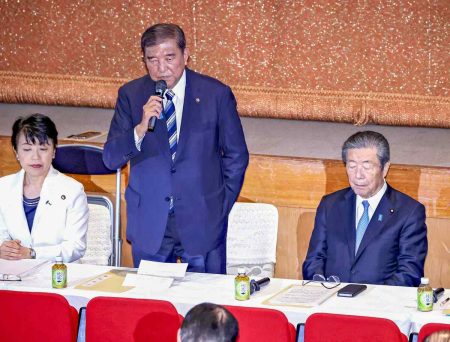
Prime Minister Shigeru Ishiba speaks at a Sept. 2 meeting of LDP members from both houses of the Diet.
10:00 JST, September 20, 2025
Understanding public opinion is one of the most important jobs for politicians. This is true for leaders in both Japan and the United States.
The Liberal Democratic Party suffered a crushing defeat in the House of Councillors election in July, losing its majority as the ruling party. The LDP suffered similarly severe defeats in last year’s House of Representatives election and this June’s Tokyo Metropolitan Assembly election — all during the administration of Prime Minister Shigeru Ishiba. The results made it clear that Ishiba was unpopular with the voters.
While there were growing calls among the LDP’s Diet members for him to step down, polls conducted by all media outlets showed that Ishiba’s approval rating was rising day by day.
This is a strange phenomenon in Japanese politics, because there is generally no better poll than an election. When the party got the contradictory public opinion results, it was a great source of confusion. One party official who was trying to prepare for Ishiba’s resignation said, “The favorable poll results for Ishiba are a problem for us.”
Even during what proved to be the waning days of his tenure, the polls encouraged Ishiba to stay in office. Also, Ishiba believed that criticism of him from within the party would be calmed under the influence of general public opinion. However, he was not able to foresee the behavior of the LDP’s Diet members and the demands for his resignation grew stronger.
Under Japan’s parliamentary cabinet system, a prime minister who does not have the support of the ruling party cannot manage the administration. About 50 days after the upper house election, Ishiba finally announced that he would be stepping down and would soon hold an election for a new party leader.
Speaking about the gap in public opinion at a press conference, he said: “Something happened that has never happened before. Something unprecedented has happened. I have thought long and hard about why.” Yet he offered no answer as to why.
One reason for this gap is said to be the growing influence of social media. In Japan, the X social media site was filled with discourse that the LDP was bullying Ishiba to pressure him to quit. Nowadays, a significant number of young people in Japan do not watch TV or read newspapers, but get their information exclusively from social media. After the election, social media may have created a mood of overwhelming support for Ishiba. However, this is only a hypothesis.
In the U.S. presidential election last November, which I covered for The Yomiuri Shimbun as a Washington correspondent, polls conducted by the media were unreliable. Then former President Donald Trump, the Republican candidate, was said to have “hidden supporters” who did not reveal to pollsters that they were Trump supporters. Why hide their support? It was likely because they did not trust the mainstream media, because Trump has been critical of media organizations such as CNN, NBC and The New York Times.
Based on polls, the media reported that the race between Trump and Democratic Vice President Kamala Harris was very close. But when the vote was held, Trump won a definitive victory in the Electoral College. This was Trump’s third presidential election, and the media and polling firms had improved their methods after reflecting on the errors of the first two. Still, the surveys were off.
As a result, the polls underestimated Trump. It was the same during the earlier stage of the contest, when Trump was vying against incumbent President Joe Biden before Biden was replaced by Harris. If Biden had known that Trump’s poll approval ratings were wrong, he might have withdrawn from the race sooner. If that had happened, the outcome of the presidential election could have been different.
Looking back, something similar happened about 50 years ago in Japan. In 1978, the LDP held its first presidential primary election by party members. Prime Minister Takeo Fukuda sought reelection, but was defeated by Secretary General Masayoshi Ohira, who was supported by one of the largest factions, and the Ohira administration came to power. Fukuda left behind the famous line, “Even the voice of heaven speaks strangely from time to time.”
Ishiba’s successor will be chosen in an LDP presidential election in October, in which LDP lawmakers and general party members will vote. The candidates must be willing to listen to the “heavenly voice” of the Liberal Democratic Party to win the election. However, that voice might not be the same as that of the general electorate in the coming national elections. They and we must continue to listen carefully to that voice to discern what it really has to say.
Political Pulse appears every Saturday.

Hiroshi Tajima
Hiroshi Tajima is a staff writer in the Political News Department of The Yomiuri Shimbun.




Most Read
Popular articles in the past 24 hours
-

Japan Defense Agency to Develop AI Intelligence Analysis System f...
-

Government to Establish ‘Command Center’ for Developing Nuclear P...
-

Moai Statue Shows Lasting Bond Between Miyagi Pref. Town, Easter ...
-

Milano Cortina 2026: Japan’s Oguri Wins Para Snowboard Silver at ...
-
Japan's Defense Ministry: North Korea Appears to Have Fired Balli...
-

Aichi Fisheries Cooperatives Use Smart Tech to Farm Triploid Oyst...
-

Teachers Support Students’ Inquiry Learning behind the Scenes
-
Japan's Lower House Passes Budget Proposal; Could Be Delayed in U...
Popular articles in the past week
-

Japan Figure Skating Legend Yuzuru Hanyu Is Proud Disaster Surviv...
-
Govt to Utilize ODA for Ensuring Economic Security; Securing Ener...
-
15 Measles Patients Confirmed in Tokyo in Past 6 Days; 1 May Have...
-
Massive Sewer Pipe Found Jutting Out of Highway in Osaka
-

Japan Govt to Tighten Requirements to Receive Permanent Residency...
-
JR Tokai Breaks Ground on Yamanashi Maglev Station; Will Be Part ...
-

Beckoning Cats Get Makeover to Fit Modern Lifestyles with Sleek D...
-
Power Outage Forces About 980 Passengers in Yokohama to Walk to T...
Popular articles in the past month
-

Producer Behind Pop Group XG Arrested for Cocaine Possession
-

Japan PM Takaichi’s Cabinet Resigns en Masse
-

Man Infected with Measles Reportedly Dined at Restaurant in Tokyo...
-

Videos Plagiarized, Reposted with False Subtitles Claiming ‘Ryuky...
-
Japan Figure Skating Legend Yuzuru Hanyu Is Proud Disaster Surviv...
-

iPS Treatments Pass Key Milestone, but Broader Applications Far f...
-

Sanae Takaichi Elected Prime Minister of Japan; Keeps All Cabinet...
-

Nepal Bus Crash Kills 19 People, Injures 25 Including One Japanes...
Top Articles in Editorial & Columns
-

Riku-Ryu Pair Wins Gold Medal: Their Strong Bond Leads to Major Comeback Victory
-

Reciprocal Tariffs Ruled Illegal: Judiciary Would Not Tolerate President’s High-Handed Approach
-
Japan’s Plan for Investment in U.S.: Aim for Mutual Development by Ensuring Profitability
-

Chronic Issues Erode Thailand’s Economy as Political Confusion Persists, Threatening Terminal Decline in Its Economy
-
Iran Situation: Japan Must Exert Diplomatic Efforts without Merely Standing by
JN ACCESS RANKING
-
Producer Behind Pop Group XG Arrested for Cocaine Possession
-
Japan PM Takaichi’s Cabinet Resigns en Masse
-
Man Infected with Measles Reportedly Dined at Restaurant in Tokyo Station
-
Videos Plagiarized, Reposted with False Subtitles Claiming ‘Ryukyu Belongs to China’; Anti-China False Information Also Posted in Japan
-
Japan Figure Skating Legend Yuzuru Hanyu Is Proud Disaster Survivor and Gold Medalist, Vows to Continue Support Efforts