
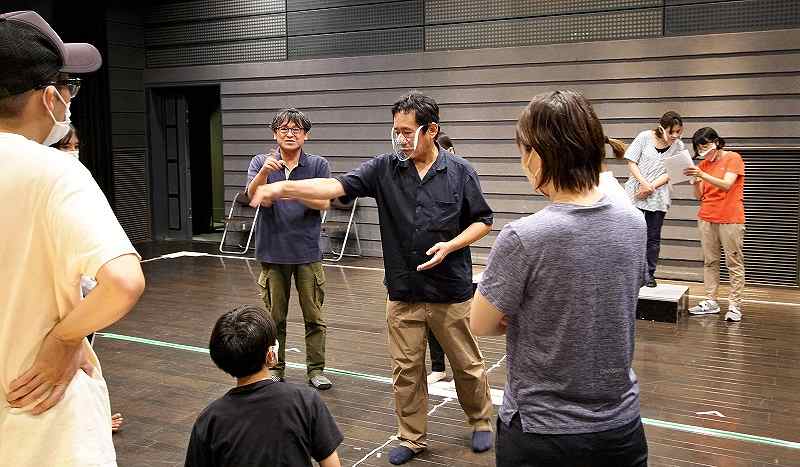
Performers of the courtroom drama “Terror” practice sign language in Kobe in September.
14:32 JST, October 20, 2022
Opportunities for actors who are deaf are increasing as audiences increasingly embrace diversity, while their talents on stage and TV and in movies are more widely recognized than before.
In early October, the courtroom drama “Terror” was performed in both sign language and spoken Japanese at Kobe Art Village Center in Hyogo Ward, Kobe.
During rehearsals in September, actors were communicating both in sign language and Japanese.
Fumiko Yamaguchi, 40, was cast as a presiding judge. She is a deaf actor who has appeared in movies and plays. Five actors who are deaf or hard of hearing were cast in “Terror.”
“It’s such a pleasure to have such an opportunity with so many fascinating performers,” Yamaguchi said.
Director Pink Chiteijin Sango said, “This is a prelude to expanding the field for actors who have hearing difficulties.”
Deaf actors Satoshi Ezoe and Eri Nasu are cast in “Silent,” a drama starring Haruna Kawaguchi that began on Fuji TV this October.
In past TV dramas, the role of a deaf person was often played by well-known actors. In this drama, audiences will encounter more convincing performances by actors who know well what it’s like to have hearing problems.
In the Japanese film “Love Life” presented at this year’s Venice Film Festival, deaf actor Atom Sunada made headlines for his humane performance as the former husband of a female protagonist.
Since October, “Deaf Actors Course 2022,” a training course for actors who are deaf or hard of hearing, has been taught by leading filmmakers including “Love Life” director Koji Fukada. Lectures are interpreted into sign language, and it has been selected by the Cultural Affairs Agency as a project to promote cultural and artistic activities by people with disabilities. The course will continue until November.
There is also a behind-the-scenes drive to further embrace diversity.
Starting in 2024, the Academy of Motion Picture Arts and Sciences will introduce new screening criteria for the Oscars that require performers and producers to include women, disabled people and racial minorities.




Most Read
Popular articles in the past 24 hours
-

National Intelligence Council: Proposed Body Must Be Utilized To ...
-
Japan's Defense Ministry: North Korea Appears to Have Fired Balli...
-

Aichi Fisheries Cooperatives Use Smart Tech to Farm Triploid Oyst...
-

CARTOON OF THE DAY (March 14)
-
Japan's Lower House Passes Budget Proposal; Could Be Delayed in U...
-

Fukuoka: American Beavers at Japan's Zoo Create Sculptures; Visit...
-

Hyogo: Family in Japan Produces Traditional Charcoal to Help Pres...
-

Election Fraud in Tokyo’s Ota Ward: Use Incident As Catalyst for ...
Popular articles in the past week
-
Japan Figure Skating Legend Yuzuru Hanyu Is Proud Disaster Surviv...
-
Govt to Utilize ODA for Ensuring Economic Security; Securing Ener...
-
15 Measles Patients Confirmed in Tokyo in Past 6 Days; 1 May Have...
-

Massive Sewer Pipe Found Jutting Out of Highway in Osaka
-

Japan Govt to Tighten Requirements to Receive Permanent Residency...
-
JR Tokai Breaks Ground on Yamanashi Maglev Station; Will Be Part ...
-

Power Outage Forces About 980 Passengers in Yokohama to Walk to T...
-

Beckoning Cats Get Makeover to Fit Modern Lifestyles with Sleek D...
Popular articles in the past month
-

Producer Behind Pop Group XG Arrested for Cocaine Possession
-

Japan PM Takaichi’s Cabinet Resigns en Masse
-

Man Infected with Measles Reportedly Dined at Restaurant in Tokyo...
-
Japan Figure Skating Legend Yuzuru Hanyu Is Proud Disaster Surviv...
-

iPS Treatments Pass Key Milestone, but Broader Applications Far f...
-

Sanae Takaichi Elected Prime Minister of Japan; Keeps All Cabinet...
-

South Korea Tightens Rules on Foreigners Buying Homes in Seoul Me...
-

Nepal Bus Crash Kills 19 People, Injures 25 Including One Japanes...
Top Articles in Culture
-

Director Naomi Kawase’s New Film Explores Heart Transplants in Japan, Production Involved Real Patients, Families
-
Beckoning Cats Get Makeover to Fit Modern Lifestyles with Sleek Designs to Match with Any Kind of Space
-

Exhibition Featuring Yoshiharu Tsuge’s Manga World Underway in Chofu, Tokyo; Unique, Surreal Works Draw Steady Crowds
-
Traditional Japanese Silk Hakama Tradition Preserved by Sole Weaver in Sendai
-
2 Unpublished Early Novellas by Japan’s Kenzaburo Oe Discovered, Show Budding Promise of Future Nobel Prize-Winning Author
JN ACCESS RANKING
-
Producer Behind Pop Group XG Arrested for Cocaine Possession
-
Japan PM Takaichi’s Cabinet Resigns en Masse
-
Man Infected with Measles Reportedly Dined at Restaurant in Tokyo Station
-
Japan Figure Skating Legend Yuzuru Hanyu Is Proud Disaster Survivor and Gold Medalist, Vows to Continue Support Efforts
-
iPS Treatments Pass Key Milestone, but Broader Applications Far from Guaranteed