
World’s Top Fashion Brands Make Strides in Sustainability; Paris Fashion Week Provides Competition for Eco-Fashion

Chanel will recycle fabric used for planet-like decorations at its runway show during Paris Fashion Week into tote bags.
12:47 JST, December 4, 2025
High-end fashion brands taking part in Paris Fashion Week, which was held from Sept. 29 to Oct. 7, vied for excellence in their attempts at sustainability. Fashion is a key industry in France, and the country has introduced laws and regulations on the issue and is working on public-private partnerships to achieve environmental measures.
Using leftover fabric
Ninety percent of new pieces presented by U.S. fashion brand Gabriela Hearst at Paris Fashion Week for Spring/Summer 2026 were made with leftover fabric recycled from previous seasons.
British label Stella McCartney presented a collection featuring groundbreaking materials, such as dresses made with plant-based artificial feathers and denim that absorbs and neutralizes pollutants contained in exhaust gases.
Equipment and furnishings used at the runway shows during fashion week are actively recycled to reduce environmental impact. For example, Chanel will donate 4,500 tote bags made from fabric used for decorations at the brand’s runway show in Paris to a charity organization.
You may also like to read
Anrealage Unveils Garments Based on Works by Artists with Disabilities, Seeks to Dismantle Barriers in Fashion World‘Polluting industry’
What is behind these efforts is criticism of the fashion industry for taking mass consumption and disposal of clothing for granted. In 2019, U.N. Trade and Development described the fashion industry as the second most polluting industry in the world.
According to the U.N. Environment Programme, the fashion industry produces 92 million tons of textile waste every year. On the other hand, just 8% of all apparel used recycled material in 2023.
In the meantime, the transition to a sustainable economy has become a high-priority as a political issue in the European Union. To deal with the problem, the Fashion Pact, a framework for multinational companies to reduce the environmental burden of fashion, was launched in 2019, led by French President Emmanuel Macron and presided over by Kering, a major French group of luxury brands. Currently, 56 companies participate in the Fashion Pact. Among them are high-end fashion brands taking part in Paris Fashion Week, such as Chanel and Chloe, as well as other big-name brands, such as H&M Group and Asics.
“In the context of serious global warming, fashion is inseparable from efforts to achieve environmental friendliness in Europe. In France, the public share a high level of crisis awareness, so the country is making progress in establishing the relevant laws and regulations,” said Mitsuru Omori, a senior manager at The Japan Research Institute, appraising the situation positively.
Legislation in progress
In France, the anti-waste law for a circular economy came into effect in 2020. The law prohibits luxury fashion brands and others from disposing of dead stock products. In 2021, the Climate Resilience Law was promulgated. Based on the law, an “eco score” labeling system for clothes, which quantifies the environmental cost of each item by giving it a score, was launched in October 2025.
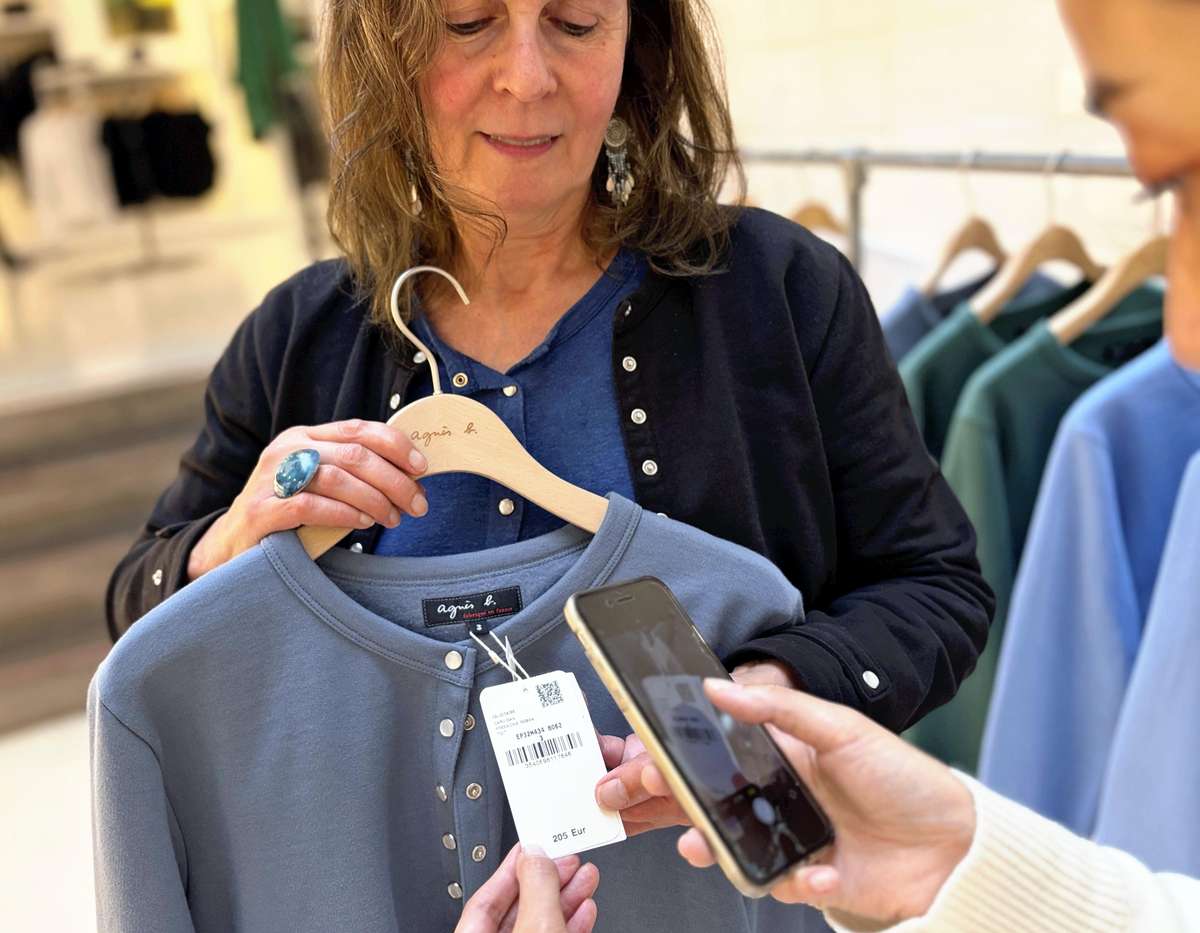
The eco score of an Agnes b. clothing item can be read by scanning the QR code on its tag with a smartphone.
French fashion brand Agnes b., another regular participant in Paris Fashion Week, started using QR codes on the tags of clothes sold at its Paris stores in October. Customers can find the eco score of each product via the QR code.
The French parliament this year passed a law regulating “ultra-fast fashion” — mass-produced, extremely cheap garments from China and other countries — which do not meet environmental standards. The law is aimed at reducing the environmental impact of such clothing and protecting domestic industries.
Challenges
The problem is how to steadily implement relevant laws and regulations and how to spread sustainability in fashion.
Clothes made from recycled fabric or other eco-friendly material require more time and effort to produce and tend to prove costly. Even environmentally concerned consumers may feel reluctant to pay a fortune for them, which hampers the spread of eco-friendly fashion.
“One effective measure is to reduce the prices of products by introducing a tax break system and subsidies for environmentally conscious companies,” said Shinichi Shuto, a professor in marketing at Bunka Fashion Graduate University.
Japan to set numerical goals
Japan is lagging behind the efforts of countries in Europe. To address this, the Economy, Trade and Industry Ministry and the Environment Ministry set up a panel for building a resource circulation system for textile products in 2023. Based on a report by the panel, a council of the Economy, Trade and Industry Ministry drew up a road map for resource circulation of textile products in June 2024.
You may also like to read
Yohji Yamamoto Pays Tribute to Giorgio Armani at Paris Fashion WeekAccording to a survey by the Environment Ministry in the same year, the domestic supply of clothing amounted to about 820,000 tons annually. Meanwhile, about 560,000 tons of clothes were discarded by businesses and homes. Garments recycled as second-hand clothes or for other purposes remained at about 170,000 tons.
Goals in the road map include a 25% reduction in clothing waste from homes compared to the 2020 level by fiscal 2030, and recycling 50,000 tons of discarded clothing into new materials annually.
Since clothing products are often made from blended fabric comprising various materials, textile recycling is slow to progress for technical and financial reasons. Therefore, textile makers and other businesses are working on research and development to boost recycling practices.
Japanese apparel companies venturing into the European market face the risk of being kicked out unless they take appropriate measures that are compatible with local environmental regulations. Uniqlo Co., which is proactively working on the issue, collects and reuses its clothes and has made it a goal to change about 50% of materials it uses to those with lower greenhouse gas emissions by fiscal 2030.
“If there’s a standardized public system for clothes, such as the one for plastic bottles, recycling of clothes will have a better chance of taking root in society,” said Yoshiko Ikoma, the chairman of Japan Ethical Initiative, an organization promoting ethical consumption. “It’s necessary to promote it in public-private collaboration so that consumers and companies can work on [recycling].”






Most Read
Popular articles in the past 24 hours
-

‘Dry Bonsai’ Gives New Life to Withered Trees, Allows Free Artist...
-

McDonald's Japan Raises Prices; Big Mac to Cost ¥500, Double Chee...
-

Nepal Bus Crash Kills 19 People, Injures 25 Including One Japanes...
-

Japan’s Nikkei Stock Average Rises as AI-Related Stocks Shine; Co...
-

Aggression against Ukraine: Malignant Precedent Must Not Be Set t...
-

Joruri Bunraku Narrative Performed in Honor of Donald Keene by La...
-

Astellas Collaborates with Vir to Develop Its Experimental Prosta...
-

Early-Blooming Kawazu Cherry Blossoms Create Sea of Pink at Park ...
Popular articles in the past week
-

Producer Behind Pop Group XG Arrested for Cocaine Possession
-

Japan PM Takaichi’s Cabinet Resigns en Masse
-

Sanae Takaichi Elected Prime Minister of Japan; Keeps All Cabinet...
-

Japan's Govt to Submit Road Map for Growth Strategy in March, PM ...
-

Bus Carrying 40 Passengers Catches Fire on Chuo Expressway; All E...
-

Japan, U.S. Name 3 Inaugural Investment Projects; Reached Agreeme...
-

Riku-Ryu Pair Wins Gold Medal: Their Strong Bond Leads to Major C...
-

Tokyo Skytree's Elevator Stops, Trapping 20 People; All Rescued (...
Popular articles in the past month
-
Producer Behind Pop Group XG Arrested for Cocaine Possession
-
Japan PM Takaichi’s Cabinet Resigns en Masse
-

Japan Institute to Use Domestic Commercial Optical Lattice Clock ...
-

Man Infected with Measles Reportedly Dined at Restaurant in Tokyo...
-

Israeli Ambassador to Japan Speaks about Japan’s Role in the Reco...
-

Videos Plagiarized, Reposted with False Subtitles Claiming ‘Ryuky...
-

Man Infected with Measles May Have Come in Contact with Many Peop...
-

Prudential Life Insurance Plans to Fully Compensate for Damages C...
Top Articles in Culture
-

BTS to Hold Comeback Concert in Seoul on March 21; Popular Boy Band Releases New Album to Signal Return
-

Director Naomi Kawase’s New Film Explores Heart Transplants in Japan, Production Involved Real Patients, Families
-

‘Jujutsu Kaisen’ Voice Actor Junya Enoki Discusses Rapid Action Scenes in Season 3, Airing Now
-

Tokyo Exhibition Offers Inside Look at Impressionism; 70 of 100 Works on ‘Interiors’ by Monet, Others on Loan from Paris
-

Traditional Japanese Silk Hakama Tradition Preserved by Sole Weaver in Sendai
JN ACCESS RANKING
-
Producer Behind Pop Group XG Arrested for Cocaine Possession
-
Japan PM Takaichi’s Cabinet Resigns en Masse
-
Japan Institute to Use Domestic Commercial Optical Lattice Clock to Set Japan Standard Time
-
Man Infected with Measles Reportedly Dined at Restaurant in Tokyo Station
-
Israeli Ambassador to Japan Speaks about Japan’s Role in the Reconstruction of Gaza