
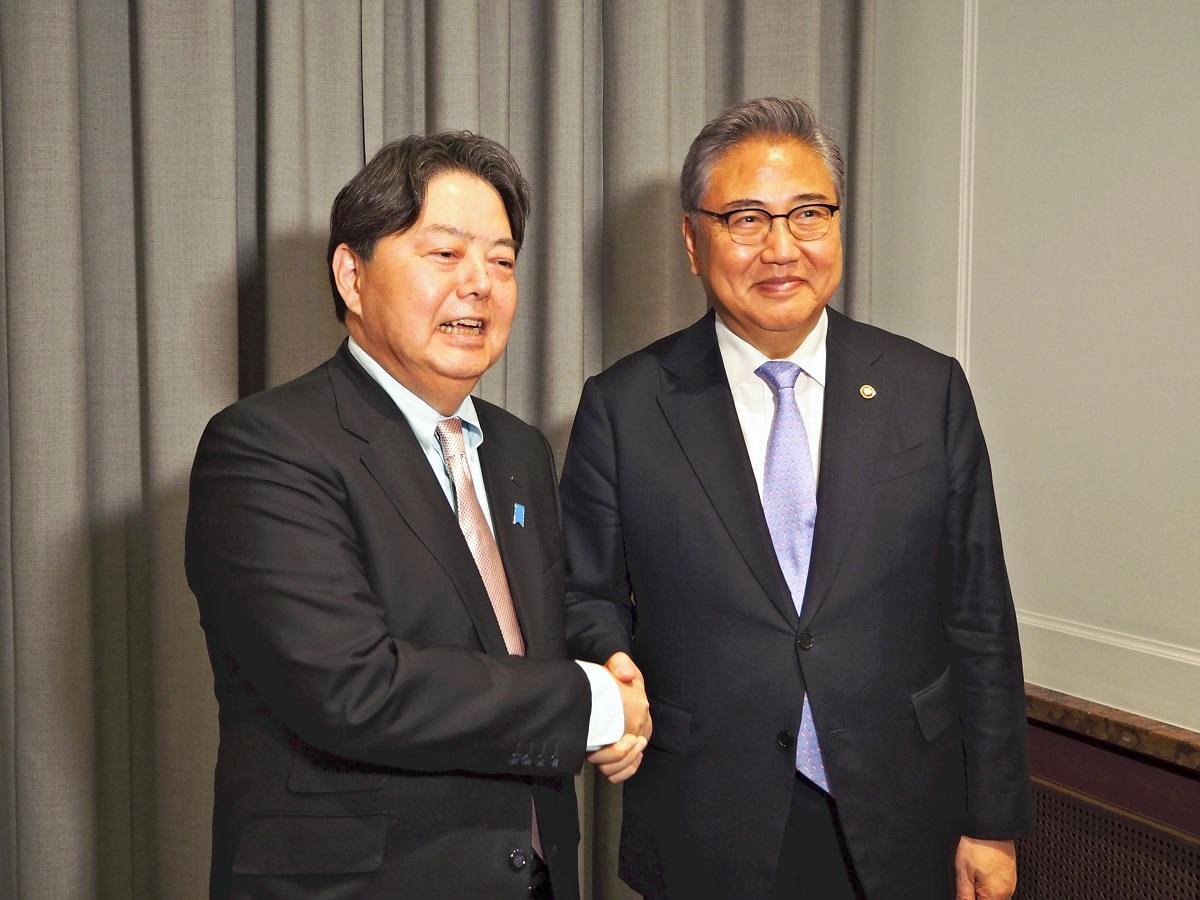
Foreign Minister Yoshimasa Hayashi, left, and South Korean counterpart Park Jin shake hands before their meeting in Munich on Saturday.
11:47 JST, February 19, 2023
MUNICH — Foreign Minister Yoshimasa Hayashi and South Korean counterpart Park Jin, meeting on Saturday on the sidelines of the Munich Security Conference, exchanged views on reaching a final solution for the unresolved issue of former wartime requisitioned workers from the Korean Peninsula, the most pressing matter currently between the two countries.
Hayashi and Park also confirmed a policy of close cooperation in dealing with North Korea.
The discussion between the two officials regarding lawsuits filed by former wartime requisitioned workers raised the issue to a higher political level as Tokyo and Seoul attempt to finally put it behind them.
It was the first face-to-face meeting between the Japanese and South Korean foreign ministers since last September. During the 35-minute meeting, they mainly discussed the issue of the former wartime requisitioned workers as well as North Korea’s launch of an intercontinental ballistic missile on Saturday.
The Japanese and South Korean governments have come up with a plan to settle the former requisitioned workers issue by having a foundation set up under the auspices of the South Korean government that would shoulder the cost of compensation in place of the defendant Japanese companies.
Hayashi and Park searched for a point regarding the lingering differences on the issue that would be acceptable to both sides.
They did not seem to reach a final decision at the meeting, but agreed that healthy bilateral relations should be restored and they will continue close communication at all diplomatic levels for an early resolution.
The South Korean Foreign Affairs Ministry announced that the two foreign ministers exchanged “serious and in-depth views based on the trust that has been built up” in discussing pressing issues including wartime workers.
The Japanese government maintains the position that the wartime workers issue was resolved under the 1965 pact between Japan and the Republic of Korea known as the Agreement on the Settlement of Problems concerning Property and Claims and on Economic Cooperation.
However, the South Korean government has been calling for a sincere response such as some kind of involvement by the defendant Japanese companies or other voluntary measures.
Since some South Korean plaintiffs remain opposed to Seoul’s proposal of paying the compensation, the South Korean government has hopes of reaching a compromise with Japan from the perspective of appeasing domestic public opinion.



Most Read
Popular articles in the past 24 hours
-

‘Dry Bonsai’ Gives New Life to Withered Trees, Allows Free Artist...
-

McDonald's Japan Raises Prices; Big Mac to Cost ¥500, Double Chee...
-

Nepal Bus Crash Kills 19 People, Injures 25 Including One Japanes...
-

Japan’s Nikkei Stock Average Rises as AI-Related Stocks Shine; Co...
-

Aggression against Ukraine: Malignant Precedent Must Not Be Set t...
-

Joruri Bunraku Narrative Performed in Honor of Donald Keene by La...
-

Astellas Collaborates with Vir to Develop Its Experimental Prosta...
-

Early-Blooming Kawazu Cherry Blossoms Create Sea of Pink at Park ...
Popular articles in the past week
-

Producer Behind Pop Group XG Arrested for Cocaine Possession
-

Japan PM Takaichi’s Cabinet Resigns en Masse
-

Sanae Takaichi Elected Prime Minister of Japan; Keeps All Cabinet...
-

Japan's Govt to Submit Road Map for Growth Strategy in March, PM ...
-

Bus Carrying 40 Passengers Catches Fire on Chuo Expressway; All E...
-

Japan, U.S. Name 3 Inaugural Investment Projects; Reached Agreeme...
-

Riku-Ryu Pair Wins Gold Medal: Their Strong Bond Leads to Major C...
-

Tokyo Skytree's Elevator Stops, Trapping 20 People; All Rescued (...
Popular articles in the past month
-
Producer Behind Pop Group XG Arrested for Cocaine Possession
-
Japan PM Takaichi’s Cabinet Resigns en Masse
-

Japan Institute to Use Domestic Commercial Optical Lattice Clock ...
-

Man Infected with Measles Reportedly Dined at Restaurant in Tokyo...
-

Israeli Ambassador to Japan Speaks about Japan’s Role in the Reco...
-

Videos Plagiarized, Reposted with False Subtitles Claiming ‘Ryuky...
-

Man Infected with Measles May Have Come in Contact with Many Peop...
-

Prudential Life Insurance Plans to Fully Compensate for Damages C...
Top Articles in Politics
-
Japan PM Takaichi’s Cabinet Resigns en Masse
-
Sanae Takaichi Elected Prime Minister of Japan; Keeps All Cabinet Appointees from Previous Term
-
Japan’s Govt to Submit Road Map for Growth Strategy in March, PM Takaichi to Announce in Upcoming Policy Speech
-

LDP Wins Historic Landslide Victory
-

LDP Wins Landslide Victory, Secures Single-party Majority; Ruling Coalition with JIP Poised to Secure Over 300 seats (UPDATE 1)
JN ACCESS RANKING
-
Producer Behind Pop Group XG Arrested for Cocaine Possession
-
Japan PM Takaichi’s Cabinet Resigns en Masse
-
Japan Institute to Use Domestic Commercial Optical Lattice Clock to Set Japan Standard Time
-
Man Infected with Measles Reportedly Dined at Restaurant in Tokyo Station
-
Israeli Ambassador to Japan Speaks about Japan’s Role in the Reconstruction of Gaza