
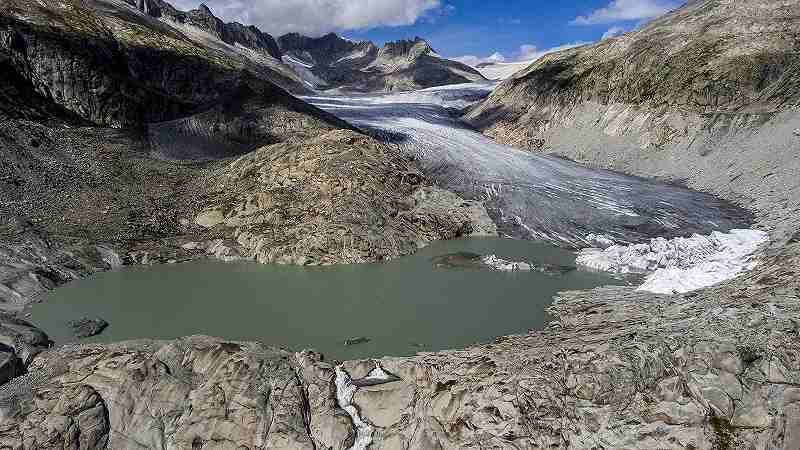
A lake at the bottom of the Rhone Glacier in Obergoms, Switzerland, is seen on Sept. 1.
17:15 JST, November 10, 2022
PARIS (Reuters) — Some of the world’s most famous glaciers, including in the Dolomites in Italy, the Yosemite and Yellowstone parks in the United States and Mount Kilimanjaro in Tanzania, are set to disappear by 2050 due to global warming, whatever the temperature rise scenario, according to a UNESCO report.
The United Nations cultural agency UNESCO monitors some 18,600 glaciers across 50 of its World Heritage sites and said that glaciers in one third of World Heritage sites will disappear by 2050 regardless of the applied climate scenario.
While the rest can be saved by keeping global temperature rise below 1.5 C relative to preindustrial levels, in a business-as-usual emissions scenario, about 50% of these World Heritage glaciers could almost entirely disappear by 2100.
“This report is a call to action. Only a rapid reduction in our CO2 emissions levels can save glaciers and the exceptional biodiversity that depends on them,” Audrey Azoulay, UNESCO’s Director General, said in a statement.
She added that the U.N.’s COP27 cimate conference will have a crucial role to help find solutions to this issue.
World Heritage glaciers as defined by UNESCO represent about 10% of the world’s glacier areas and include some of the world’s best-known glaciers, whose loss is highly visible as they are focal points for global tourism.
The report’s lead author Tales Carvalho told Reuters that World Heritage glaciers lose on average some 58 billion tons of ice every year — equivalent to the total annual volume of water used in France and Spain together — and contribute to almost 5% of global observed sea-level rise.
UNESCO recommends that given the inevitable further shrinking of many of these glaciers in the near future, local authorities should make glaciers a focus of policy, by improving monitoring and research and by implementing disaster risk reduction measures.
“As glacier lakes fill up, they can burst and can cause catastrophic floods downstream,” Carvalho said.





Most Read
Most read in the last 24 hours
-

Shifts Startup Focus to Nurturing Global Winners
-

Princess Aiko Enjoys Imperial Court Music, Dance; Production, Cos...
-

Mother Supports My Sister Too Much, Gives Her Kids Much More Than...
-

Bibimbap with Spring Vegetables and Asari Clam Miso a Rich Taste ...
-

Umami History: Kyoto Chef Murata Worked to Share Japan’s Scientif...
-

Appeal of Japanese Food: Make Good Use of ‘Discoveries’ by People...
-

Okinawa Gubernatorial Election: Candidates Should Advocate Realis...
-

Official App to Help Startups Meet Other Participants
Most read in the last 7 days
-
Earthquake Hits Japan's Tohoku Region; 3-meter Tsunami Warning Is...
-

China, South Korea Object to Japanese PM Takaichi's Ritual Offeri...
-

Trump Extends the Ceasefire with Iran but Keeps the Blockade
-

India's Arms Indigenization Quest for Self-Reliance / New Delhi S...
-

¥1,000 Coins to Be Issued to Mark Anniversary of Beginning of Jap...
-

Most Serious Cyberattacks against the UK Now from Russia, Iran an...
-

Trump Opposes United–American Merger, Signals Support for Spirit
-

System Malfunction in Haneda Airport Causes 83 Flight Cancelation...
Most read in the last 30 days
-
Earthquake Hits Japan's Tohoku Region; 3-meter Tsunami Warning Is...
-

Police Find Child's Shoe During Search for Missing Boy in Nantan,...
-

Body Found in Nantan, Kyoto Prefecture, During Search for 11-Year...
-
China, South Korea Object to Japanese PM Takaichi's Ritual Offeri...
-
Cherry Blossoms, Rapeseed Flowers Perform Colorful ‘Duet’ in Niig...
-
Trump Extends the Ceasefire with Iran but Keeps the Blockade
-

Olympic Gold Medal-Winning Figure Skaters Riku-Ryu Announce Retir...
-

Japanese Prime Minister Takaichi Speaks to Pakistani Prime Minist...
Top Articles in Science & Nature
-

Govt Aims to Establish Bear Population Control by FY30, Hopes to Achieve ‘Coexistence’ with Bears
-
Japan’s Panasonic Develops Automated System to Produce Ips Cells from Patient’s Blood
-
Punch The Monkey Getting Used to Life Without Stuffed ‘Mother’
-

‘Electric Aircraft’ to Begin Test Flights from Kitakyushu Airport, Aiming for Practical Use in Cargo Transport Route
-

New Robotics Center to Conduct Experiments Around the Clock; New Facility Aims to Accelerate Research Efforts
JN ACCESS RANKING
-
Earthquake Hits Japan’s Tohoku Region; 3-meter Tsunami Warning Issued (Update 1)
-
Police Find Child’s Shoe During Search for Missing Boy in Nantan, Kyoto Prefecture
-
Body Found in Nantan, Kyoto Prefecture, During Search for 11-Year-Old Boy in Area (Update 1)
-
China, South Korea Object to Japanese PM Takaichi’s Ritual Offering to Yasukuni Shrine
-
Cherry Blossoms, Rapeseed Flowers Perform Colorful ‘Duet’ in Niigata
Most read in the last 24 hours
-
Shifts Startup Focus to Nurturing Global Winners
-
Princess Aiko Enjoys Imperial Court Music, Dance; Production, Cos...
-
Mother Supports My Sister Too Much, Gives Her Kids Much More Than...
-
Bibimbap with Spring Vegetables and Asari Clam Miso a Rich Taste ...
-
Umami History: Kyoto Chef Murata Worked to Share Japan’s Scientif...
Most read in the last 7 days
-
Earthquake Hits Japan's Tohoku Region; 3-meter Tsunami Warning Is...
-
China, South Korea Object to Japanese PM Takaichi's Ritual Offeri...
-
Trump Extends the Ceasefire with Iran but Keeps the Blockade
-
India's Arms Indigenization Quest for Self-Reliance / New Delhi S...
-
¥1,000 Coins to Be Issued to Mark Anniversary of Beginning of Jap...
Most read in the last 30 days
-
Earthquake Hits Japan's Tohoku Region; 3-meter Tsunami Warning Is...
-
Police Find Child's Shoe During Search for Missing Boy in Nantan,...
-
Body Found in Nantan, Kyoto Prefecture, During Search for 11-Year...
-
China, South Korea Object to Japanese PM Takaichi's Ritual Offeri...
-
Cherry Blossoms, Rapeseed Flowers Perform Colorful ‘Duet’ in Niig...