
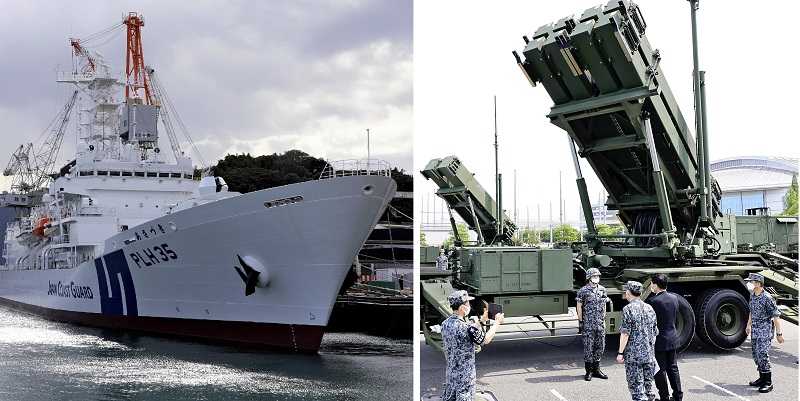
Left: The Japan Coast Guard’s large patrol ship Asazuki is seen in November last year. Right: Self-Defense Forces personnel conduct a deployment drill for ground-to-air guided missiles of the PAC-3 system in Osaka, in May.
14:31 JST, September 10, 2022
The government has begun to consider adopting a method of calculating its defense budget that would include the budget for coastal security and other items, as part of its effort to have the defense budget reach 2% of Japan’s gross domestic product over the next five years, government sources said.
This calculation method is the one used by the North Atlantic Treaty Organization, which aims for member countries’ defense-related expenditures to be at least 2% of GDP. To compare the defense efforts of member countries, NATO defines items to be included in the defense-related expenditures, such as expenses related to the coast guard, U.N. peacekeeping operations and pensions for veterans, none of which are currently included in Japan’s defense expenditures.
According to the sources, the Japanese government has decided that it is appropriate to adopt the NATO standards as a reference for the 2% goal.
Japan’s defense budget is about ¥5.4 trillion in the initial budget for the current fiscal year, while the coast guard budget is about ¥220 billion and the cost of veterans’ pensions and survivor benefits is about ¥110 billion. If Japan adds up these items and the like by applying the NATO standards, defense-related expenditures will amount to about ¥6.1 trillion or 1.08% of GDP.
The government also intends to conduct an examination to see if there are any items from the science and technology budget that can be counted as defense-related expenses. The annual science and technology budget exceeds ¥4 trillion, but only 4% of it is for the Defense Ministry, while more than 60% is for the Education, Culture, Sports, Science and Technology Ministry and the Economy, Trade and Industry Ministry. The government sees that it may be possible to count expenditures for other ministries’ projects as defense-related expenses if they are expected to be used for defense purposes, such as in the space sector.





Most Read
Popular articles in the past 24 hours
-
Japan's Budget on Track for Quick Passage, but Ruling Parties to ...
-

Ransomware Attacks Hitting Japan's Small, Midsize Firms
-

7 Men Arrested Over Robbery of ¥423 Mil. on Tokyo Street; Members...
-

German Journalist Traces Footsteps of Great-Grandfather Who Was P...
-

10 Foreign Tourists Sustain Injuries After Fire at Capsule Hotel ...
-

World Baseball Classic: Red Sox’s Abreu Hits 3-run Homer, Giving ...
-

World Baseball Classic: Venezuela Beats Japan in Back-and-Forth Q...
-

Rapid Services on JR Chuo Line Suspended; Accident at Kokubunji S...
Popular articles in the past week
-

Japan Figure Skating Legend Yuzuru Hanyu Is Proud Disaster Surviv...
-
Govt to Utilize ODA for Ensuring Economic Security; Securing Ener...
-
15 Measles Patients Confirmed in Tokyo in Past 6 Days; 1 May Have...
-
Massive Sewer Pipe Found Jutting Out of Highway in Osaka
-
Japan Govt to Tighten Requirements to Receive Permanent Residency...
-
Power Outage Forces About 980 Passengers in Yokohama to Walk to T...
-
JR Tokai Breaks Ground on Yamanashi Maglev Station; Will Be Part ...
-

Imperial Family Watches World Baseball Classic Game Against Austr...
Popular articles in the past month
-

Producer Behind Pop Group XG Arrested for Cocaine Possession
-

Japan PM Takaichi’s Cabinet Resigns en Masse
-

Man Infected with Measles Reportedly Dined at Restaurant in Tokyo...
-
Japan Figure Skating Legend Yuzuru Hanyu Is Proud Disaster Surviv...
-

iPS Treatments Pass Key Milestone, but Broader Applications Far f...
-

Sanae Takaichi Elected Prime Minister of Japan; Keeps All Cabinet...
-

South Korea Tightens Rules on Foreigners Buying Homes in Seoul Me...
-

Nepal Bus Crash Kills 19 People, Injures 25 Including One Japanes...
Top Articles in Politics
-
Japan PM Takaichi’s Cabinet Resigns en Masse
-
Sanae Takaichi Elected Prime Minister of Japan; Keeps All Cabinet Appointees from Previous Term
-

Japan’s Govt to Submit Road Map for Growth Strategy in March, PM Takaichi to Announce in Upcoming Policy Speech
-
LDP Begins Training New Lawmakers to Avoid Scandal, Gaffes; Historic Victory in Latest Election Heightens Focus on Party
-

Japan PM Sanae Takaichi Welcomes Peach Ambassadors Koga Momo Musume to Official Residence
JN ACCESS RANKING
-
Producer Behind Pop Group XG Arrested for Cocaine Possession
-
Japan PM Takaichi’s Cabinet Resigns en Masse
-
Man Infected with Measles Reportedly Dined at Restaurant in Tokyo Station
-
Japan Figure Skating Legend Yuzuru Hanyu Is Proud Disaster Survivor and Gold Medalist, Vows to Continue Support Efforts
-
iPS Treatments Pass Key Milestone, but Broader Applications Far from Guaranteed