
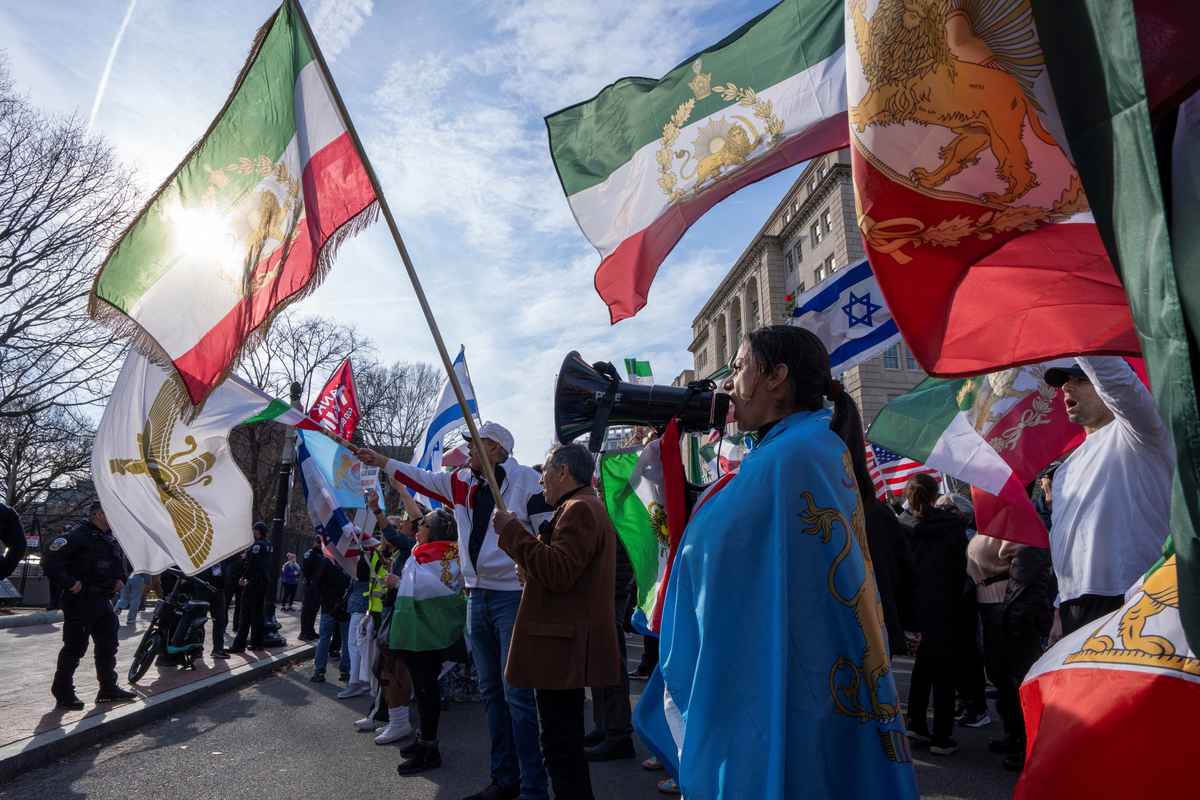
Demonstrators gather near the White House during a rally and protest in solidarity with Iranian people, in Washington, D.C., U.S., March 14, 2026.
16:53 JST, March 15, 2026
PALM BEACH, Florida/DUBAI/JERUSALEM, March 15 (Reuters) – U.S. President Donald Trump threatened further strikes on Iran’s Kharg Island oil export hub and urged allies to deploy warships to secure the Strait of Hormuz, an artery for global energy supplies, as Tehran vowed to intensify its response.
With the U.S.-Israeli war on Iran in its third week, Trump said U.S. strikes had “totally demolished” much of the island and warned of more, telling NBC News on Saturday, “We may hit it a few more times just for fun.”
The remarks marked a sharp escalation from Trump, who had previously said the U.S. was targeting only military sites on Kharg, and undercut diplomatic efforts. His administration has rebuffed efforts by Middle Eastern allies to start negotiations, three sources told Reuters.
WAR, ENERGY CRISIS LOOK SET TO PERSIST
The war showed no sign of ending. Trump said Tehran appeared ready to make a deal to end the conflict but that “the terms aren’t good enough yet.”
Tehran’s ability to halt shipping through the Strait of Hormuz, through which a fifth of the world’s oil passes, poses a difficult problem for the U.S. and its allies. Energy prices are soaring as the war causes the biggest-ever disruption in oil supply, and the energy crisis looked set to continue.
“The Countries of the World that receive Oil through the Hormuz Strait must take care of that passage, and we will help — A LOT!” Trump wrote in a social media post on Saturday. “The U.S. will also coordinate with those Countries so that everything goes quickly, smoothly, and well.”
Iranian Foreign Minister Abbas Araqchi said Iran would respond to any attack on its energy facilities.
Iran’s Revolutionary Guards said on Sunday they had carried out missile and drone strikes on targets in Israel and three U.S. bases in the region, calling the attacks the first round of retaliation for workers killed in Iran’s industrial areas. The Israeli military said it was intercepting incoming launches.
Saudi Arabia intercepted and destroyed 10 drones in Riyadh and the east, the defense ministry said. Iran’s Revolutionary Guards said they no had connection to the attack, semi-official Fars news agency reported.
A drone attack disrupted a major United Arab Emirates energy hub on Saturday, and the U.S. warned U.S. citizens on Saturday to leave Iraq.
The war that Trump and Israeli Prime Minister Benjamin Netanyahu launched on February 28 has killed more than 2,000 people, mostly in Iran, according to reports from governments and state media. At least 15 were killed when an airstrike hit a refrigerator and heater factory in the central Iranian city of Isfahan, the semi-official Fars news agency said on Saturday.
NO IMMEDIATE TAKERS ON TRUMP’S HORMUZ REQUEST
Russia is supplying Iran with Shahed drones to use against the U.S. and Israel, Ukrainian President Volodymyr Zelenskiy told CNN. Shahed drones have been linked to other attacks on countries in the region, although their manufacturers are not always clear.
Oil market disruptions looked unlikely to end soon. Some oil-loading operations were suspended in the UAE’s Fujairah emirate, a global ship-refueling hub, after a drone attack, industry and trade sources said on Saturday.
Trump, in a post on his Truth Social platform, urged China, France, Japan, South Korea, Britain and others to send warships to the Strait of Hormuz. None of those countries gave any immediate indication they would do so.
Takayuki Kobayashi, Japan’s ruling party policy chief, declined to rule out the possibility, but told public broadcaster NHK that “the (legal) threshold is very high.”
Japan interprets its pacifist postwar constitution to mean it can deploy its military if the nation’s survival is threatened, but the government would have to invoke a 2015 security law that has not been used.
France is seeking to assemble a coalition to secure the Strait of Hormuz once the security situation stabilizes, while Britain is discussing a range of options with allies to ensure the security of shipping, officials have said.
Iran’s Supreme Leader Ayatollah Mojtaba Khamenei, who replaced his slain father, has said the Strait of Hormuz should remain closed.








Most Read
Popular articles in the past 24 hours
-
Japan's Budget on Track for Quick Passage, but Ruling Parties to ...
-

Ransomware Attacks Hitting Japan's Small, Midsize Firms
-

German Journalist Traces Footsteps of Great-Grandfather Who Was P...
-

10 Foreign Tourists Sustain Injuries After Fire at Capsule Hotel ...
-

World Baseball Classic: Venezuela Beats Japan in Nail-biting Back...
-

Rapid Services on JR Chuo Line Suspended; Accident at Kokubunji S...
-

Rapid Services Resume on JR Chuo Line; Suspension Caused by Accid...
-

World Baseball Classic: Red Sox’s Abreu Hits 3-run Homer, Giving ...
Popular articles in the past week
-

Japan Figure Skating Legend Yuzuru Hanyu Is Proud Disaster Surviv...
-

Govt to Utilize ODA for Ensuring Economic Security; Securing Ener...
-
15 Measles Patients Confirmed in Tokyo in Past 6 Days; 1 May Have...
-
Massive Sewer Pipe Found Jutting Out of Highway in Osaka
-
Japan Govt to Tighten Requirements to Receive Permanent Residency...
-
Power Outage Forces About 980 Passengers in Yokohama to Walk to T...
-
JR Tokai Breaks Ground on Yamanashi Maglev Station; Will Be Part ...
-

Parents in Japan to Get Instagram Notifications When Teens Repeat...
Popular articles in the past month
-

Producer Behind Pop Group XG Arrested for Cocaine Possession
-

Japan PM Takaichi’s Cabinet Resigns en Masse
-

Man Infected with Measles Reportedly Dined at Restaurant in Tokyo...
-
Japan Figure Skating Legend Yuzuru Hanyu Is Proud Disaster Surviv...
-

iPS Treatments Pass Key Milestone, but Broader Applications Far f...
-

Sanae Takaichi Elected Prime Minister of Japan; Keeps All Cabinet...
-

South Korea Tightens Rules on Foreigners Buying Homes in Seoul Me...
-

Nepal Bus Crash Kills 19 People, Injures 25 Including One Japanes...
Top Articles in News Services
-
Survey Shows False Election Info Perceived as True
-

Japan’s Nikkei Stock Average Falls as US-Iran Tensions Unsettle Investors (UPDATE 1)
-
Japan’s Nikkei Stock Average Rises on Tech Rally and Takaichi’s Spending Hopes (UPDATE 1)
-

Japan to Ban Use of Power Banks on Airplanes
-

North Korea Unveils Image of Kim Jong Un’s Teenage Daughter Firing Rifle
JN ACCESS RANKING
-
Producer Behind Pop Group XG Arrested for Cocaine Possession
-
Japan PM Takaichi’s Cabinet Resigns en Masse
-
Man Infected with Measles Reportedly Dined at Restaurant in Tokyo Station
-
Japan Figure Skating Legend Yuzuru Hanyu Is Proud Disaster Survivor and Gold Medalist, Vows to Continue Support Efforts
-
iPS Treatments Pass Key Milestone, but Broader Applications Far from Guaranteed