
Milano Cortina 2026: Kagiyama Took Long, Difficult Road to Becoming Japan’s Ace Figure Skater
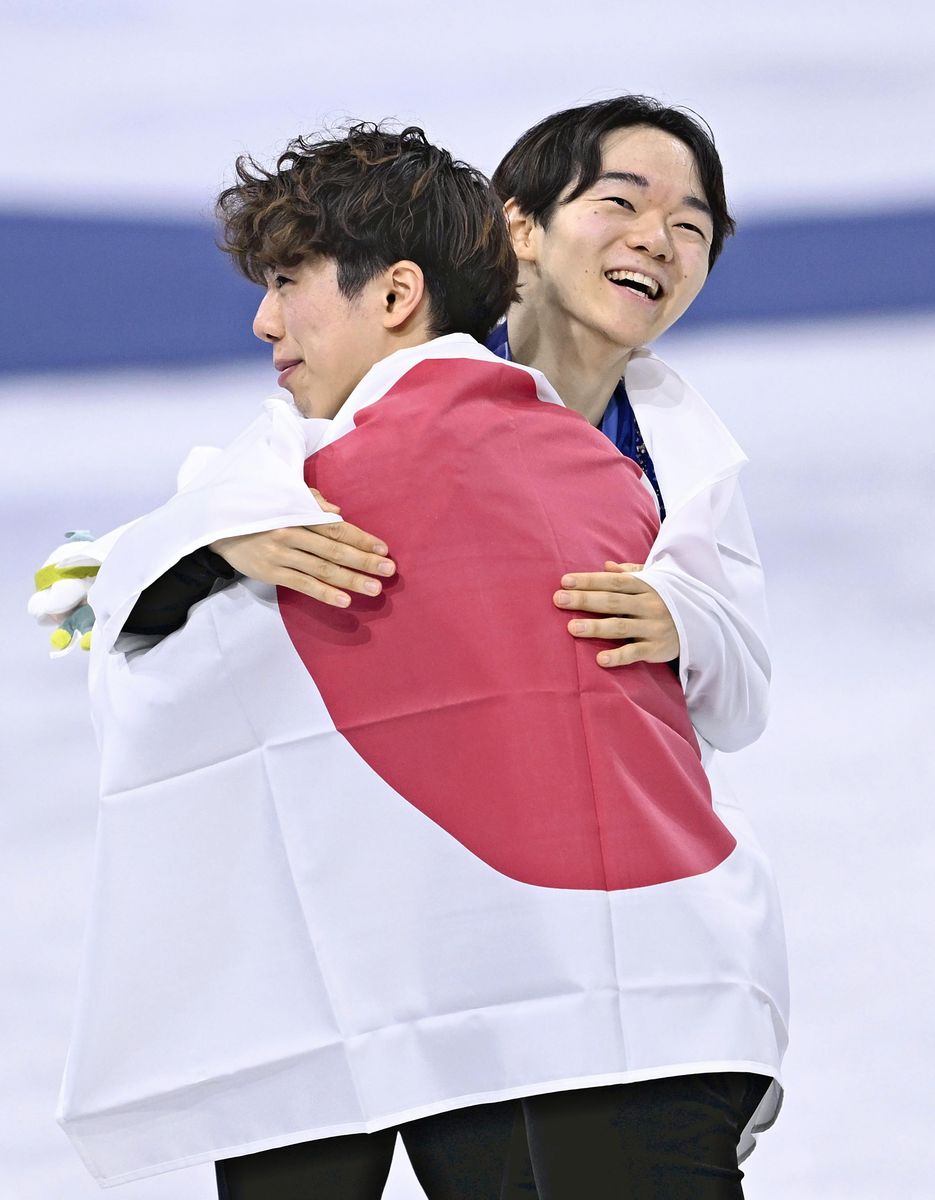
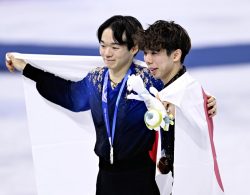
Yuma Kagiyama, right, who won the silver medal in the men’s figure skating singles, celebrates with bronze medalist Shun Sato at the Milano Cortina Olympics in the suburbs of Milan on Friday.
21:00 JST, February 14, 2026
Figure skater Yuma Kagiyama blossomed on the ice at the Milano Cortina Olympics on Friday, delivering an expressive performance of lithe yet powerful skating to secure his second consecutive silver medal in the men’s singles event. Japan’s ace skater, who has consistently aimed to be an “all-rounder,” truly showed his mettle in the event’s turbulent final showdown at the Games.
Kagiyama, 22, took on the free skate on Friday, after placing 5.09 points behind U.S. favorite Ilia Malinin. in Tuseday’s short program. In his free skate, Kagiyama lost his balance on his opening quadruple Salchow and fell on the subsequent quadruple flip. Nevertheless, he thrilled the crowd with smooth steps and dazzling spins, provisionally securing second place.
His expression remained stiff after the performance, but Malinin, who performed after Kagiyama, also made a series of mistakes. When Kagiyama was confirmed as the silver medalist, he smiled and waved to the audience.
“I have some regrets, but I managed to fight through them,” he said after the medal ceremony.
Becoming a champion
Choreographer Misao Sato, 55, who once coached Kagiyama, remembers a remark made by Kagiyama’s father, Masakazu, after a move to Yokohama when Kagiyama was in his first year of junior high school.
“I know it will be tough if he gets involved in [figure skating] seriously. If he doesn’t say that’s what he wants to do, it’s alright for him to just enjoy skating,” Sato recalled Masakazu saying.
Masakazu, 54, was also once a figure skater and competed in the men’s singles at the 1992 Albertville and 1994 Lillehammer Olympics.
At that time, dance moves that other skaters could learn in a week would take Kagiyama a month or more to master. He had never won a national-level competition.
However, his attitude changed in his third year of junior high school, when Masakazu suffered a cerebral hemorrhage. Kagiyama told his father that he wanted to skate seriously. Around that time, he began frequently telling Sato that he wanted to become an all-rounder. He began taking time to practice not just jumps, but spins and steps, trying to hone his precision, Sato recalled.
Kagiyama made his Olympic debut in 2022, as a third-year high school student, competing in the Beijing Games alongside Yuzuru Hanyu, 31, who won the gold medal in the men’s singles at both the Sochi and Pyeong-chang Games, and Shoma Uno, 28, who took silver at Pyeongchang. Kagiyama felt at ease as he enjoyed being on the big stage, watching and learning from two skaters he looked up to, before he achieved the remarkable feat of surpassing even them to earn a silver medal at Beijing.
Generational shift
In the years following the Beijing Olympics, Japanese men’s figure skating underwent a rapid generational shift. Hanyu announced his retirement from competition in July 2022. Uno, who had won consecutive World Championships in 2022 and 2023, announced his own retirement in May 2024. After their departures, Kagiyama began to be called Japan’s “ace” figure skater.
The only one now standing between him and unchallenged dominance of the sport was Malinin, the man who earned the nickname “Quad God” for being the only figure skater in the world to successfully land a quadruple Axel. In the 2024 season, Kagiyama placed second at the Grand Prix Final and third at the World Championships — with Malinin ahead of him both times. Kagiyama was unable to stand atop the same pinnacle where previous Japanese aces had reigned.
Even a year ago, Kagiyama was struggling under the pressure of having to live up to expectations. Overly focused on results, he filled his programs with highly difficult jumps, causing him to make numerous mistakes. He even made errors with steps and spins, which he had rarely done before.
Finding an answer in himself
“What does it mean to be an ace?” Kagiyama kept asking himself. It was a question that no one else could answer. He found his answer in returning to his original goal of becoming an all-rounder to compete on the world stage. He then began focusing on every detail — from intricate steps and spins to subtle facial expressions — dedicating himself to delivering a performance that would move spectators.
“The results he achieved while under huge pressure prove that he has made thorough efforts,” Masakazu said of his son after Friday’s free skate. “I believe it’s no exaggeration to say he has worked harder than anyone else in the world. I want to celebrate him.”



Related Tags



Most Read
Popular articles in the past 24 hours
-
Japan, U.S. Fail to Make Final Decision on $550 Bil. Investment P...
-
Council Submits Proposals for Revising Retrial System; Some Legal...
-

Milano Cortina 2026: Japan’s Totsuka Wins Gold, Yamada Takes Bron...
-
Heirs to Kyoto Talent: Craftsman Works to Keep Tradition of ‘Kinr...
-

2026 Has Seen a Grim Dawn in Iran; What Will the Rest of the Year...
-
Exit of Opposition Veterans Brings Breath of Generational Change
-
Milano Cortina 2026: Japan Take Silver and Bronze in Bittersweet ...
-

New CRA Leader: Ogawa Should Quickly Present Party’s Vision for F...
Popular articles in the past week
-

Woman with Measles Visited Hospital in Tokyo Multiple Times Befor...
-

Prudential Life Insurance Plans to Fully Compensate for Damages C...
-

Woman with No Overseas Travel History Infected with Measles in Na...
-

LDP Wins Historic Landslide Victory
-

Measles Patient Flew Between Tokyo, Hokkaido in Late January; Lik...
-

LDP Wins Landslide Victory, Secures Single-party Majority; Ruling...
-
Milano Cortina 2026: Kokomo Murase Comes Out on Top After Overcom...
-

Tokyo, Many Regions across Japan Hit with Heavy Snow
Popular articles in the past month
-

Japan Institute to Use Domestic Commercial Optical Lattice Clock ...
-

Israeli Ambassador to Japan Speaks about Japan’s Role in the Reco...
-

Man Infected with Measles May Have Come in Contact with Many Peop...
-

China Eyes Rare Earth Foothold in Malaysia to Maintain Dominance,...
-
Australian Woman Dies After Mishap on Ski Lift in Nagano Prefectu...
-
Woman with Measles Visited Hospital in Tokyo Multiple Times Befor...
-
Foreign Snowboarder in Serious Condition After Hanging in Midair ...
-
Prudential Life Insurance Plans to Fully Compensate for Damages C...
Top Articles in Sports
-
Aonishiki Tops Atamifuji in Playoff to Win New Year Grand Sumo Tournament in Ozeki Debut
-
Milano Cortina 2026: Kokomo Murase Comes Out on Top After Overcoming Obstacles, Aiming for Greater Heights in Competition
-

Milano Cortina 2026: Olympics-Torch Arrives in Co-Host Cortina on Anniversary of 1956 Games
-
Milano Cortina 2026: Japan’s Athletes Arrive in Italy for Milano Cortina Winter Olympics; Other Athletes to Arrive from Now
-
Sumo Scene / What’s in a Sumo Name? The Reason Why the New Year Tournament Is Called the January Tournament
JN ACCESS RANKING
-
Japan Institute to Use Domestic Commercial Optical Lattice Clock to Set Japan Standard Time
-
Israeli Ambassador to Japan Speaks about Japan’s Role in the Reconstruction of Gaza
-
Man Infected with Measles May Have Come in Contact with Many People in Tokyo, Went to Store, Restaurant Around When Symptoms Emerged
-
China Eyes Rare Earth Foothold in Malaysia to Maintain Dominance, Counter Japan, U.S.
-
Australian Woman Dies After Mishap on Ski Lift in Nagano Prefecture