
Milano Cortina 2026: Totsuka Strikes Gold, While Kagiyama Takes Silver; Champions on Heels of Trailblazer Hirano
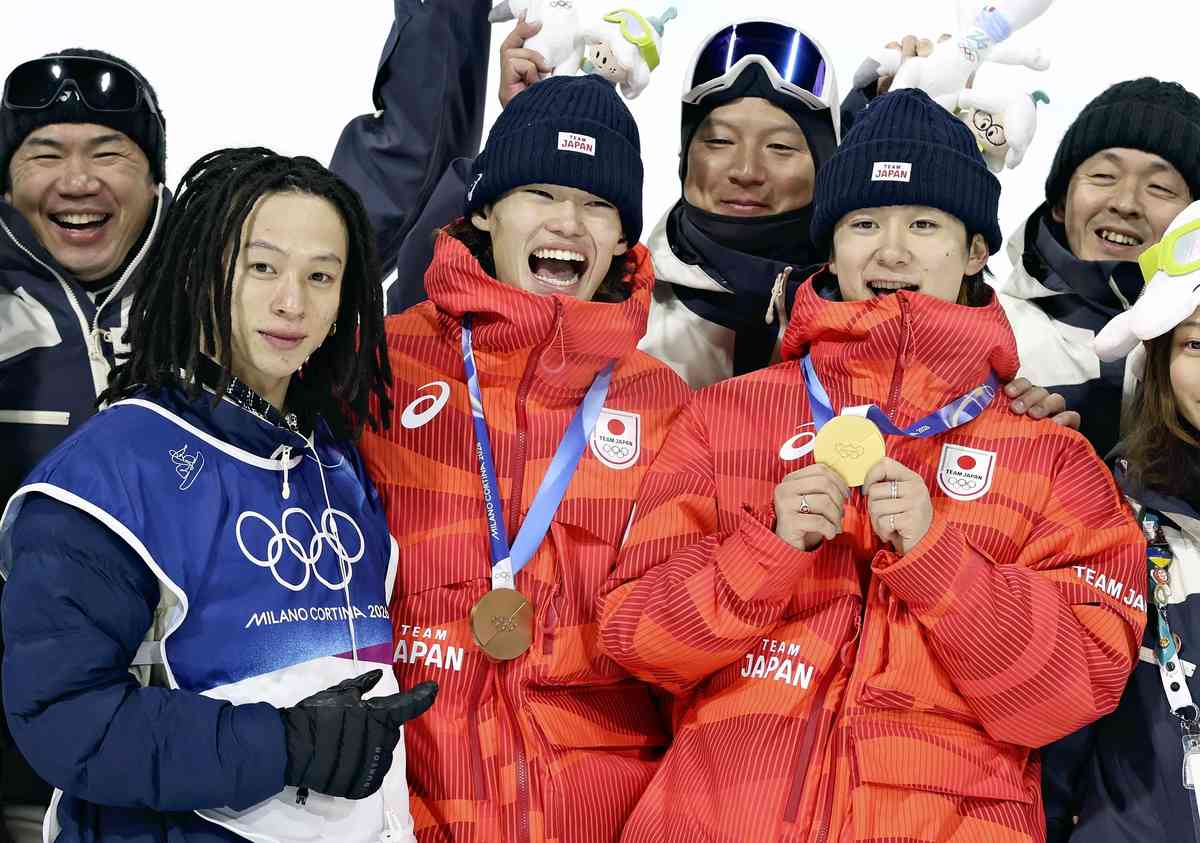
From right in the front row: Gold medalist Yuto Totsuka smiles as he holds his medal next to bronze medalist Ryusei Yamada and Ayumu Hirano after the men’s snowboard halfpipe final in Livigno, Italy, on Friday.
16:17 JST, February 14, 2026
MILAN — Yuto Totsuka, 24, won gold in the men’s snowboard halfpipe final on Friday, the eighth day of the Milano Cortina Olympics, while 19-year-old Ryusei Yamada picked up the bronze.
Japan has now secured back-to-back Olympic titles in the event following Ayumu Hirano’s victory at the 2022 Beijing Games. In total, Japanese athletes have won 20 gold medals across all Olympic Winter Games.
It was Totsuka’s third consecutive bid for Olympic glory and his first medal, which he secured with a commanding score of 95.00 in the second run.
Hirano finished seventh.
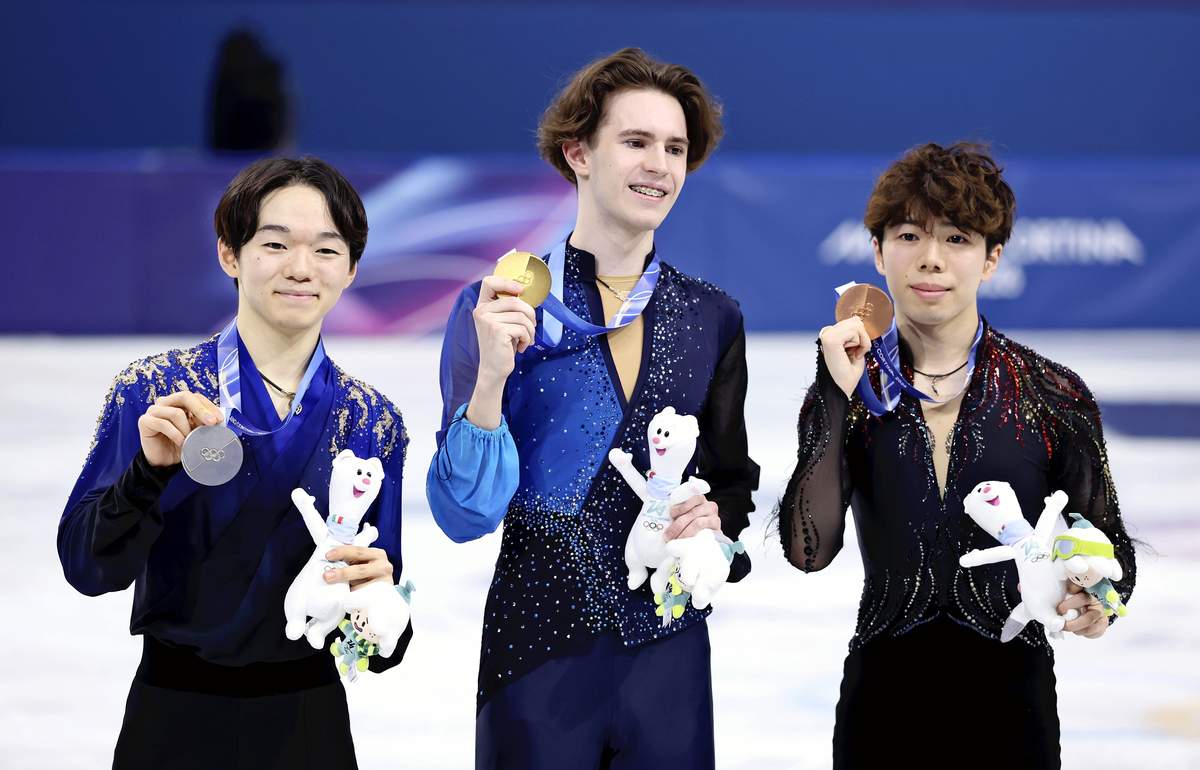
Silver medalist Yuma Kagiyama, left, gold medalist Mikhail Shaidorov, center, and bronze medalist Shun Sato hold their medals up on Friday in Milan.
Meanwhile, in the men’s figure skating free skate on the same day, Yuma Kagiyama captured his second consecutive silver medal with a total of 280.06 points. Although the 22-year-old finished sixth in the free skate segment, his strong showing in the short program ensured that he had a place on the podium.
The bronze went to Shun Sato, 22, who was making his Olympic debut.
You may also like to read
Milano Cortina 2026: Defending Champion Ayumu Hirano of Japan Finishes 7th in Men’s Snowboard Halfpipe Milano Cortina 2026: Japan Take Silver and Bronze in Bittersweet Night for KagiyamaKazakhstan’s Mikhail Shaidorov, 21, climbed from fifth in the short program to take the gold, providing a dramatic comeback for the competition. On the other hand, overnight leader Ilia Malinin, 21, of the United States faltered in the free skate to finish 15th, which dropped him to eighth place overall.
On Hirano’s heels
For four years, Yuto Totsuka had been following the tracks made by Ayumu Hirano, who won gold in the halfpipe event at the previous Games. “I am happy to have won gold on the same Olympic stage [as Hirano],” Totsuka said.
After the event, the two hugged and paid their respects to each other.
The key to Hirano’s gold-medal performance at the 2022 Beijing Olympics was a triple cork 1440, which combines three flips with four full rotations.
Once considered the pinnacle of difficulty in snowboarding, the trick has since seen a surge in popularity among snowboarders, with more athletes striving to master it. Totsuka is among those who have successfully added the maneuver to their repertoire.
The definitive moment of the final came in the second run. After landing a triple cork 1440 in a switch stance, Totsuka maintained his momentum and landed a second consecutive triple cork 1440. It was this run, which earned him a high score of 95.00, that secured the gold medal.
It was a defining moment for the sport, as Totsuka elevated the standard of the competition to an even higher level with the very maneuver Hirano had used to raise the standard four years earlier.
“I’m where I am today because I have a role model like Ayumu so close to me,” said Totsuka, acknowledging the influence of his veteran teammate.
This environment, in which competitors chase after a trailblazer who has competed in four consecutive Winter Olympics, combined with a culture of friendly rivalry, has become the foundation of the Japanese men’s team, which is considered the strongest in the country’s history.
Hirano complimented Totsuka with a smile. “The level is so high, it’s beyond what I could have imagined four years ago, and he has truly demonstrated the strength of Japan,” he said.
Following the medal ceremony, Totsuka called Hirano his hero and someone who continues to inspire him. “But he’s my rival too,” he said. “So I want to do everything I can to stay ahead of him.”



Related Tags


Most Read
Popular articles in the past 24 hours
-
Japan's Ruling Bloc Aims to Reclaim Key Committee Posts in Lower ...
-

Japan, U.S. Fail to Make Final Decision on $550 Bil. Investment P...
-
Council Submits Proposals for Revising Retrial System; Some Legal...
-

Milano Cortina 2026: Japan’s Totsuka Wins Gold, Yamada Takes Bron...
-

2026 Has Seen a Grim Dawn in Iran; What Will the Rest of the Year...
-
Heirs to Kyoto Talent: Craftsman Works to Keep Tradition of ‘Kinr...
-
Exit of Opposition Veterans Brings Breath of Generational Change
-
Milano Cortina 2026: Japan Take Silver and Bronze in Bittersweet ...
Popular articles in the past week
-

Woman with Measles Visited Hospital in Tokyo Multiple Times Befor...
-

Prudential Life Insurance Plans to Fully Compensate for Damages C...
-

Woman with No Overseas Travel History Infected with Measles in Na...
-

LDP Wins Historic Landslide Victory
-

LDP Wins Landslide Victory, Secures Single-party Majority; Ruling...
-

Measles Patient Flew Between Tokyo, Hokkaido in Late January; Lik...
-
Milano Cortina 2026: Kokomo Murase Comes Out on Top After Overcom...
-

Tokyo, Many Regions across Japan Hit with Heavy Snow
Popular articles in the past month
-

Japan Institute to Use Domestic Commercial Optical Lattice Clock ...
-

Israeli Ambassador to Japan Speaks about Japan’s Role in the Reco...
-

Man Infected with Measles May Have Come in Contact with Many Peop...
-

China Eyes Rare Earth Foothold in Malaysia to Maintain Dominance,...
-

Australian Woman Dies After Mishap on Ski Lift in Nagano Prefectu...
-
Woman with Measles Visited Hospital in Tokyo Multiple Times Befor...
-
Foreign Snowboarder in Serious Condition After Hanging in Midair ...
-
Record-Breaking Snow Cripples Public Transport in Hokkaido; 7,000...
Top Articles in Sports
-
Aonishiki Tops Atamifuji in Playoff to Win New Year Grand Sumo Tournament in Ozeki Debut
-
Milano Cortina 2026: Kokomo Murase Comes Out on Top After Overcoming Obstacles, Aiming for Greater Heights in Competition
-

Milano Cortina 2026: Olympics-Torch Arrives in Co-Host Cortina on Anniversary of 1956 Games
-
Milano Cortina 2026: Japan’s Athletes Arrive in Italy for Milano Cortina Winter Olympics; Other Athletes to Arrive from Now
-
Sumo Scene / What’s in a Sumo Name? The Reason Why the New Year Tournament Is Called the January Tournament
JN ACCESS RANKING
-
Japan Institute to Use Domestic Commercial Optical Lattice Clock to Set Japan Standard Time
-
Israeli Ambassador to Japan Speaks about Japan’s Role in the Reconstruction of Gaza
-
Man Infected with Measles May Have Come in Contact with Many People in Tokyo, Went to Store, Restaurant Around When Symptoms Emerged
-
China Eyes Rare Earth Foothold in Malaysia to Maintain Dominance, Counter Japan, U.S.
-
Australian Woman Dies After Mishap on Ski Lift in Nagano Prefecture